Description
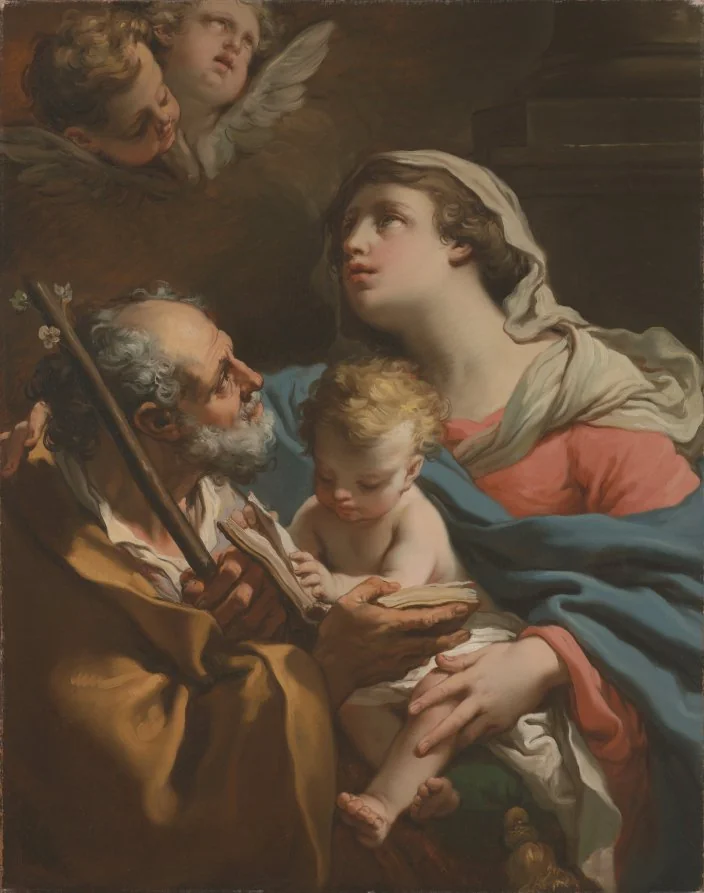
A work of Gandolfi's later years, The Holy Family was exhibited in the religious festival at the church of San Procolo in Bologna in 1776. The painting's balanced composition, along with the suggestion of emotional connections among the figures, expresses the religious honesty of Gandolfi's art. Here St. Joseph holds the scriptures for the Christ child, who sits on his mother's lap; the elderly Joseph also holds the flowering rod, a sign from heaven that he was chosen to be Mary's husband. Joseph looks with concern toward Mary, who in turn looks up toward the cherubim hovering in a cloud at the upper left. Viewers of the private devotional painting were meant to understand that the young Christ reads of his future in the gospels, and that the suffering he will endure is reflected in Mary's sad gaze. Gandolfi was the most popular member of a prominent artistic family in Bologna. As both draftsman and painter he distinguished himself in religious, mythological, and genre subjects and was admired by his Italian and English patrons. He is known for his down-to-earth naturalism, typical of Bolognese art. The frame—although modern—is a "Gandolfini," so-called because the style was created for paintings by members of the Gandolfi family.
Provenance
Sold: Sotheby's Monaco, 16 and 17 June 1989, lot #322.; London private collection (Giovanni Sarti, Paris, 1998), sold to the Cleveland Museum of Art, 1998.
Accession Number
1998.10
Medium
oil on canvas
Dimensions
Framed: 105.5 x 87 x 6 cm (41 9/16 x 34 1/4 x 2 3/8 in.); Unframed: 87 x 68.5 cm (34 1/4 x 26 15/16 in.)
Classification
Painting
Credit Line
John L. Severance Fund
Tags
Painting Neoclassical & Romantic (1751–1850) Oil Painting Canvas Italian Color: Orange Color: Brown
Background & Context
Background Story
The Holy Family from 1776 depicts the Virgin Mary, Joseph, and the Christ Child in the composition of tender intimacy that is the hallmark of Bolognese Baroque religious painting. Gandolfi's treatment combines the dynamic compositional energy of his secular works with the devotional warmth that distinguishes the best Bolognese religious painting, and the 1776 date places this in his most productive period, when he was producing both religious and secular commissions with equal skill. The Holy Family is rendered with the fluent handling and rich color that distinguish Gandolfi's mature oil painting from the more austere Neoclassical style that was beginning to challenge the Baroque tradition in Bologna.
Cultural Impact
Gandolfi's Holy Family is important in the history of Bolognese painting because it demonstrates the continued vitality of the Baroque religious tradition in the face of the Neoclassical challenge. The 1776 painting combines the dynamic compositional energy and rich color of the Baroque tradition with the devotional warmth that distinguishes Bolognese religious painting, demonstrating that the Baroque tradition was still producing accomplished work even as Neoclassicism was beginning to displace it.
Why It Matters
The Holy Family is Gandolfi's Baroque religious painting at the height of its vitality: the Virgin and Child rendered with dynamic compositional energy and rich color that demonstrate the continued power of the Bolognese tradition. The 1776 painting proves that Baroque religious painting could still compete with the emerging Neoclassical style.