Accession Number
1999.210
Medium
oil on canvas
Dimensions
Unframed: 35.9 x 51.2 cm (14 1/8 x 20 3/16 in.)
Classification
Painting
Credit Line
Gift in memory of John M. Henderson
Tags
Painting Neoclassical & Romantic (1751–1850) Oil Painting Canvas American Color: Yellow Color: Gold Color: White
Background & Context
Background Story
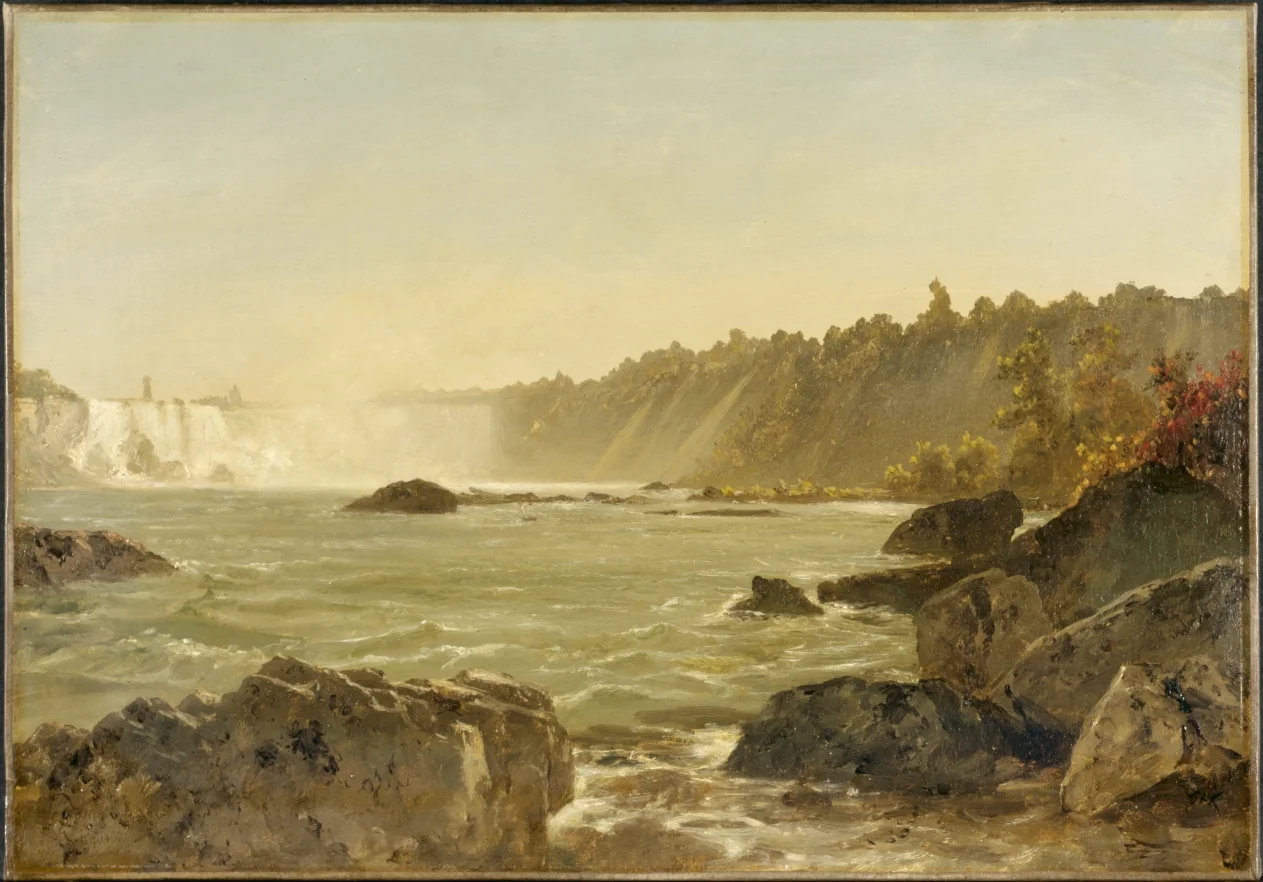
View of Niagara Falls (c. 1851-1852) depicts what was arguably the most famous natural landmark in North America—a subject that every serious American landscape painter was expected to address. Niagara Falls was America's first internationally recognized natural wonder, and its representation in art carried both aesthetic and national significance: demonstrating that the New World could produce natural spectacles equal to or surpassing anything the Old World offered. Kensett's treatment of this iconic subject distinguishes itself through Luminist restraint: where other painters emphasized the falls' overwhelming power and misty drama, Kensett emphasizes clarity and light—even Niagara's immense turbulence can be rendered with Luminist precision and atmospheric delicacy. The early 1850s was a period when Niagara Falls was being developed as a tourist destination, with hotels, viewing platforms, and commercial attractions beginning to transform the natural experience. Kensett's painting captures the falls at this transitional moment—still sublime but increasingly accessible. His Luminist technique, with its smooth surfaces and suppressed brushwork, might seem inadequate to Niagara's immense energy, yet Kensett's achievement lies in finding a visual language for the falls that distinguishes his view from the countless more dramatic treatments.
Cultural Impact
Kensett's Niagara Falls painting influenced the tradition of representing America's most famous natural landmark, offering a Luminist alternative to the dramatic treatments that dominated. The painting influenced how American landscape painting approached overwhelming natural subjects, demonstrating that restraint and precision could serve even the most turbulent subjects. The painting also contributed to the visual documentation of Niagara Falls before extensive commercial development.
Why It Matters
This painting matters because it demonstrates that even the most spectacular natural subject can be treated with artistic restraint—and that this restraint can reveal dimensions of the subject that dramatic treatments miss. Kensett's Niagara Falls captures the light in the mist, the clarity of the water, and the atmospheric effects surrounding the falls with a delicacy that complements rather than contradicts the subject's inherent power.