Description
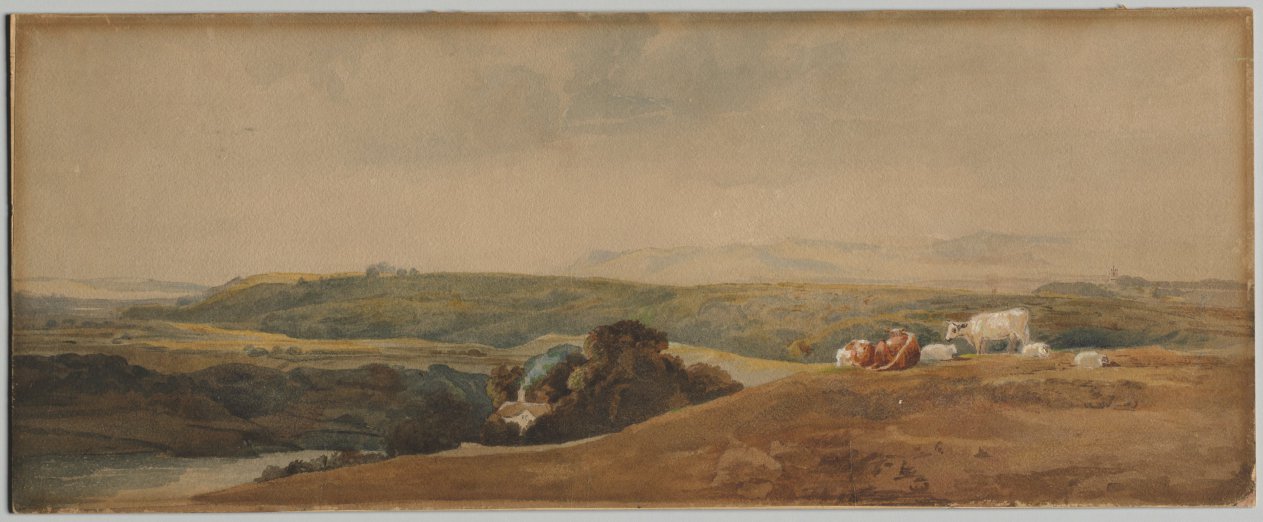
Among the key artists of the golden age of watercolor painting in England, Peter DeWint was known for his panoramic views of spacious, seemingly commonplace landscapes rendered in broad washes of earth-tone hues. This drawing depicts the ruins of Neath Abbey, a Cistercian monastery established in the early 12th century in south Wales. From the Tudor period there was industrial activity around the abbey, and by the time DeWint was painting the priory, the Neath Abbey Iron Company had engulfed the environs of the church with copper smelting and manufacture. DeWint chose to omit evidence of the transformation of the area and its role in the Industrial Revolution.
Provenance
(Bill Thomson, London) (1986); Harry and Nina Pollock, Cleveland Heights, OH (?-before 2005); Painting and Drawing Society, Cleveland Museum of Art, Cleveland, OH, given to the Cleveland Museum of Art, Cleveland, OH (2005); Cleveland Museum of Art, Cleveland, OH (2005-)
Accession Number
2005.198
Medium
watercolor with traces of graphite underdrawing and scratch-away
Dimensions
Overall: 16 x 23.6 cm (6 5/16 x 9 5/16 in.)
Classification
Drawing
Credit Line
Gift of the Painting and Drawing Society of The Cleveland Museum of Art
Tags
Drawing Neoclassical & Romantic (1751–1850) Watercolor Graphite & Pencil British Color: Brown Color: Gray
Background & Context
Background Story
Peter De Wint (1784-1849) was a British painter known for the atmospherically composed, precisely observed watercolor landscapes that make him one of the most accomplished watercolorists of the British tradition. Neath Abbey from c. 1840s depicts Neath Abbey in Wales in the atmospherically composed, precisely observed manner that distinguishes De Wint's best work from the more general watercolor landscape painting of his contemporaries. De Wint was known for his atmospherically composed, precisely observed watercolor landscapes that capture the mood and atmosphere of the British countryside with remarkable delicacy, and the c. 1840s painting shows the British watercolor tradition at its most accomplished.
Cultural Impact
Neath Abbey is important in the history of British watercolor painting because it demonstrates the atmospherically composed, precisely observed manner that De Wint brought to watercolor landscape painting as one of the most accomplished watercolorists of the British tradition. De Wint's atmospherically composed, precisely observed watercolor landscapes—capturing the mood and atmosphere of the British countryside with remarkable delicacy—represent one of the most accomplished traditions in British watercolor painting, and the c. 1840s painting shows this tradition at its most atmospherically composed.
Why It Matters
Neath Abbey is De Wint's atmospherically composed British watercolor: the Welsh abbey rendered in the precisely observed manner of one of the most accomplished watercolorists of the British tradition. The c. 1840s painting shows the British watercolor tradition at its most atmospherically composed.