Description
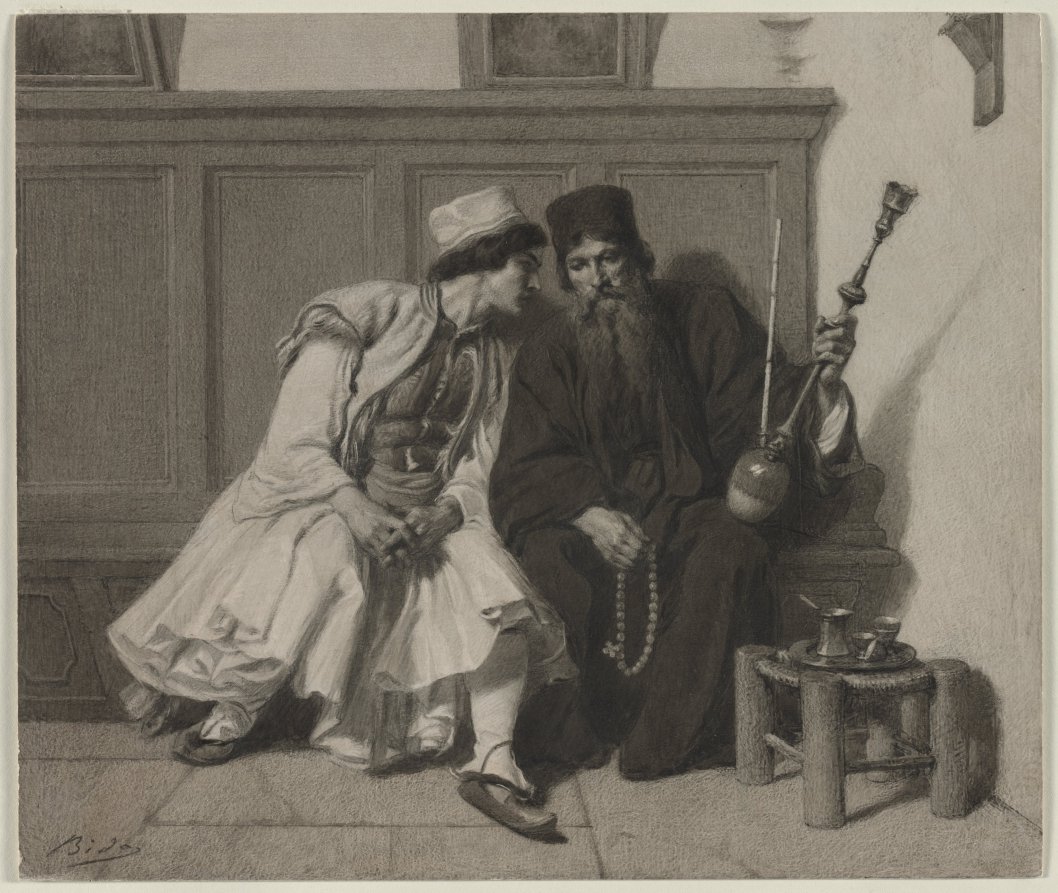
This precise and carefully finished work reflects an unusual technique. Building up the entire area with ink and graphite over white chalk, Bida used a stylus to scratch a comprehensive network of tiny lines, providing highlights and picking out details. For his Orientalist subjects, Bida traveled repeatedly to the Near East-the first time in 1843 when he went to Constantinople and Syria from Venice. Although he closely observed the costumes and people encountered overseas, the decorative arrangements and symmetrical space in this draw-ing exemplify the theatrical aspects of Bida's art.
Provenance
(Fischer-Kiener Galerie, Paris 1978)
Accession Number
2008.381
Medium
brush and black and gray ink, graphite, and stylus on white wove paper coated with a white ground
Dimensions
Sheet: 40.7 x 29.2 cm (16 x 11 1/2 in.); Image: 38.2 x 25.9 cm (15 1/16 x 10 3/16 in.)
Classification
Drawing
Credit Line
Bequest of Muriel Butkin
Tags
Drawing Neoclassical & Romantic (1751–1850) Ink Graphite & Pencil Paper French Color: Brown
Background & Context
Background Story
Alexandre Bida's "Café in Constantinople" (1847) is a meticulously rendered drawing depicting the interior of a coffeehouse in Ottoman Istanbul, populated by figures in traditional Turkish dress engaged in the rituals of coffee drinking, conversation, and leisure. The drawing exemplifies the Orientalist tradition in French art — the fascination with the cultures, landscapes, and daily life of the Middle East and North Africa that captivated European artists throughout the nineteenth century.
Bida (1813–1895) was a French painter and draftsman who specialized in Orientalist subjects, traveling extensively in Egypt, Turkey, and the Levant during the 1840s and 1850s. He was also a highly accomplished Biblical painter whose New Testament scenes were widely reproduced in engravings and popular devotional publications. This dual identity — Orientalist traveler and Biblical illustrator — reflects the intertwined nature of religious and cultural exploration in nineteenth-century French art, where the same curiosity that sent artists to study the Holy Land also drew them to the daily life of its contemporary inhabitants.
This drawing's unusual technique reflects Bida's meticulous approach. He built up the entire image with ink and graphite over a white chalk ground, then used a stylus to scratch a comprehensive network of tiny lines, providing highlights and picking out details. This combined technique of buildup and subtraction — drawing and then scraping away — allowed him to achieve a level of detail and tonal subtlety that rivals engraving, producing effects of light and texture impossible with ink alone.
The coffeehouse was a central institution of Ottoman social life — a place for political discussion, storytelling, and the ceremonial preparation and consumption of coffee. By depicting this scene with such precision, Bida provided his European audience with a window into a world that seemed simultaneously alluring and inaccessible. The drawing's detailed rendering of architectural elements, textiles, and domestic objects serves as ethnographic documentation as well as artistic entertainment.
However, like all Orientalist art, Bida's Constantinople also reflects the power dynamics of colonial-era Europe's relationship with the Islamic world. The very act of depicting Ottoman life for European consumption implied a gaze of ownership — the right to observe, catalogue, and represent another culture. Modern viewers can appreciate Bida's technical mastery and genuine curiosity about Ottoman life while remaining aware of the colonial context that made such representations possible.
Cultural Impact
Bida's Orientalist drawings contributed to the European visual vocabulary of the Middle East — a vocabulary that shaped Western perceptions of Islamic cultures for generations, for better and worse.
Why It Matters
"Café in Constantinople" is a masterwork of Orientalist draftsmanship that combines ethnographic observation with extraordinary technical skill, offering a detailed window into Ottoman coffeehouse culture while reflecting the colonial dynamics of nineteenth-century cultural tourism.