Description
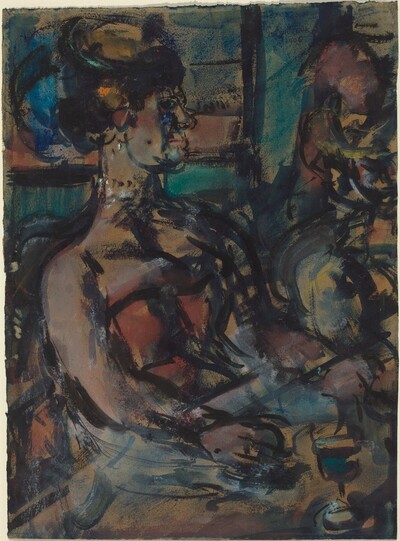
A forerunner to the cabaret, the café-concert was an irresistible subject for artists working in fin-de-siècle Paris. Here, the performers are illuminated by the unnatural glow of gas footlights, while the musicians in the orchestra, seen mostly from behind, are tucked in the shadowy foreground. The neck of the double bass extends above the crowd, drawing the viewer’s eye to the climactic cancan.
Provenance
[]
Accession Number
2008.407
Medium
brush and brown wash, heightened with white gouache, over graphite
Dimensions
Sheet: 36 x 51.7 cm (14 3/16 x 20 3/8 in.)
Classification
Drawing
Credit Line
Bequest of Muriel Butkin
Tags
Drawing Impressionist & Modern (1851–1900) Graphite & Pencil Gouache French Color: Orange Color: Brown
Background & Context
Background Story
Valmy and Léa from c. 1885-95 is a wash drawing by Béraud depicting two figures in the brush and wash medium that he used for his most spontaneous and intimate works. The drawing's subject—two individuals identified by name—suggests a portrait of specific people from Béraud's Parisian circle, and the wash medium allows a spontaneity and intimacy that the more finished oil paintings sometimes lack. The c. 1885-95 date places this in Béraud's most productive period, when he was painting and drawing the Parisian social life that made him famous.
Cultural Impact
Béraud's wash drawings are important complements to his better-known oil paintings because they show the spontaneity and direct observation that underlie the more deliberate finish of the paintings. Valmy and Léa demonstrates that Béraud's precise observation of Parisian life was not limited to the more finished oil paintings but extended to the rapid, intimate medium of wash drawing, creating a more personal record of the social life that his oil paintings document with greater formality.
Why It Matters
Valmy and Léa is Béraud's intimate side: two figures from his Parisian circle rendered in the spontaneous medium of brush and wash that allows a directness and intimacy the oil paintings sometimes lack. The c. 1885-95 drawing shows the social life of Belle Époque Paris from a more personal perspective than the formal oil paintings.