Description
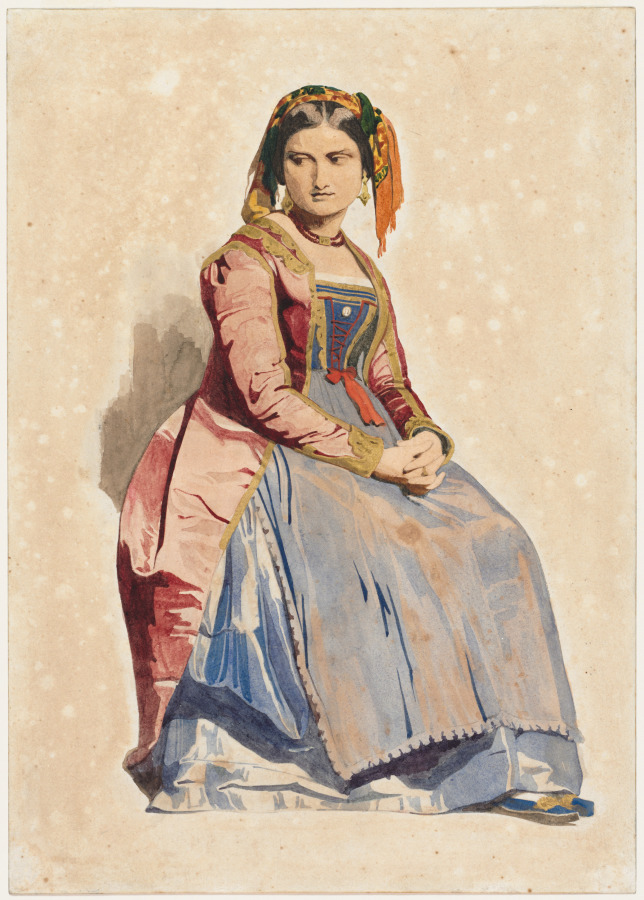
During the 15th century, La Saltarelle was a popular Neapolitan court dance named for its particular leaping step, after the Italian verb saltare (to jump). Lively and merry, it was played in a fast triple meter. In the 19th century, the saltarello was featured in the Carnival celebrations preceding Lent in Rome. After witnessing the Roman Carnival of 1831, the German composer Felix Mendelssohn incorporated the dance into the finale of one of his masterpieces, the Italian Symphony.
Provenance
Shepherd Gallery, New York City, October 1978
Accession Number
2010.171
Medium
watercolor and gouache with selective gum glazing over a faint graphite underdrawing
Dimensions
Sheet: 25.4 x 35.7 cm (10 x 14 1/16 in.)
Classification
Drawing
Credit Line
Bequest of Muriel Butkin
Tags
Drawing Neoclassical & Romantic (1751–1850) Watercolor Graphite & Pencil Gouache French Color: Orange
Background & Context
Background Story
Dominque Louis Papety (1815-1849) was a French painter known for the precisely observed, characterfully composed genre paintings that make him one of the most accomplished genre painters of the French Academic tradition. La Saltarelle from the 1800s depicts a saltarelle—a traditional Italian dance—in the precisely observed, characterfully composed manner that distinguishes Papety's best work from the more general genre painting of his contemporaries. The saltarelle was a traditional Italian folk dance that was one of the most picturesque subjects in 19th-century genre painting, and Papety's precisely observed, characterfully composed treatment shows the French genre tradition at its most accomplished.
Cultural Impact
La Saltarelle is important in the history of French genre painting because it demonstrates the precisely observed, characterfully composed manner that Papety brought to genre subjects as one of the most accomplished genre painters of the French Academic tradition. The saltarelle—a traditional Italian folk dance—was one of the most picturesque subjects in 19th-century genre painting, and the 1800s painting shows this tradition at its most precisely observed.
Why It Matters
La Saltarelle is Papety's precisely observed genre painting: a traditional Italian dance rendered in the characterfully composed manner of one of the most accomplished genre painters of the French Academic tradition. The 1800s painting shows one of the most picturesque subjects in 19th-century genre painting at its most precisely observed.