Provenance
P.M. Turner [probably Percy Moore Turner], London; (sale, Christie's, London, 11 April 1924, no. 89, as by Jan van Hemessen, bought in by Lacey).[1] W. Lever, Esq. (Spink & Son Ltd., London);[2] (Ehrich Galleries, New York, by 1925); (their sale, American Art Association, Anderson Galleries Inc., New York, 18-19 April 1934, 1st day, no. 54, as by Jan van Hemessen); Chester Dale [1883-1962], New York; gift 1943 to NGA.
[1] The original note in the 1986 systematic catalogue is as follows: "The word _Lacey_ is written in ink in the margin of the Library of Congress copy of the catalogue." A letter of 9 June 1988 from Martha Hepworth at the Getty Provenance Index (in NGA curatorial files) provided the additional information that the consignor to the 1924 sale was Turner, and that Lacey bought in the painting, it was not sold.
[2] The Lever name was placed between Ehrich Galleries and the 1934 sale in the 1986 systematic catalogue. However, the 1934 sale was a sale of Ehrich Galleries stock, and it is in the sale catalogue that the Lever name appears, indicating the Lever ownership came prior to that of Ehrich. Information contained in the Chester Dale papers (in NGA curatorial files) is somewhat contradictory, stating both that Ehrich purchased the painting from Spink and Son, who provided no history, as well as that the painting had been in the "former collection W. Lever, London". Other notes in the NGA curatorial file speculate without conclusion on the identity of "W. Lever". It seems probable that the ownership by Lever occurred prior to the painting's leaving England.
Accession Number
1943.7.7
Medium
oil on panel
Dimensions
overall: 107.8 x 76 cm (42 7/16 x 29 15/16 in.) | framed: 136.5 x 109.8 cm (53 3/4 x 43 1/4 in.)
Classification
Painting
Credit Line
Chester Dale Collection
Tags
Painting Renaissance (1400–1599) Oil Painting Panel Painting Netherlandish
Background & Context
Background Story
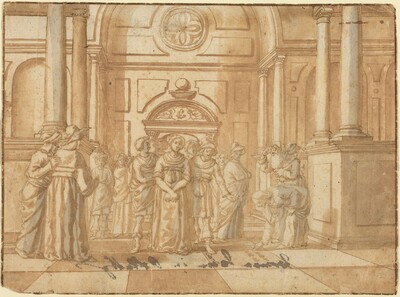
The Healing of the Paralytic is a painting by an anonymous Netherlandish artist of the sixteenth century, dating to approximately 1560-1590. The work depicts one of Christ's miracles as recorded in the Gospels, an episode that held deep significance in Reformation-era theology and art. The healing of the paralytic at the pool of Bethesda or at Capernaum was interpreted during the Protestant Reformation as a demonstration of faith's power to save—a central theological concern in an era when the nature of salvation was the most urgent question in European religious life. The late sixteenth century was a period of devastating religious conflict in the Netherlands, where the Protestant revolt against Spanish Catholic rule overlapped with the broader Reformation struggle. Antwerp, which had been the greatest center of painting in northern Europe, was sacked in 1576 and again in 1584-1585, dispersing its artistic community across Europe. In this context, religious paintings served not merely as devotional objects but as statements of theological and political allegiance. The anonymous artist who created this work operated within the rich Netherlandish tradition that had been shaped by earlier masters from Jan van Eyck through Pieter Bruegel the Elder. By the late sixteenth century, Netherlandish art was navigating between Mannerist stylization and the emerging realism that would characterize the seventeenth-century Golden Age. The painting's subject allowed the artist to combine narrative drama with the depiction of human suffering and divine compassion—themes that would have resonated powerfully with contemporary audiences living through war, plague, and religious persecution. The decision to present the paralytic's healing also engaged with contemporary debates about the relationship between physical and spiritual healing, the role of faith in salvation, and the authority of miracle narratives.
Cultural Impact
Netherlandish religious paintings of this period documented and shaped the spiritual concerns of communities divided by Reformation conflicts. The anonymous artist's choice of subject reflected universal human concerns about suffering and healing that transcended sectarian boundaries, even as it engaged with specifically Protestant or Catholic readings of scriptural authority.
Why It Matters
This painting matters as a record of Netherlandish religious art during the Reformation era, demonstrating how biblical narratives were interpreted and visualized during one of the most turbulent periods in European history, and preserving the legacy of the many anonymous artists who sustained local artistic traditions through decades of conflict.