Provenance
Possibly Jonathan Sturges [1802-1874], New York, and Fairfield, Connecticut;[1] his son, Frederick Sturges [d. 1917], New York, and Fairfield, Connecticut; his son, Frederick Sturges, Jr. [1876-1977], Fairfield, Connecticut; gift 1953 to NGA.
[1] According to Frederick Sturges, Jr. (letter of 18 January 1966 in NGA curatorial files), the picture was "painted for my grandfather Jonathan Sturges." Letters of 27 August and 7 December 1981 from Frederick Sturges III (in NGA curatorial files) state that family tradition held that all paintings in the Sturges collection were originally purchased by Jonathan Sturges. In this and four other instances (see Casilear, _View on Lake George_ [1978.6.1]; Durand, _Forest in the Morning Light_ and _A Pastoral Scene_ [1978.6.2 and 1978.6.3]; and Kensett, _Beach at Beverly_ [1978.6.5]) no certain evidence establishes ownership by Jonathan Sturges. No works by Kensett are mentioned in the discussions of the Jonathan Sturges collection in "Our Private Collections, No. II," The Crayon 3, February 1856, 57-58; Thomas S. Cummings, _Historic Annals of the National Academy of Design (1825-1863)_, Philadelphia, 1865: 141 (reprint, New York, 1965); or Henry T. Tuckerman, _Book of the Artists_, New York, 1867: 627 (reprint, New York, 1967). Kensett's account book has an entry in 1857 for a Newport Scene sold for $300, which may refer to the National Gallery painting (letter of 26 July 1965 from Ellen H. Johnson, in NGA curatorial files); however, the name of the purchaser is not listed, making it impossible to verify this assumption.
Accession Number
1953.1.1
Medium
oil on canvas
Dimensions
overall: 57.2 x 91.4 cm (22 1/2 x 36 in.) | framed: 85.7 x 119.4 x 10.2 cm (33 3/4 x 47 x 4 in.)
Classification
Painting
Credit Line
Gift of Frederick Sturges, Jr.
Tags
Painting Impressionist & Modern (1851–1900) Oil Painting Canvas American Color: Gold Color: Green
Background & Context
Background Story
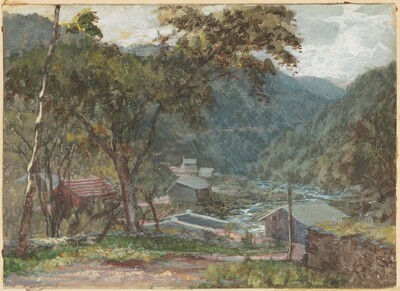
John Frederick Kensett's Beacon Rock, Newport Harbor (1857) exemplifies the Luminist approach to landscape painting that Kensett perfected—the serene, light-filled compositions that represent the Hudson River School's most meditative dimension. Beacon Rock, a landmark in Newport Harbor, Rhode Island, provided Kensett with a subject that combined topographical specificity with the atmospheric clarity that was his signature. The year 1857 was significant: Newport was emerging as America's premier resort destination, where the Gilded Age elite would build their summer cottages, and Kensett's painting captures the harbor before this transformative development. Beacon Rock itself—a modest promontory rather than a dramatic peak—suited Kensett's temperament, which favored serene beauty over dramatic sublimity. His Luminist technique—smooth surfaces, precise detail, and the suppression of visible brushwork—creates paintings that seem to radiate light rather than merely represent it. The harbor's still water, acting as a mirror for the sky and surrounding landscape, allowed Kensett to explore the reflected light effects that were central to Luminist practice. The painting's quietude—its rejection of dramatic weather, spectacular effects, and composistic drama—represents a deliberate aesthetic choice: the assertion that calm and clarity are as worthy of artistic attention as storm and grandeur.
Cultural Impact
Kensett's Newport paintings influenced how the Rhode Island coast was represented in American art, establishing visual conventions for depicting coastal serenity that influenced later American Impressionists who also worked in Newport. The paintings influenced tourism imagery for Newport and contributed to the cultural identity of the resort as a place of refined beauty. Kensett's Luminist technique influenced later American painters who similarly sought to capture light's specific effects with precision and restraint.
Why It Matters
This painting matters because it represents an alternative to the dramatic wilderness vision that dominates popular understanding of the Hudson River School. Kensett's Beacon Rock demonstrates that the same commitment to American landscape could produce paintings of contemplative quietude as effectively as paintings of alpine grandeur—expanding our understanding of what American landscape art achieved.