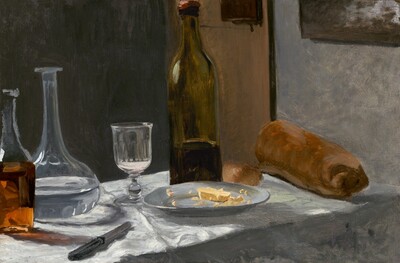
Provenance
Acquired from the artist by James F. Sutton [d. 1915], New York; (Sutton sale, American Art Association, New York, 16 January 1917, no. 151 [sale given as collection of Mrs. Florence Macy Sutton]); purchased by (Durand-Ruel)[1] for Mrs. Henry Osborne Havemeyer, née Louisine Waldron Elder [1855-1929], New York; (Havemeyer sale, American Art Association, New York, 10 April 1930, no. 71); purchased by Chester Dale [1882-1962], New York; gift to NGA 1958.
[1]Annotated copy of sales catalogue in NGA curatorial files.
Accession Number
1958.12.1
Medium
oil on canvas
Dimensions
overall: 74 x 92.5 cm (29 1/8 x 36 7/16 in.) | framed: 89.7 x 107 x 5.4 cm (35 5/16 x 42 1/8 x 2 1/8 in.)
Classification
Painting
Credit Line
Chester Dale Collection
Tags
Painting Impressionist & Modern (1851–1900) Oil Painting Canvas French
Background & Context
Background Story
Morning Haze (1888) represents Monet's engagement with atmospheric effects at their most subtle—the haze that softens outlines, reduces contrast, and creates the unified atmospheric field that was increasingly his primary subject. By 1888, Monet had been living at Giverny for five years and was developing the serial approach to painting that would dominate his late career. The morning haze—atmospheric moisture creating a luminous veil between the observer and the landscape—provided Monet with conditions ideally suited to his artistic priorities: the dissolution of form into light, the suppression of detail in favor of atmosphere, and the creation of images that exist at the boundary between representation and abstraction. The year 1888 was significant: Monet was painting the Méditerranée coast at Antibes, and his engagement with southern light was producing some of his most chromatically brilliant work. Morning Haze, likely painted at Giverny rather than the Midi, represents the counter-current in his work—the northern, atmospheric, and tonal approach that balanced the Mediterranean's chromatic intensity. The painting's emphasis on haze rather than clarity connects it to the broader 19th-century interest in atmospheric effects that extended from Turner's vaporous landscapes to Whistler's nocturnes.
Cultural Impact
Monet's atmospheric haze paintings influenced the development of late Impressionism toward increasingly dissolved and atmospheric effects, anticipating the transition from Impressionism to Symbolism that occurred in the 1890s. The paintings influenced later atmospheric painters from Whistler to the American Tonalists who similarly valued the visual qualities of indeterminate weather. The morning haze subject also influenced how atmospheric optics was represented in art, connecting painting to contemporary scientific interest in atmospheric phenomena.
Why It Matters
This painting matters because it represents Monet's art at the point where representation begins to approach abstraction—the landscape exists as a series of atmospheric events rather than a collection of identifiable objects. For contemporary viewers, the painting anticipates the abstract painting of the 20th century while remaining firmly grounded in observed reality, demonstrating how abstraction can emerge from the logic of perception rather than from theoretical principle.