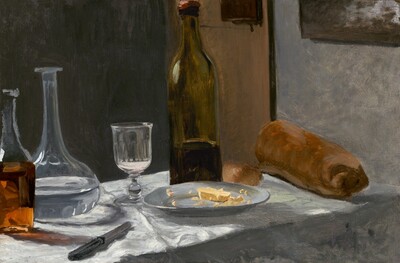
Provenance
Probably Jean-Baptiste Faure [1830-1914], Paris. Adolphe A. Tavernier, Paris; (his sale, Galerie Georges Petit, Paris, 6 March 1900, no. 58); Th. Revillon; (his sale, Galerie Georges Petit, Paris, 1 March 1924, no. 25); purchased by V. Revillon. Probably (Durand-Ruel, Paris), in 1959.[1] (sale, Palais Galliera, Paris, 23 November 1965, no. 198). (Fritz and Peter Nathan, Zurich), c. 1967. Catherine G. Curran [1926-2007], New York; gift (partial and promised) 1990 to NGA; gift completed 2008.
[1] The painting was exhibited at Durand-Ruel in 1959.
Accession Number
1990.59.1
Medium
oil on canvas
Dimensions
overall: 57 × 80 cm (22 7/16 × 31 1/2 in.) | framed: 75.57 × 99.7 × 10.16 cm (29 3/4 × 39 1/4 × 4 in.)
Classification
Painting
Credit Line
Gift of Catherine Gamble Curran and Family, in Honor of the 50th Anniversary of the National Gallery of Art
Tags
Painting Impressionist & Modern (1851–1900) Oil Painting Canvas French
Background & Context
Background Story
Monet painted Sainte-Adresse in the summer of 1867, while staying with his family in the coastal district of Le Havre. It depicts the fashionable beachfront at Sainte-Adresse with a clarity and brilliance that anticipates Impressionism by several years - yet the painting's structure remains grounded in the conventions of marine painting and the example of Jongkind and Boudin, Monet's early mentors.
The composition divides neatly into three horizontal zones: the terraced garden in the foreground, populated by well-dressed figures; the sparkling sea in the middle distance, dotted with sailboats; and the pale, cloud-streaked sky above. Each zone is painted in its own chromatic key - warm earth tones, brilliant blue-green, and luminous white-gray - creating a sense of layered atmospheric depth.
Monet was just 26 and virtually unknown when he painted this. His family disapproved of his career, and traditional venues repeatedly rejected his work. Yet Sainte-Adresse shows no trace of frustration - its mood is one of confident, even exhilarated observation. The tiny flags on the boats, the crisp outline of the garden against the sea, and the almost photographic clarity of the air all convey a young artist freshly discovering the power of painting outdoors.
Cultural Impact
Sainte-Adresse is now recognized as one of the earliest masterworks of the style that would become Impressionism. Its combination of plein-air observation, broken color, and everyday subject matter established a template that Monet and his colleagues would refine over the following decade, culminating in the first Impressionist exhibition of 1874.
Why It Matters
This painting captures the moment before a revolution - the instant when a young artist, working alone on a beach in Normandy, discovered that painting outdoors in natural light could transform not just the look of art but its very subject matter.