Provenance
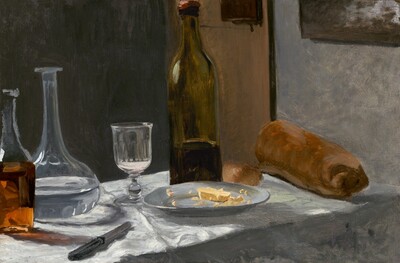
From the artist to M. Cahuzac, Paris in November 1880 until at least 1882;[1] Georges de Bellio [1828-1894], Paris; by inheritance to M et Mme Ernest Donop de Monchy [she née Victorine de Bellio, 1863-1958], Paris, until at least 1897; Alexandre Berthier, 4th Prince de Wagram [1883-1918], Paris; in 1914 to (Durand-Ruel, Paris);[2] sold 1929 to Chester Dale [1882-1962], New York; bequest 1963 to NGA.
[1]Lent by Cahuzac to the 7th Impressionist Exhibition, in 1882. [2] Provenance according to Daniel Wildenstein, _Claude Monet. Biographie et catalogue raisonné_, 5 vols., Lausanne and Paris, 1974, no. 629.
Accession Number
1963.10.181
Medium
oil on canvas
Dimensions
overall: 99.6 x 73 cm (39 3/16 x 28 3/4 in.) | framed: 121.9 x 95.2 cm (48 x 37 1/2 in.)
Classification
Painting
Credit Line
Chester Dale Collection
Tags
Painting Impressionist & Modern (1851–1900) Oil Painting Canvas French
Background & Context
Background Story
The Kiss, painted between 1907 and 1908, is Gustav Klimt's most famous work and the culminating masterpiece of his Golden Phase. It depicts a couple locked in an embrace on a flower-strewn cliff edge, the man bending to kiss the woman's cheek while she closes her eyes and turns her face toward his. Their bodies, wrapped in golden robes covered in geometric ornament, dissolve into the decorative surface until they seem to become one with the gold.
Klimt's Golden Phase was inspired by the Byzantine mosaics of Ravenna. The gold leaf, the flat decorative patterns, and the elimination of spatial depth all derive from Byzantine art, transposed into a modern idiom of erotic love. The painting's most radical feature is its obliteration of the boundary between figure and ornament: the man's robe is covered in rectangles, the woman's in circular floral motifs, and their bodies emerge from and dissolve back into the decorative field.
The painting was purchased by the Austrian government at the 1908 Kunstschau. Its instant acceptance - in contrast to the scandal that had greeted Klimt's earlier university paintings - suggests the public recognized a resolution of the conflict between eroticism and beauty that had defined his career.
Cultural Impact
The Kiss became the most popular painting of the Art Nouveau movement and established the image of the gilded embrace as a universal symbol of romantic love. Its influence on decorative art, fashion, and design extends from the Wiener Werkstatte to contemporary luxury branding.
Why It Matters
This painting is Klimt's reconciliation of the two forces that defined his career: the desire to celebrate erotic love and the desire to create pure decorative beauty. The golden surface, at once protective and imprisoning, creates a world where love and art are indistinguishable.