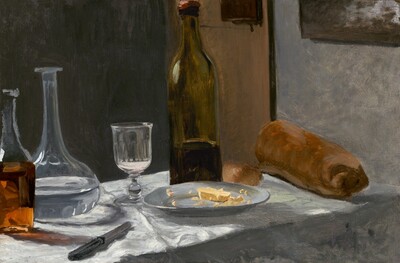
Provenance
Dr. Georges de Bellio [1828-1894], Paris; probably by inheritance to M and Mme [she née Victorine de Bellio,1863-1958] Ernest Donop de Monchy, Paris.[1] Sold 1907 for or by von Tschudi through (Boussod, Valadon et Cie., Paris).[2] (Galerie Caspari, Munich)in 1916.[3] Mrs. Meta Schütte, Bremen, by 1918 and probably in Schütte family collection until c. 1948;[4] by inheritance to her granddaughter and her husband, Dr. Friedrich Wilhelm and Mrs. Charlotte Oelze, Bremen.[5] (E.J. van Wisselingh and Co., Amsterdam); sold February 1951 to (Wildenstein and Co., London, New York, and Paris);[6] by whom sold December 1956 to Arnold Kirkeby, New York; (his sale, Parke-Bernet Galleries, New York, 19 November 1958, no. 12); Mr. and Mrs. George Friedland, Merion, Pennsylvania; (their sale, Parke-Bernet Galleries, New York, 13 December 1961, no. 80). (M. Knoedler & Co., London, New York and Paris); sold January 1965 to Mr. Paul Mellon, Upperville, Virginia; gift 1983 to NGA.
[1] No. 85 bis in inventory of de Bellio collection cited in Remus Niculescu, "Georges de Bellio, l'Ami des Impressionistes (I)," _Paragone_ no. 247, September 1970, p. 52. See also letter from Niculescu to Paul Mellon, dated 12 April 1970, in NGA curatorial files.
[2] According to Wildenstein 1974, no. 101.
[3] According to 1961 Parke-Bernet sales catalogue.
[4] The painting was lent to a 1918 exhibition of works in Bremen private collections, and listed in the catalogue as lent by Frau Meta Schütte. It was also published by Emil Waldmann in "Bremer Privatsammlungen," _Kunst und Künstler_ XVII, 1919, p. 176. Also published as Schütte collection in the listing of "Monet paintings in some well-known museums and private collections" included in Oscar Reuterswärd, _Monet, En konstnärshistorik_, Stockholm, 1948, p. 279.
[5] According to 1961 Friedland sales catalogue.
[6] See letter dated 18 June 1999 from Wildenstein & Co. regarding date of acquisition from Van Wissellingh and sale to Kirkeby (in NGA curatorial files).
Accession Number
1983.1.25
Medium
oil on canvas
Dimensions
overall: 116.2 x 88.8 cm (45 3/4 x 34 15/16 in.) | framed: 150.5 x 122.6 cm (59 1/4 x 48 1/4 in.)
Classification
Painting
Credit Line
Collection of Mr. and Mrs. Paul Mellon
Tags
Painting Impressionist & Modern (1851–1900) Oil Painting Canvas French
Background & Context
Background Story
The Cradle (1867) is one of Monet's most intimate paintings, depicting his companion and future wife Camille Doncieux with their infant son Jean—.subject that reveals the private dimension of an artist whose public reputation was built on landscape and light. The year 1867 was significant: Jean was Monet's first child, born to Camille before their marriage in 1870, and his arrival created the financial and emotional pressures that marked Monet's early career. The painting's intimate subject—the mother watching over her sleeping child—connects Monet to the broader French tradition of domestic genre painting while revealing how Impressionist technique served private as well as public subjects. Camille, who would become Monet's most frequent model in the 1860s and 1870s, is depicted here with a tenderness that the more formal portraits of the period sometimes lack. The cradle itself, with its drapery and structure, provided Monet with an interior still-life element that combined with the figure study and the domestic setting to create a multi-genre composition. The painting also documents Monet's domestic life at a period when his financial struggles made such scenes particularly poignant—the family was poor, and the cradle, however lovingly depicted, represented a claim on resources that the struggling artist could barely meet.
Cultural Impact
Monet's domestic paintings influenced how Impressionist artists' private lives were understood, revealing that the movement's signature outdoor subjects coexisted with intimate domestic scenes. The paintings influenced later Intimist painters like Vuillard and Bonnard who similarly found beauty in domestic interiors. The Cradle specifically influenced how motherhood was represented in Impressionist art, offering a male artist's perspective on a subject more often painted by women like Morisot and Cassatt.
Why It Matters
This painting matters because it reveals the private Monet—the father and partner rather than the landscape revolutionary. The Cradle demonstrates that the Impressionist technique of light and color served emotional as well as perceptual ends, creating images of domestic intimacy that are as significant as the outdoor scenes that defined the movement's public reputation.