Provenance
Art Union of Philadelphia, in 1851 (listed for sale, $60). found 1940s in Rhode Island by B.R. Leviss, Fall River, Massachusetts; (Vose Galleries, Boston); sold 1965 to John Wilmerding, then Cambridge, Massachusetts; gift 2004 to NGA.
Accession Number
2004.66.1
Medium
oil on canvas
Dimensions
overall: 61.3 x 43.7 cm (24 1/8 x 17 3/16 in.) | framed: 78.11 × 60.33 × 8.89 cm (30 3/4 × 23 3/4 × 3 1/2 in.)
Classification
Painting
Credit Line
John Wilmerding Collection
Tags
Painting Neoclassical & Romantic (1751–1850) Oil Painting Canvas American
Background & Context
Background Story
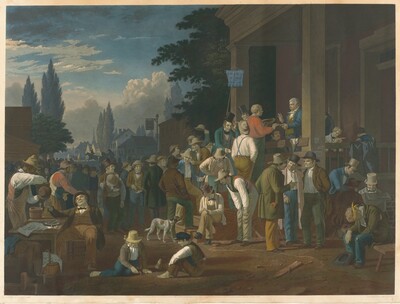
Mississippi Boatman from 1850 is one of Bingham's most distinctive character studies, depicting a solitary riverboatman in a composition that reduces the narrative element to a minimum in favor of the figure itself. Where Bingham's more famous river paintings (The Jolly Flatboatmen, Fur Trappers) include multiple figures in complex narrative scenarios, Mississippi Boatman focuses on a single figure—the boatman's weathered face, his relaxed but capable posture, and his connection to the river that is his livelihood. The 1850 date places this in Bingham's most productive period, when he was painting the Missouri and Mississippi River scenes that made his reputation.
Cultural Impact
Bingham's single-figure river studies are among the most psychologically penetrating works in 19th-century American art because they strip away the narrative complexity of his larger compositions and focus on the individual character of the rivermen who were his subjects. Mississippi Boatman is a portrait of a type—the self-reliant western boatman—but it is also a portrait of an individual, with a specific face, a specific posture, and a specific relationship to the river.
Why It Matters
Mississippi Boatman is Bingham's character study at its most focused: a single riverboatman stripped of narrative context, defined by his weathered face, his capable posture, and his connection to the river. The painting reduces the frontier narrative to an individual portrait—the type revealed through the person.