Provenance
Purchased 1845 from the artist by the American Art Union, New York; won 1845 by James D. Carhart, Macon, Georgia; by descent through the Carhart family; (Berry–Hill Galleries, New York); purchased 1960 by Lawrence A. Fleischman, Detroit; (Kennedy Galleries, New York); purchased 1961 by the Corcoran Gallery of Art, Washington; acquired 2014 by the National Gallery of Art.
Accession Number
2014.79.6
Medium
oil on canvas
Dimensions
overall: 64.8 × 76.2 cm (25 1/2 × 30 in.) | framed: 81.3 × 92.7 × 7.3 cm (32 × 36 1/2 × 2 7/8 in.)
Classification
Painting
Credit Line
Corcoran Collection (Museum Purchase, Gallery Fund and Gifts of Charles C. Glover, Jr., Orme Wilson, and Mr. and Mrs. Lansdell K. Christie)
Tags
Painting Neoclassical & Romantic (1751–1850) Oil Painting Canvas American
Background & Context
Background Story
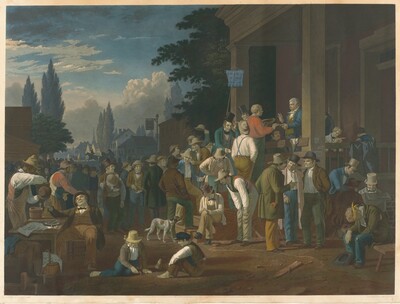
George Caleb Bingham (1811-1879) was the foremost painter of American frontier life, known for his depictions of Missouri River boatmen, trappers, and settlers. Cottage Scenery from 1845 is an unusual work in Bingham's oeuvre—a landscape with a cottage rather than a narrative of frontier life. The painting's subject—a rustic cottage in a woodland clearing—belongs to the tradition of American pastoral painting that Bingham rarely engaged with, and its treatment demonstrates his ability to apply the compositional principles of his narrative paintings to a purely landscape subject.
Cultural Impact
Cottage Scenery is important in Bingham's oeuvre because it demonstrates that his artistic skills extended beyond the narrative paintings of riverboatmen and frontier elections that made his reputation. The compositional balance, the careful observation of light and atmosphere, and the integration of architecture into landscape are all present in this pastoral scene, suggesting that Bingham's narrative paintings owed their compositional success to skills that he could deploy in any genre.
Why It Matters
Cottage Scenery is Bingham without the riverboatmen: a pastoral landscape that demonstrates his compositional skills extend beyond frontier narrative. The rustic cottage in a woodland clearing is pure pastoral—a genre Bingham rarely explored, but one that reveals the landscape painter behind the storyteller.