Provenance
Submitted by the artist for sale to the American Art-Union, New York; recommended for purchase 9 October 1846 by the Union's executive committee, as _Dance on the Flat boat_; reported as chosen to be engraved as a mezzotint 2 November 1846 by the Union's committee on the engraving for 1847; officially renamed _The Jolly Flatboatman_ [_sic_] 6 December 1846 by the Union's executive committee; turned over to the engraver 7 December 1846; payment for purchase approved 1 February 1847; awarded at its annual meeting 24 December 1847 by the Art-Union to Benjamin van Schaick.[1] Herbert Claiborne Pell, Jr. [1884-1961], New York; his son, Claiborne Pell [1918-2009], Washington, D.C., and Newport, Rhode Island;[2] Pell Family Trust; purchased 1986 by Richard A. Manoogian, Detroit; Richard and Jane Manoogian Foundation,Taylor, Michigan; purchased 8 April 2015 by NGA.
[1] The details of the painting's early history and the widely-distributed engraving made of it are traced by John Francis McDermott, "Jolly Flatboatmen: Bingham and His Imitators," _Antiques_ 73, no. 3 (March 1958): 266-269. Benjamin van Schaick was a grocer who lived at 76 Warren Street in New York City. His receipt of the painting was announced in _Transactions of the American Art-Union for the Year 1847_, New York, 1848: 32, no. 1. McDermott speculates that the engraver finished with the painting in the spring of 1848, after which it was delivered to its new owner.
[2] The painting's location after 1847 was not publicly known until 1952, when the art historian Fern Rusk Shapley was invited by Claiborne Pell to see it in his Washington house. In 1954 Pell lent the painting to an exhibition at the City Art Museum of St. Louis, and Shapley published her article "Bingham's 'Jolly Flatboatmen'," _Art Quarterly_ XVII, no. 4 (Winter 1954): 352-356. The article quotes a letter of 25 August 1954 from Claiborne Pell's father, Herbert C. Pell, Jr., to Shapley (356 n. 8), in which the elder Pell writes that his "great-grandfather William Pell" purchased the painting "direct from some exposition," that it was inherited by his grandfather Clarence Pell and hung in his grandmother's house at 119 East 36th Street in New York, and had been "in the family possession more than sixty years ago," which would have been in the late 19th century.
However, Herbert C. Pell, Jr.'s great-grandfather, William Ferris Pell, died in 1840, six years before the painting was created, and so could not have been the original Pell family owner. Herbert Jr.'s grandfather, Clarence Pell, lived from 1820 to 1865, and was possibly the Pell who purchased the painting, or it could have been another William in the large Pell family who acquired it. Further research may discover the details.
Accession Number
2015.18.1
Medium
oil on canvas
Dimensions
overall: 96.8 x 123.2 cm (38 1/8 x 48 1/2 in.) | framed: 116.8 x 143.8 x 10.5 cm (46 x 56 5/8 x 4 1/8 in.)
Classification
Painting
Credit Line
Patrons' Permanent Fund
Tags
Painting Neoclassical & Romantic (1751–1850) Oil Painting Canvas American
Background & Context
Background Story
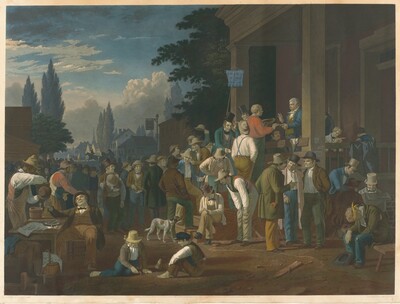
The Jolly Flatboatmen from 1846 is Bingham's most celebrated painting, depicting a group of Mississippi River boatmen dancing on the deck of their flatboat while another plays the fiddle and others watch and lounge. The painting's composition—a pyramidal arrangement of figures with the dancer at the apex—is adapted from the tradition of classical figure composition, but its subject is emphatically American: the flatboatmen of the western rivers, the working men who transported goods down the Mississippi in the years before the railroad made river transport obsolete. The 1846 date places this in the period when Bingham was establishing his reputation as the painter of western river life.
Cultural Impact
The Jolly Flatboatmen is one of the most reproduced and recognizable paintings in American art because it established the visual iconography of the Mississippi River boatman that persists to this day. The dancing figure at the apex of the composition became the defining image of the western riverman—vigorous, self-reliant, and cheerfully democratic. The painting's combination of classical composition and American subject made it a founding work of American genre painting.
Why It Matters
The Jolly Flatboatmen is Bingham's masterpiece and the founding image of American genre painting: a classical pyramidal composition filled with democratic American rivermen, the dancer at the apex transforming classical figure arrangement into a celebration of western vigor and good humor. The painting made the Mississippi boatman an American icon.