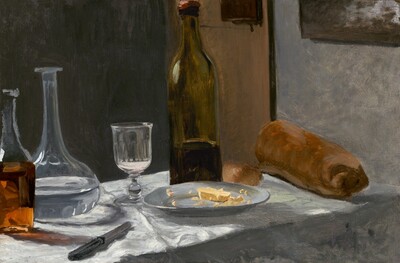
Provenance
(Galerie Montag, Zurich); Guy de Portalès, 1912. (sale, Christie's London, 29 March 1988, no. 306, (Richard Green, London); private collection, London, 1988); (Richard Green, London, 2009); Mr. and Mrs. James T. Dyke, Little Rock, 2009; purchased by NGA, 2013.
Accession Number
2013.102.2
Medium
pastel on blue wove paper
Dimensions
overall: 31.1 x 50.2 cm (12 1/4 x 19 3/4 in.)
Classification
Drawing
Credit Line
Florian Carr Fund
Tags
Drawing Early Modern (1901–1950) Pastel Paper French
Background & Context
Background Story
Waterloo Bridge (1901) belongs to Monet's London series—paintings created during his visits to the Savoy Hotel overlooking the Thames. Monet painted multiple canvases of Waterloo Bridge under different atmospheric conditions, and the 1901 visit produced some of the series' most accomplished works. The bridge's five arches, reduced to dark silhouettes against the foggy sky, provided Monet with a geometric armature around which he could organize his atmospheric compositions. London's fog—actually a mixture of natural mist and coal smoke from the city's countless chimneys—created the diffused light that Monet found irresistible. Each morning, he would assess the conditions and select the appropriate canvas, working rapidly to capture effects that changed by the minute. The industrial character of the scene—smokestacks emitting plumes, steamboats on the river—connected Monet's art to modern urban life in ways that his rural subjects did not. The Waterloo Bridge series demonstrates the serial method at its most productive: the same architectural subject yields radically different images depending on atmospheric conditions, arguing that visual truth is always conditional rather than absolute.
Cultural Impact
Monet's London series influenced urban Impressionist painting and established how cities could be represented through atmosphere rather than architectural detail. The paintings influenced the visual identity of London's Thames, contributing to the river's cultural representation as a site of atmospheric beauty. The serial method influenced subsequent artists from Cézanne to the Abstract Expressionists who similarly worked in sustained series.
Why It Matters
This painting matters because it demonstrates how the serial approach reveals that no single image can represent a subject's full visual reality. Each Waterloo Bridge painting captures a momentary atmospheric truth; together, they argue that perception is always conditional and that the artist's task is to reveal this conditionality rather than disguise it.