Provenance
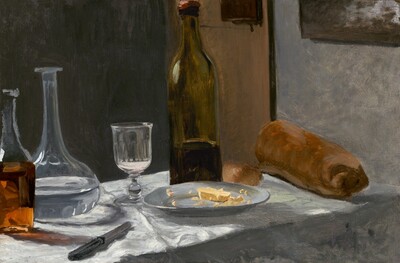
Possibly purchased 1872 from the artist by (Durand-Ruel, Paris).[1] Mlle Marguerite Hugo, Paris, by c. 1957;[2] sold 1965 to (Wildenstein and Co., London, New York and Paris);[3] sold 14 March 1966 to Ailsa Mellon Bruce [1901-1969], New York; bequest 1970 to NGA.
[1] Daniel Wildenstein, _Monet [vol. 1: The Triumph of Impressionism; vols. 2-4: Catalogue raisonné - Werkverzeichnis]_, 4 vols., Cologne and Paris, 1996: 2:99, no. 223, repro.
[2] The painting was lent by Mlle Hugo to the 1957 Arts Council of Great Britain exhibition shown in Edinburgh and London. In the Wildenstein prospectus (in NGA curatorial files), she is identified as the great-granddaughter of Victor Hugo.
[3] Acquisition source and date according to letter from Joseph Baillio of Wildenstein dated 14 December 1998, in NGA curatorial files.
Accession Number
1970.17.42
Medium
oil on canvas
Dimensions
overall: 50.4 x 65.2 cm (19 13/16 x 25 11/16 in.) | framed: 70.8 x 85.7 x 8.3 cm (27 7/8 x 33 3/4 x 3 1/4 in.)
Classification
Painting
Credit Line
Ailsa Mellon Bruce Collection
Tags
Painting Impressionist & Modern (1851–1900) Oil Painting Canvas French
Background & Context
Background Story
Argenteuil (c. 1872) simply titled with the town's name, depicts the suburban community that was arguably the birthplace of Impressionism. Monet moved to Argenteuil in 1871 and lived there until 1878, painting the town's river, bridges, boats, and leisure activities with an intensity that produced some of the movement's defining works. This painting, probably one of the earlier views, captures the town's character before the full development of Monet's Impressionist technique—suggesting a transitional moment between his earlier Realist-influenced style and the broken-color approach that would emerge over the next few years. Argenteuil in 1872 was transforming from rural village to suburban retreat: the railroad connected it to Paris in twenty minutes, and the Seine's scenic beauty attracted Parisians seeking leisure outside the city. Monet's painting likely captures this transitional character—the rural landscape giving way to suburban development, the river serving both commercial and recreational functions. The town of Argenteuil provided Monet with his most productive period: the paintings he made there between 1871 and 1878 established Impressionism as a coherent visual practice and created the template for suburban leisure subjects that influenced the entire movement.
Cultural Impact
Monet's Argenteuil paintings influenced how suburban leisure was represented in French art, establishing the model of riverside recreation that defined Impressionism's most popular subjects. The paintings influenced later artists working at the intersection of city and country—from the Post-Impressionists to the Fauves—who similarly found subjects in transitional suburban landscapes. The Argenteuil paintings also influenced how French suburban development was understood, documenting the transformation of rural communities into commuter towns.
Why It Matters
This painting matters because it captures the place where Impressionism achieved its characteristic form. Argenteuil was not just a subject for Monet—it was the crucible where years of experimentation and development crystallized into a coherent movement. Every subsequent Impressionist painting of suburban leisure owes something to the Argenteuil paintings and the visual grammar they established.