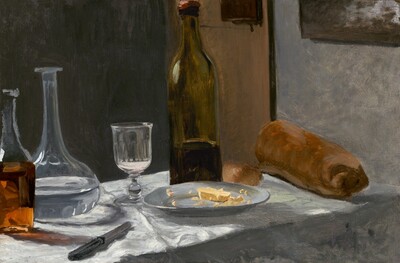
Provenance
Purchased November 1880 from the artist by Cahuzac. Dr. Filleau, Paris; purchased September 1883 by (Durand-Ruel, Paris and New York); sold July 1891 to Potter [1826-1902] and Bertha [1849-1918] Palmer, Chicago. (Durand-Ruel, Paris and New York), in 1892. William H. Fuller [d. 1902], New York, in 1893. (Durand-Ruel, Paris and New York), in 1897. Edward C. [d. 1915] and Mary Griffin [1855-1937] Walker, Willistead Manor, Walkerville, Ontario, and Washington, by 1907;[1] bequest 4 May 1937 to the Corcoran Gallery of Art, Washington; acquired 2015 by the National Gallery of Art.
[1] Provenance according to Daniel Wildenstein, _Monet: Catalogue Raisonné - Werkverzeichnis_, 4 vols. Cologne and Paris, 1996: 2:no. 611.
Accession Number
2015.19.65
Medium
oil on canvas
Dimensions
overall: 66.68 × 81.92 cm (26 1/4 × 32 1/4 in.) | framed: 90.49 × 106.05 × 9.53 cm (35 5/8 × 41 3/4 × 3 3/4 in.)
Classification
Painting
Credit Line
Corcoran Collection (Edward C. and Mary Walker Collection)
Tags
Painting Impressionist & Modern (1851–1900) Oil Painting Canvas French
Background & Context
Background Story
The Willows (1880) depicts willow trees—a species common along French waterways that provided Monet with some of his most atmospheric subjects. Willow trees, with their pendulous branches and delicate foliage, create a distinctive visual effect: light filters through the hanging branches in complex patterns, and the trees' characteristic form—weeping, graceful, and responsive to wind—offered Monet a subject that existed at the boundary between landscape and abstraction. The year 1880 places this during Monet's Vétheuil period, when he was painting the Seine and its banks with an intensity born of personal difficulty and professional ambition. Willows were particular favorites of Monet: they lined the riverbanks where he painted and their relationship with water—roots in the river, branches reflected on its surface—made them natural subjects for an artist whose primary interest was water and its visual effects. The painting's treatment likely emphasizes the willows' atmospheric effect rather than their botanical detail—Monet was increasingly interested in how the trees created light conditions rather than in how they grew. This emphasis on the visual effect of trees—their shadows, their filtered light, their contribution to atmospheric unity—connects The Willows to the broader Impressionist reorientation of landscape painting from topography to perception.
Cultural Impact
Monet's willow paintings influenced how riparian landscapes were represented in Impressionist art, establishing the willow as a signature tree of French waterway painting. The paintings influenced later French landscape painters who similarly valued trees for their atmospheric rather than botanical qualities. The willow subject also influenced how the Seine's banks were represented, contributing to the river's cultural identity as a landscape gracefully defined by these characteristic trees.
Why It Matters
This painting matters because it demonstrates Monet's evolving method: the willows are rendered for their contribution to the scene's total atmospheric effect rather than as individual botanical specimens. This shift from things to their visual effects—from what trees are to what they do to light—is the central innovation of Impressionist landscape painting.