Red and Pink Rocks and Teeth

Description

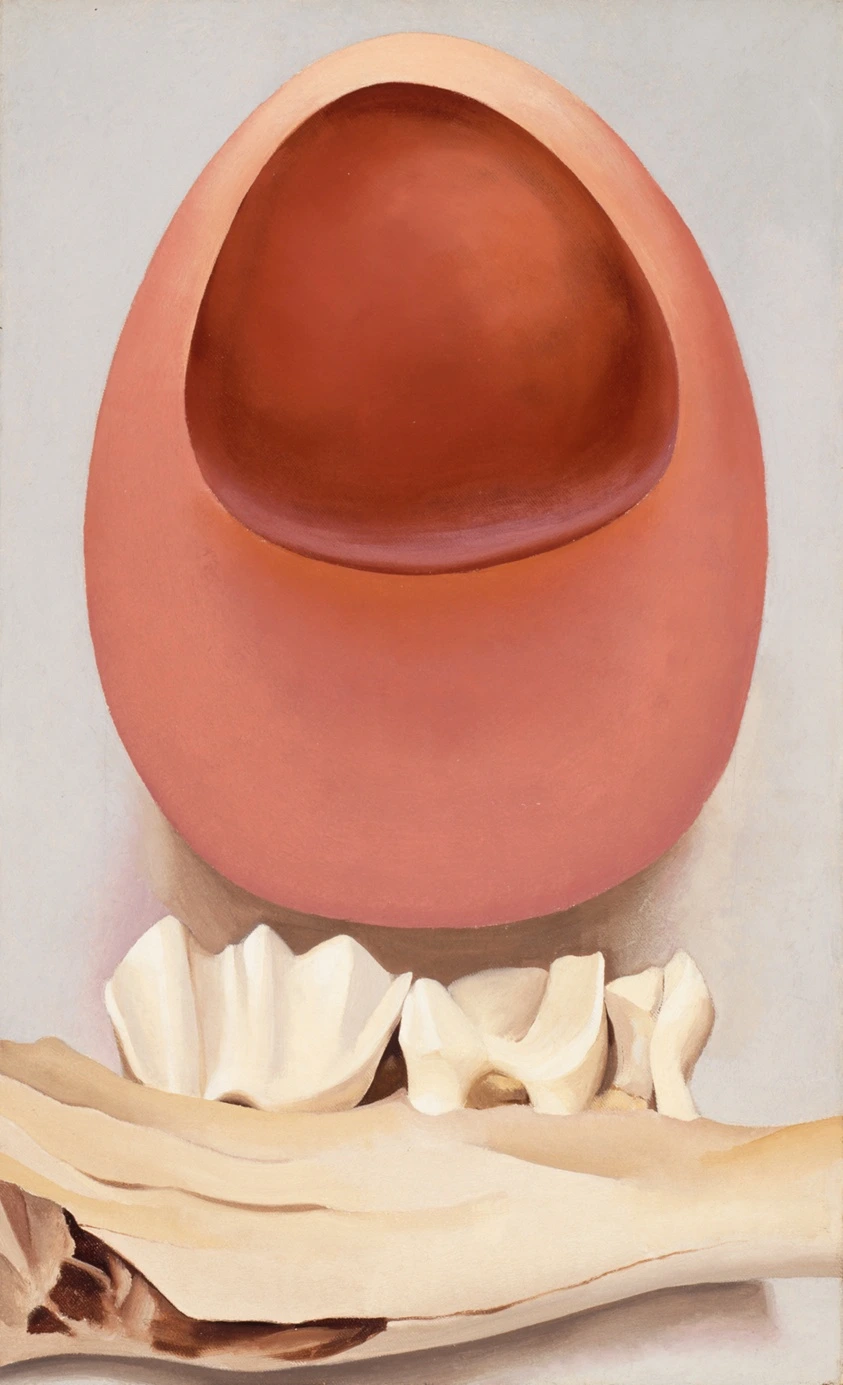
Georgia O’Keeffe was fascinated by the animal bones, weathered and worn, that she found in the desert in New Mexico. In Red and Pink Rocks and Teeth she presented a jawbone alongside two stacked rocks that appear both monumental and indeterminate. The smooth, rounded forms of the red and pink rocks appear in enigmatic relation to one another, as the red pebble appears to recede from the picture plane even though it must be perched on top of the pink stone. Their abstracted forms and warm colors contrast sharply with the bleached, angular teeth and hard, cracked appearance of the jawbone and together construct a modern trompe l’oeil that questions the nature of representation and perception.

Provenance

Georgia O’Keeffe (1887–1986), New York and New Mexico, then Abiquiú, NM, from 1949 [on loan to the Art Institute of Chicago from 1949; letter from O’Keeffe to Daniel Catton Rich, Dec. 29, 1955; copy in curatorial object file]; given through the Alfred Stieglitz Collection to the Art Institute of Chicago, 1955.

Red and Pink Rocks and Teeth

Georgia O'Keeffe

1938

Accession Number

84742

Medium

Oil on canvas

Dimensions

53.3 × 33 cm (21 × 13 in.)

Classification

oil on canvas

Museum

The Art Institute of Chicago

Chicago, United States

Credit Line

Alfred Stieglitz Collection, gift of Georgia O'Keeffe
Background & Context

Background Story

"Red and Pink Rocks and Teeth" is one of Georgia O'Keeffe's most powerful New Mexico compositions, painted in 1938 during the period when she was establishing her second home in Ghost Ranch and beginning the transformation of Southwestern landscape into personal mythology. The canvas shows a cluster of red and pink geological formations that could be rocks, bones, or eroded teeth—O'Keeffe's title deliberately maintains the ambiguity, allowing the viewer to oscillate between geological and anatomical readings. This ambiguity is characteristic of her mature work: the New Mexico landscape is never merely observed but always transformed through the lens of memory, desire, and the body's vulnerability. The palette is warm and earthy—terracotta, coral, and pale rose that seem to glow with the heat of the high desert sun. The composition is cropped close, eliminating sky and horizon to create a monumental abstraction that recalls the sculptural forms of her early charcoal drawings. Art historians have connected this work to the Southwestern regionalism that was emerging in American art during the 1930s, though O'Keeffe's treatment is more personal, less ethnographic than contemporaries like John Marin or Marsden Hartley. The "teeth" in the title may refer to actual animal bones that O'Keeffe collected in the desert, arranging them in compositions that merged still life and landscape. This conflation of categories—organic and inorganic, living and dead, near and far—is what gives her New Mexico paintings their metaphysical resonance. The painting also reflects her growing independence from the New York art world: by 1938 she was spending most of the year in the Southwest, emerging from Stieglitz's shadow to establish her own artistic identity.

Cultural Impact

This Southwestern canvas merged geological formation and anatomical memory, establishing O'Keeffe's mature conflation of landscape and body that influenced American regionalist abstraction.

Why It Matters

It matters because O'Keeffe made rocks look like teeth and made both look like desire—proving that the desert could be as intimate as skin.