Description
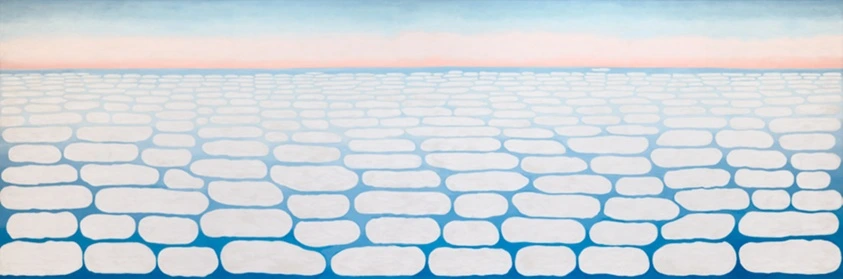
Painted in the summer of 1965, when Georgia O’Keeffe was 77 years old, this monumental work culminates a series inspired by the artist’s experiences as an airplane passenger during the 1950s. Working in Abiquiu, New Mexico, O’Keeffe began around 1963 to capture the endless expanses of clouds she had observed from airplane windows during trips all over the world. Beginning with a relatively realistic depiction of small white clouds on a three-by-four-foot canvas, she progressed to more stylized images of the motif on larger surfaces. O’Keeffe wrote:
"I painted a painting eight feet high and twenty-four feet wide—it kept me working every minute from six a.m. till eight or nine at night as I had to be finished before it was cold—I worked in the garage and it had no heat—Such a size is of course ridiculous but I had it in my head as something I wanted to do for a couple of years."
In 1970 Sky above Clouds IV was scheduled to be included in a retrospective of O’Keeffe’s work at the Whitney Museum of American Art, New York, the Art Institute of Chicago, and the San Francisco Museum of Art. After being shown in New York and Chicago, the painting was determined to be too large to enter the doors of the museum in San Francisco. It thus remained on loan to the Art Institute for more than a decade, while the artist and public-minded collectors of her art arranged for it to join the museum’s permanent collection.
The special relationship between O’Keeffe and the Art Institute began in 1905, when she enrolled as a student at the School of the Art Institute. Her first museum retrospective was organized here in 1943. Later, as the executor for the estate of her husband, the pioneering American photographer and art dealer Alfred Stieglitz, O’Keeffe presented the Art Institute with an important group of modernist works, including a number of her own, many of which are on view in the galleries of American art. She continued to make significant additions to this bequest until her death, at age 98, in 1986.
Provenance
Accession Number
100858
Medium
Oil on canvas
Dimensions
243.8 × 731.5 cm (96 × 288 in.)
Classification
Painting
Credit Line
Purchased with funds provided by the Paul and Gabriella Rosenbaum Foundation; gift of Georgia O'Keeffe