Accession Number
70039
Medium
Pastel on wood pulp laminate board
Dimensions
54.6 × 69.8 cm (21 1/2 × 27 1/2 in.)
Classification
pastel
Credit Line
Alfred Stieglitz Collection, bequest of Georgia O'Keeffe
Background & Context
Background Story
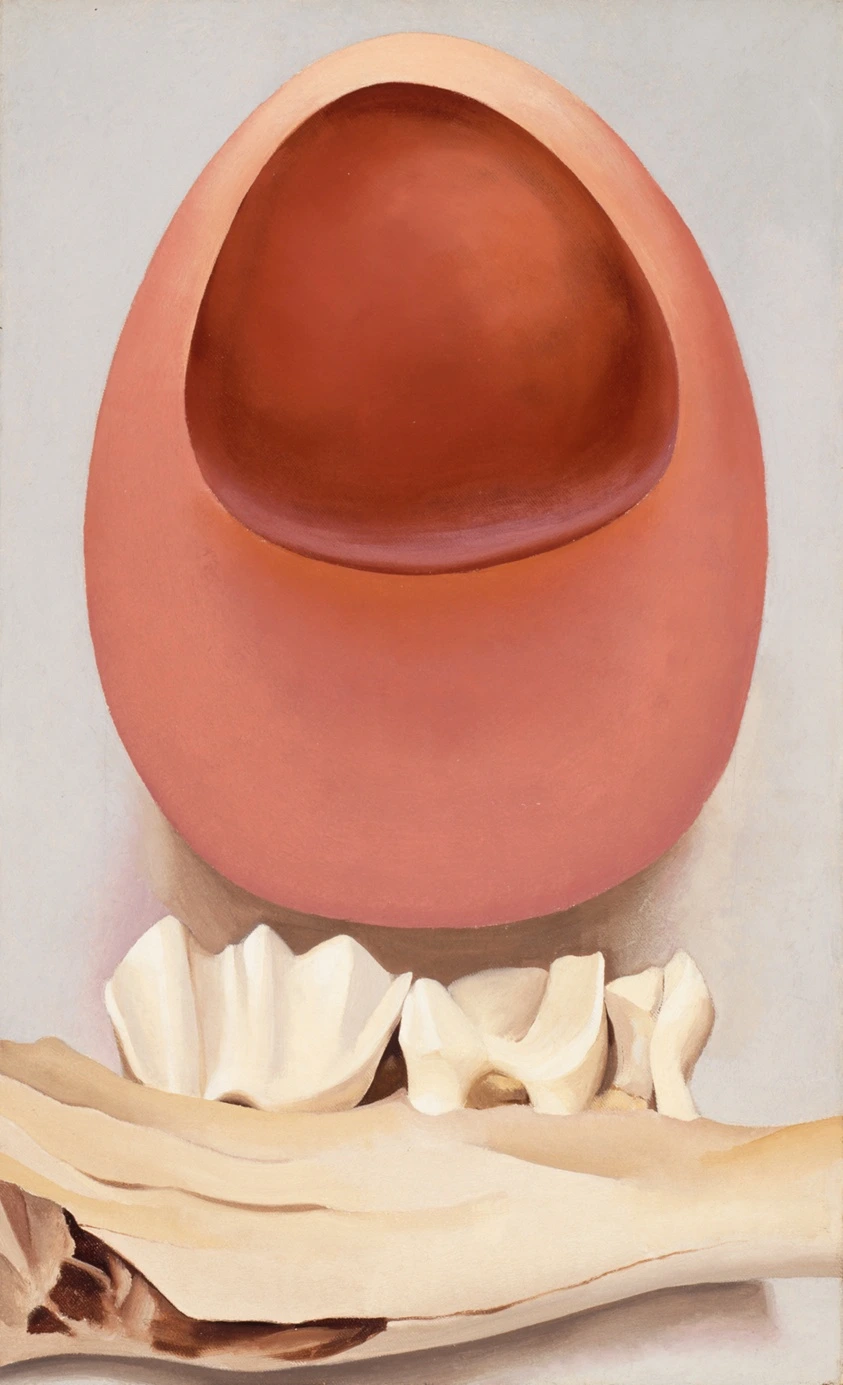
"White Shell with Red" is one of O'Keeffe's most spectacular pastels, executed in 1938 on wood pulp laminate board and showing a large seashell against a field of saturated red that seems to pulse with visceral energy. The shell itself is rendered with microscopic precision—each ridge and chamber described in white and pale gray pastel that creates a tactile, almost sculptural surface. The red background is equally important: it is not merely a backdrop but a presence, a color so intense that it threatens to overwhelm the shell while simultaneously intensifying the object's whiteness through complementary contrast. This use of red connects to O'Keeffe's famous declaration that she had been "maddened" by the color, which she associated with blood, passion, and the interior of the body. The conflation of shell and bodily interior is deliberate: O'Keeffe frequently said that she painted shells because they reminded her of the shapes inside her own body, and the red background makes this analogy explicit. The wood pulp laminate support was unusual for pastel work; it provided a smooth, stable surface that allowed the dense layering of pigment without the flaking that traditional paper might encourage. This technical innovation allowed O'Keeffe to achieve a saturation of color that rivaled oil painting. Art historians have connected this work to the Surrealist interest in biomorphic form, particularly the shell and bone imagery of Picasso and Miró, though O'Keeffe always insisted that her sources were observation rather than theory. In the history of American art, the pastel belongs to the moment when O'Keeffe was achieving both critical respect and popular fame, her flower and shell images reproduced in magazines and advertisements across the country.
Cultural Impact
This pastel made the seashell a metaphor for bodily interior, using saturated red and wood pulp support to rival oil painting's intensity while conflating nature with visceral self-knowledge.
Why It Matters
It matters because O'Keeffe painted a shell and saw her own blood—proving that a beach souvenir could contain the entire body if the red was deep enough.