Description
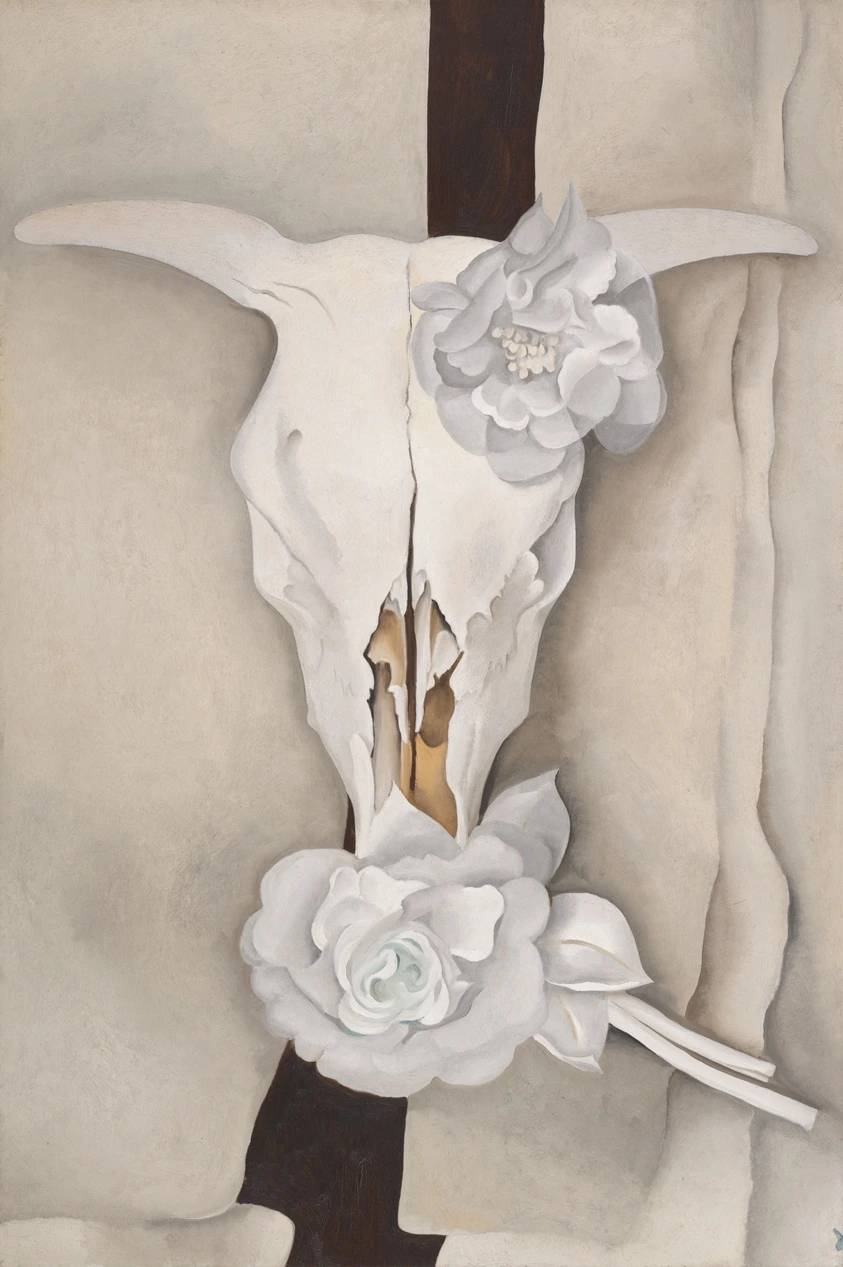
Georgia O’Keeffe collected this cow’s skull in New Mexico during the summer of 1930, when a drought had devastated the Southwest, and many animal skeletons could be found in the desert. She was captivated by the stark elegance of the bones and shipped some back to New York so she could paint them the following year. She noted, “To me they are as beautiful as anything I know. . . . The bones seem to cut sharply to the center of something that is keenly alive on the desert.” O’Keeffe’s inclusion of the calico fabric roses—which were used to decorate graves in New Mexico—further evokes questions of life, death, and mortality.
Provenance
Georgia O’Keeffe (1887–1986), New York and New Mexico [letter from O’Keeffe to Daniel Catton Rich, Nov. 14, 1947; copy in curatorial object file]; given through the Alfred Stieglitz Collection to the Art Institute of Chicago, 1947.
Accession Number
61428
Medium
Oil on canvas
Dimensions
91.4 × 61 cm (36 × 24 in.)
Classification
oil on canvas
Credit Line
Alfred Stieglitz Collection, gift of Georgia O'Keeffe
Background & Context
Background Story
Georgia O'Keeffe (1887-1986) painted Cow's Skull with Calico Roses in 1931 during the period when she had recently discovered the landscape and objects of New Mexico, finding in the desert Southwest the subjects that would dominate her work for the rest of her career. The painting juxtaposes a bleached cow skull against a dark background with artificial calico roses—the kind of paper flowers used to decorate graves in the Southwest—creating a memento mori that combines the natural and the artificial, the living and the dead. The 1931 date places this in O'Keeffe's first full summer in New Mexico, when she was producing the desert paintings that would define her mature style.
Cultural Impact
Cow's Skull with Calico Roses is one of O'Keeffe's most iconic works and a defining image of American modernism. The painting combines the desert Southwest's bleached bones with the artificial flowers that decorate its graves, creating an American memento mori that replaces the European tradition of skulls and hourglasses with objects specific to the American landscape. The painting's influence on American art and popular culture has been enormous—it has become one of the most reproduced images in American painting.
Why It Matters
Cow's Skull with Calico Roses is O'Keeffe's American memento mori: a bleached cow skull and artificial grave flowers against a dark ground, replacing the European vanitas tradition with objects specific to the American desert. The 1931 painting is one of the most iconic images in American modernism and defines O'Keeffe's New Mexico period.