Description
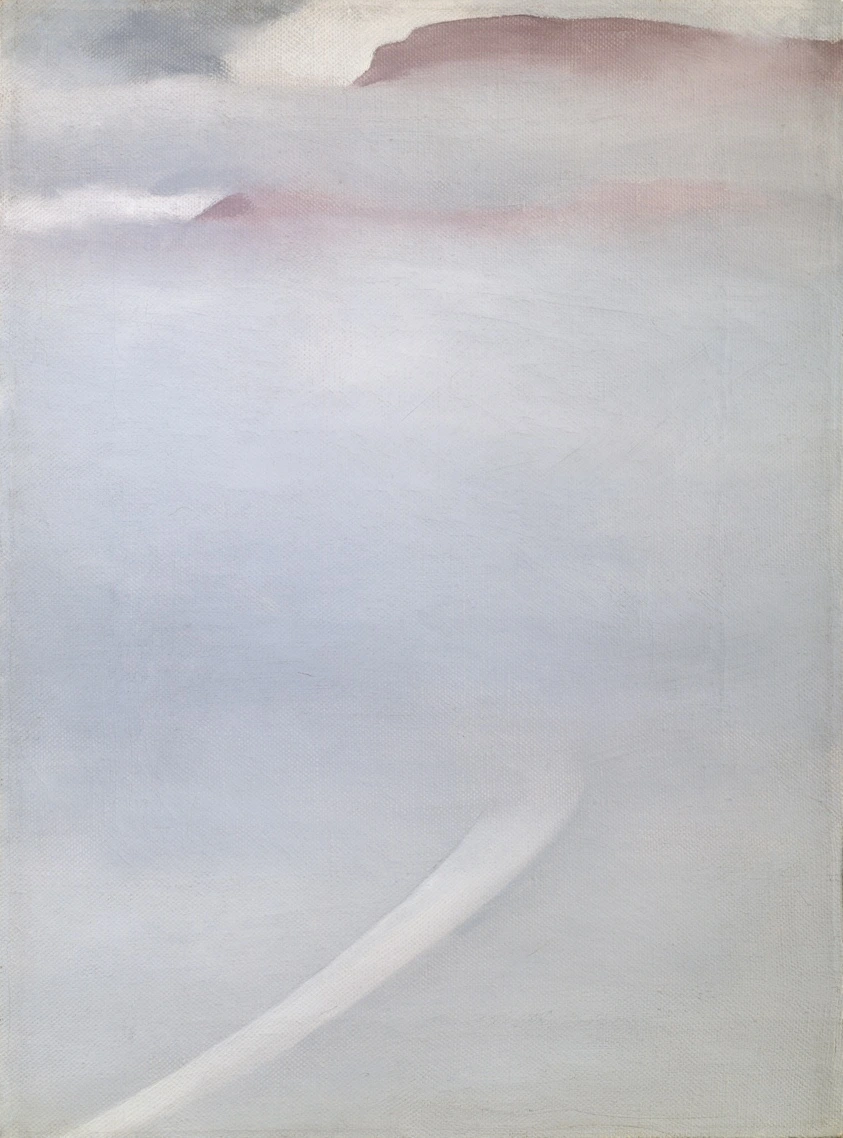
This atmospheric painting of gray mists tumbling down a mesa and obscuring the road below strikingly demonstrates Georgia O’Keeffe’s fascination with changing weather effects. Although her works frequently demonstrate a crystal clarity of perception, here she captured a cloudy moment seen from her home and studio in Abiquiu, New Mexico. Her bedroom overlooked the main road that connected Abiquiu with the larger towns of Española and Santa Fe, and her eye was drawn to its wide sweep up the mesa.
Provenance
Georgia O’Keeffe (1887–1986), Abiquiú, NM; sold to Paul Rosenbaum (1897–1982) and Gabriella Rosenbaum (1905–2000; born Gabriella Kramer), Chicago and Palm Springs, FL, 1967 [Lynes 1999, vol. 2, 896, cat. 1461; documentation in curatorial object file]; by descent to Gabriella Rosenbaum; bequeathed to the Art Institute of Chicago, 2002.
Accession Number
158750
Medium
Oil on canvas
Dimensions
41.3 × 30.8 cm (16 1/4 × 12 1/8 in.)
Classification
oil on canvas
Credit Line
Bequest of Paul and Gabriella Rosenbaum
Background & Context
Background Story
"Road – Mesa with Mist" is one of Georgia O'Keeffe's most atmospheric late paintings, executed in 1961 during the period when she had largely retreated from New York to New Mexico and was producing the austere, luminous landscapes that defined her final decades. The composition shows a road leading toward a mesa that emerges from or disappears into mist, the horizon line dissolved in a pale atmosphere that makes the distinction between earth and sky almost impossible to determine. The palette is extraordinarily restrained—whites, pale grays, and muted earth tones that create an atmosphere of quiet mystery and spatial ambiguity. This chromatic austerity is characteristic of O'Keeffe's late work: she had moved away from the bold colors of her early flower paintings toward a more meditative, almost monochrome approach that emphasized form and space over chromatic drama. The road itself is a recurring motif in her New Mexico paintings, suggesting both journey and arrival, the passage through landscape toward some undefined destination that may be spiritual rather than geographical. The mesa with mist suggests the transient effects of weather that O'Keeffe observed daily from her Ghost Ranch studio, the way the desert could transform from clarity to mystery in minutes as clouds moved across the plateau. Art historians have connected this painting to the broader tradition of American landscape painting, from the luminism of Fitz Hugh Lane to the abstracted vistas of Arthur Dove, noting that O'Keeffe's treatment combines observational precision with modernist simplification. The work also reflects the artist's personal circumstances in 1961: she was in her seventies, her eyesight was beginning to fail, and the pale, misty landscapes may express both the physical limitations of age and a deepening spiritual vision.
Cultural Impact
This 1961 Ghost Ranch luminist landscape dissolved mesa and mist into monochrome meditative ambiguity, using pale desert weather to bridge aging eyesight with deepening spiritual vision.
Why It Matters
It matters because O'Keeffe painted a road disappearing into fog and made it feel like a prayer—proving that even emptiness could be a destination if the light was pale enough.