Description
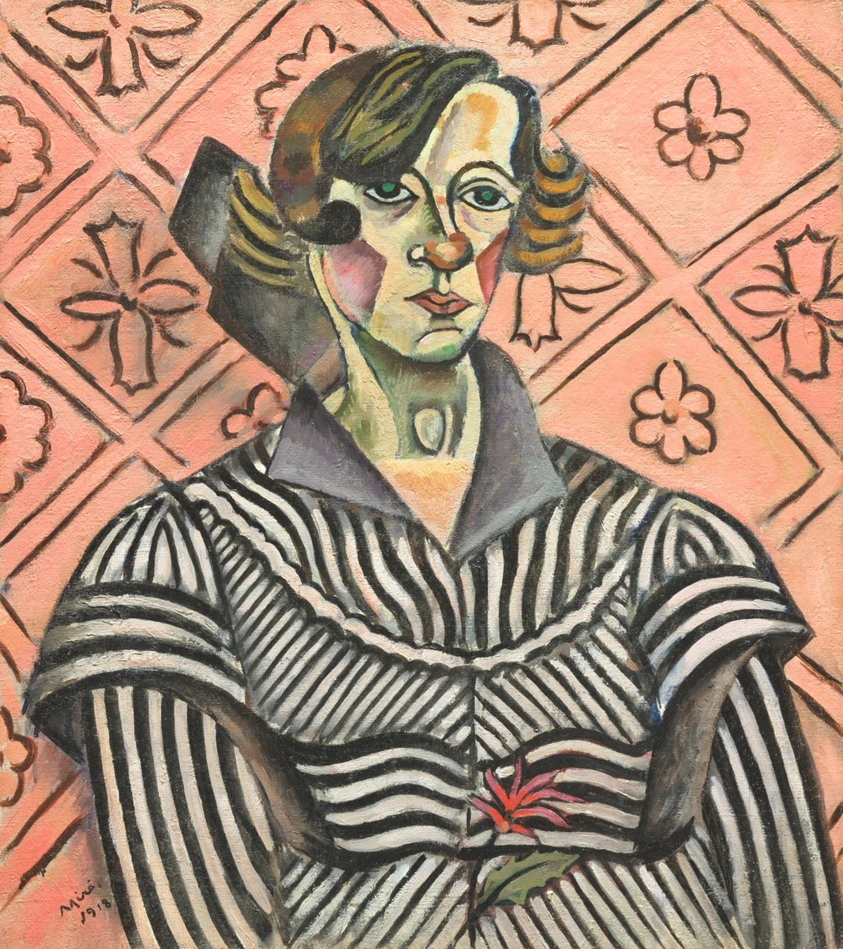
This painting belongs to a group of fascinating and highly individual works by Joan Miró that document his early efforts to grapple with revolutionary developments in modern art (such as Fauvism and Cubism) and to forge his own direction. These efforts culminated in the early 1920s in the artist's breakthrough to a style of fantastic, simplified forms, freely and loosely scattered across the surface of his pictures with an exuberant abandon that is hard to imagine based on this tightly constructed portrait. And yet, something of this exuberance—of the vitality and poetic intensity of Miró‘s later works—seems indeed to underly this strangely powerful portrait, manifesting itself, for example, in the unrestrained rhythms of the dress, barely held in check by the diamond grid in the background, or in the lyrical note introduced by the small flower on the front of the dress.
Different and often contrasting impulses are brought here into uneasy balance through the sheer force of Miró's talent for creating compelling simplifications of the forms before him. The strong rhythms established by the dress, wallpaper, and face all vie for attention, as do the artist's various sources of inspiration: the influence of the Fauves and especially of Henri Matisse in the bold use of color, dense application of paint, and flat patterning of the dress and background; the effect of Cubism in the far more sculptural, angular treatment of the face; and the impact of the Romanesque frescoes of Miró's native Catalonia (which the artist himself acknowledged as a major inspiration) in the linear rhythms of the dress, hair, and background, in the frontal pose, and in the large, staring eyes. This is a painting of dramatic contrasts, between the insistent flatness of the dress and back-ground and the Cubist modeling of the face, between the startling pink of the wallpaper and the restrained black-and-white color scheme of the dress, between the human presence of the sitter and the strong linear patterns that threaten to engulf it. It does not seem surprising, given the impact this portrait still has today, that the young woman who initially agreed to sit for it became frightened both by Miró's intensity and his strange style of painting, forcing him to finish the portrait from memory.
—Entry, Margherita Andreotti, Art Institute of Chicago Museum Studies, Vol. 20, No. 2, The Joseph Winterbotham Collection at The Art Institute of Chicago (1994), p. 152-153.
This is one of thirty-five works that comprise the Winterbotham Collection. Click here to learn more about the collection.
Provenance
Accession Number
5375
Medium
Oil on canvas
Dimensions
69.5 × 62 cm (27 3/8 × 24 3/8 in.)
Classification
oil on canvas
Credit Line
Joseph Winterbotham Collection