The Policeman

Description

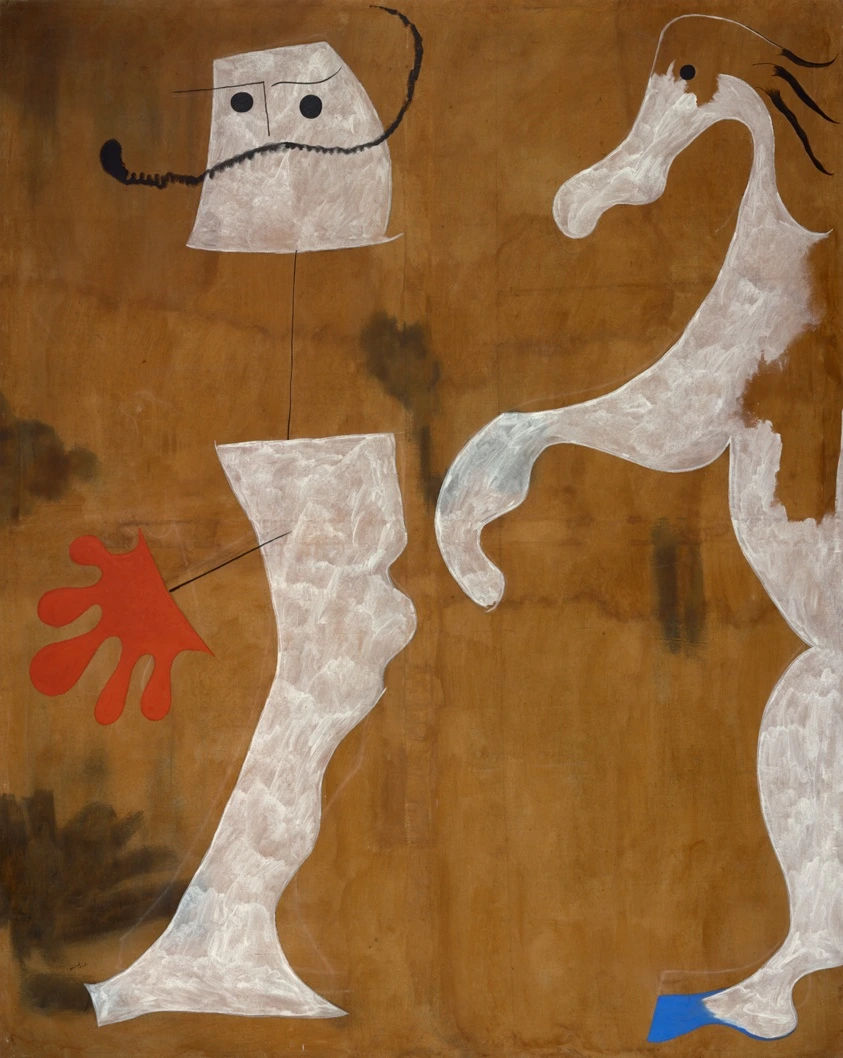
Soon after Joan Miró moved to Paris from his native Barcelona in 1920, he met a group of avant-garde painters and writers who advocated merging the everyday rational world with that of dreams and the unconscious in order to produce an absolute reality, or surreality. To release images of this higher realm, the Surrealists embraced automatism, a spontaneous working method much like free association. Miró experimented with automatism: “Even a few casual wipes in cleaning my brush,” he said, “may suggest the beginning of a picture.” Between 1925 and 1927, his experiments unleashed a revolutionary series of works called the “dream paintings,” which straddle abstraction and representation in freely moving, calligraphic compositions. In The Policeman, a large canvas from this group, two biomorphic shapes spring to life as a policeman and a horse, their forms defined by thinly applied white paint against a neutral ocher ground. The form on the left has sprouted five buds that act as fingers, and both forms extrude curves that suggest torsos or mouths. With sketch-like dots and squiggles added to their heads to make eyes and a mustache, Miró’s shapes come to life in a liquid space as animated equivalents of a policeman and his horse.

Provenance

Jacques Viot (Galerie Pierre), Paris, acquired directly from artist, late October–early November 1925 [Lanchner 1993]. René Gaffé, Brussels, by June 1928–at least 1962 [Lanchner 1993]; sold to Norman Granz, Galerie Verve, Breganzona, Switzerland, around 1962–to at least April 1963 [Lanchner 1993]; sold to Richard Feigen Gallery, Chicago, April 1963 [letter April 12, 2001 from Richard Feigen and Co.]; sold to Claire Zeisler, Chicago, 27 April 1963–99 [letter listed above]; bequeathed to the Art Institite, 1999.

The Policeman

Joan Miró

1925

Accession Number

111654

Medium

Oil on canvas

Dimensions

248 × 194.9 cm (97 5/8 × 76 3/4 in.)

Classification

Painting

Museum

The Art Institute of Chicago

Chicago, United States

Credit Line

Bequest of Claire Zeisler
Background & Context

Background Story

Joan Miró's "The Policeman" (1925) is a painting from the period when Miró, having moved from Barcelona to Paris, was developing the radically simplified visual language that would make him one of the most original artists of the twentieth century. The painting depicts a vaguely human form — the "policeman" of the title — reduced to a few essential elements: a round head with staring eyes, a body of interlocking geometric shapes, and spindly limbs that terminate in oversized hands and feet. The background is a flat, unmodulated expanse of color that offers no spatial context, leaving the figure suspended in a void. The year 1925 was a pivotal one in Miró's career. He had been in Paris since 1920, moving in the circles of the Dadaists and the emerging Surrealists, and his work had progressively moved away from the colorful, detail-rich style of his early paintings toward the spare, sign-like imagery that would define his mature work. Under the influence of André Breton's Surrealist manifestos and the automatic drawing techniques that the Surrealists were developing, Miró began to liberate his imagery from rational control, allowing his subconscious to generate forms that were simultaneously childish, witty, and disturbing. "The Policeman" belongs to a group of paintings from 1924–25 that Miró called "peinture-poésie" (painting-poetry) — works in which the image is accompanied by (or functions as) a word or phrase that creates an ironic or absurdist counterpoint. The title "The Policeman" sets up an immediate dissonance with the image: this is not a representation of a policeman but a visual poem about authority, surveillance, and the absurdity of imposing rational order on an irrational world. The figure's enormous, staring eyes suggest surveillance and scrutiny, while its precarious, barely balanced form suggests the fundamental instability of the authority it represents. The painting also reflects Miró's Catalan identity and his resistance to the authoritarian tendencies of the Spanish state. Growing up in Barcelona under the repressive regime of Miguel Primo de Rivera (who seized power in a military coup in 1923), Miró had direct experience of the arbitrary exercise of police power. "The Policeman" can be read as a Surrealist critique of authority — an image that reduces the figure of state power to a ridiculous, unstable, and ultimately absurd construction. Miró's technique in this painting is characteristically reductive. The forms are simplified to the point of becoming hieroglyphs — visual signs that stand for ideas rather than depicting objects. This reductive approach was central to Miró's contribution to modern art: the insight that a few well-chosen shapes and colors could convey as much meaning as the most elaborate representational painting, and that simplicity could be a more powerful weapon against bourgeois convention than complexity.

Cultural Impact

Miró's 'peinture-poésie' paintings of the mid-1920s created a new visual language — spare, sign-like, and charged with subconscious meaning — that influenced the development of both Surrealism and Abstract Expressionism.

Why It Matters

This painting reduces authority to an absurd hieroglyph — a policeman rendered as a staring, unstable construction that embodies Miró's Surrealist critique of state power and his Catalan resistance to authoritarianism.