Provenance
Igor Markevitch, Switzerland (died 1983), until 1939 [letters January 6 and 7, 2004 from Ariane Lelong-Mainaud, ADOM, in curatorial file]; sold by him to Gérald Cramer, Geneva, 1939–1945 [letters mentioned above]; sold by him to Igor Markevitch, Switzerland, 1945 [letters mentioned above]; sold by him to Gérald Cramer, Geneva, 1945 [letter November 19, 1990 from Gérald Cramer, in curatorial file]; sold by him to Richard Feigen & Co., Chicago, in 1960 [letter November 19, 1990 mentioned above]; sold by the gallery to Mr. and Mrs. Harold X. Weinstein, Chicago, March 8, 1960 [letter February 26, 1976 from Lotte Drew-Bear, Richard Feigen and Co. in curatorial file]; given by them to the Art Institute, 1960.
Accession Number
12752
Medium
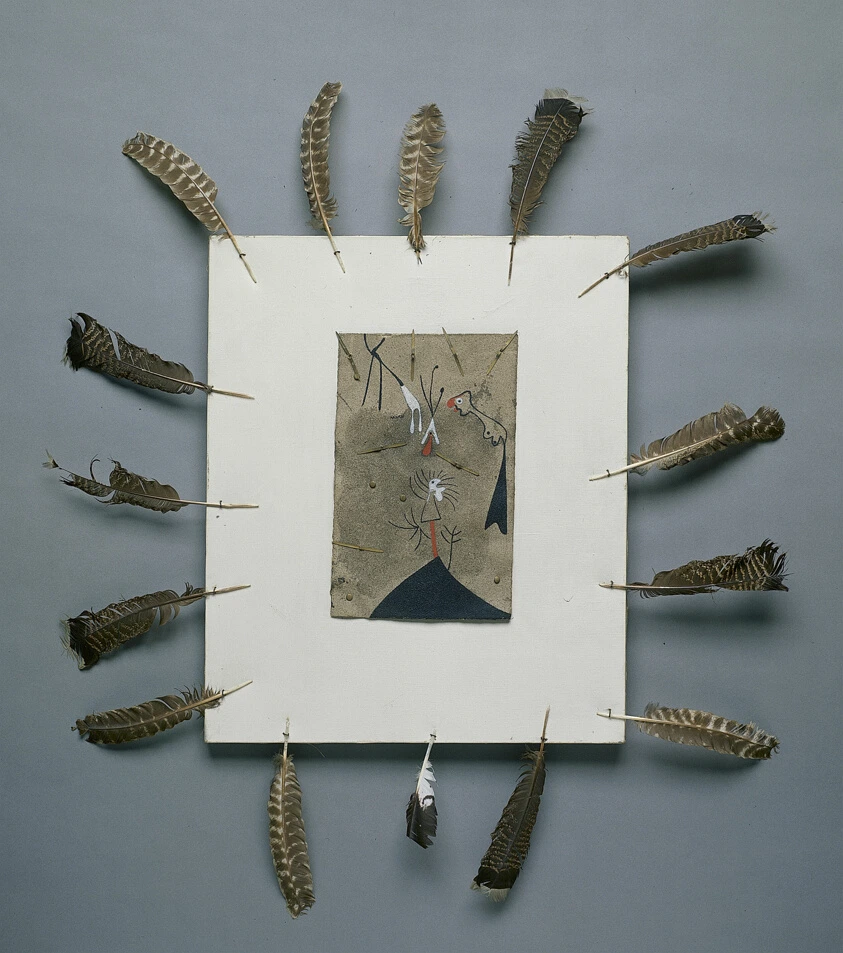
Oil and metal fasteners on sandpaper, mounted on canvas, with feathers
Dimensions
108 × 99 cm (42 1/2 × 39 in.)
Classification
Painting
Credit Line
Gift of Mr. and Mrs. Harold X. Weinstein
Background & Context
Background Story
"Man, Woman, and Bulls" is one of the most materially complex works of Miró's Surrealist period, painted in 1935 on sandpaper mounted on canvas with metal fasteners and actual feathers attached to the surface. The composition shows the artist's characteristic biomorphic figures—a red oviform woman, a stick-like man, and the black silhouettes of bulls—against a gritty yellow ground that evokes Spanish earth. The sandpaper support is crucial: its rough texture resists fluid brushwork, forcing Miró to work with a dry, scratchy application that records the physical struggle between artist and material. The metal fasteners and feathers introduce three-dimensional elements that blur the boundary between painting and assemblage, anticipating the combine paintings of Rauschenberg by two decades. The bull motif carries deep personal significance for Miró as a Catalan artist; the animal appears throughout his work as a symbol of peasant Spain, of the bullring's ritual violence, and of the primitive energies that Surrealism sought to unleash. The man and woman are rendered with the same reductive vocabulary that Miró had developed since the early 1920s: a few lines suggest anatomy without describing it, allowing the viewer to project narrative content onto abstract forms. This psychological openness is what makes Miró's work distinct from the more programmatic abstraction of Mondrian or the more explicit symbolism of Dalí. The painting was produced during the tense period before the Spanish Civil War, and some critics have read the bulls as premonitions of the violence that would soon engulf the country, though Miró himself resisted such literal interpretations.
Cultural Impact
This mixed-media assemblage anticipated Rauschenberg's combines while embedding Catalan identity in sandpaper texture, metal, and feathers, making painting a physical object rather than a window.
Why It Matters
It matters because Miró glued feathers to sandpaper and called it Spain—proving that home could be carried in rough yellow dust and black bull shapes.