Description
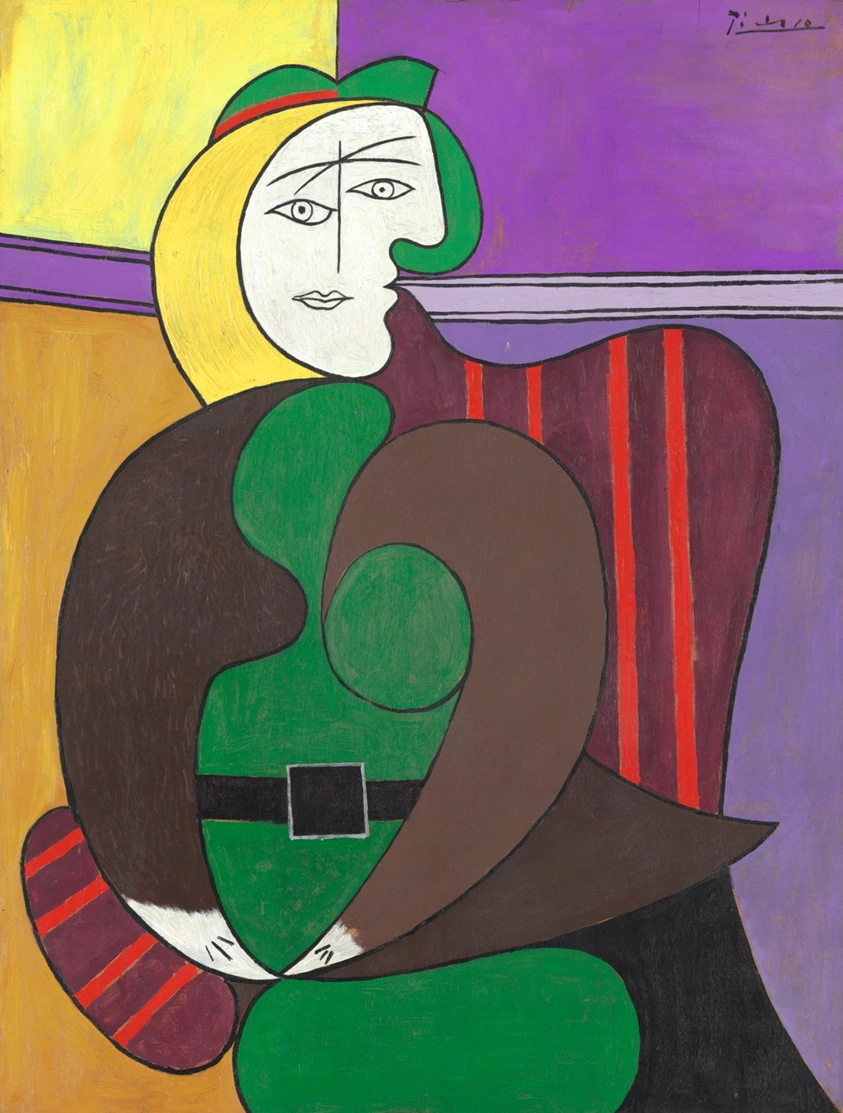
In December 1931 Pablo Picasso began a series of paintings of Marie-Thérèse Walter, a French model with whom he was romantically involved while married to his first wife, Olga Khokhlova. Perhaps acknowledging their double life, Picasso invented a new motif–a face encompassing both frontal and profile views. A constant innovator, Picasso experimented with materials as well as with form and style. The Red Armchair demonstrates the artist's inventive use of Ripolin, an industrial house paint. Mixing it with oil paint he produced various surfaces, from the rough, yellow background to the almost brushless finish of the black lines.
Provenance
The artist; Galerie Louise Leiris, Paris, 1955 [letter from Eleanore Saidenberg, Oct. 10, 1975; copy in curatorial file]; sold to Saidenberg Gallery, July 25, 1956 [Invoice, July 25, 1956; copy in curatorial file]; given to the Art Institute, 1957.
Accession Number
5357
Medium
Oil and Ripolin on panel
Dimensions
131.1 × 98.7 cm (51 5/8 × 38 7/8 in.)
Classification
Painting
Credit Line
Gift of Mr. and Mrs. Daniel Saidenberg
Background & Context
Background Story
Pablo Picasso's "The Red Armchair" (December 16, 1931) depicts Marie-Thérèse Walter, the young woman with whom Picasso had been romantically involved since 1927 while married to his first wife Olga Khokhlova. The painting shows Walter seated — or more accurately, sprawled — in a red armchair, her body a cascade of soft, biomorphic forms that combine voluptuousness and abstraction in equal measure. The date is significant: December 16, 1931 was Picasso's fiftieth birthday, and the painting can be read as both a celebration of his new love and a meditation on aging, desire, and the transformative power of art.
Marie-Thérèse Walter entered Picasso's life in January 1927, when she was seventeen and he was forty-five. According to Picasso's own account, he approached her on the street and said, "You have an interesting face. I would like to paint you. I am Picasso." Their affair, conducted in secret because of Picasso's marriage, became the dominant emotional and artistic force in his life for the next decade, producing some of his most celebrated paintings, sculptures, and prints.
"The Red Armchair" belongs to a series of paintings from 1931–32 in which Picasso developed a radically new approach to the female nude. Influenced by his concurrent sculptural experiments — he was making bone-like metal constructions at his Boisgeloup studio — Picasso reimagined the female body as an assemblage of spherical forms: breasts become globes, limbs become tubular shafts, faces become split profiles that show two viewpoints simultaneously. The result is neither a realistic depiction of a woman nor a purely abstract composition, but a hybrid — a body that has been taken apart and reassembled according to the artist's desires.
The painting's use of Ripolin — a commercial house paint that Picasso began using in 1912 — gives the surface a glossy, enamel-like quality distinct from traditional oil paint. The red of the armchair is particularly intense, applied in thick, confident strokes that contrast with the smoother modeling of the figure. This juxtaposition of different paint types and application methods creates a surface that is as physically varied as the forms it describes.
The painting's erotic charge is unmistakable, but it operates through transformation rather than explicit depiction. Marie-Thérèse's body is not shown as it actually appeared but as Picasso imagined it — enlarged, softened, and rearranged to express desire rather than to record appearance. This transformation of the female body through the artist's subjective vision became one of the central strategies of twentieth-century art, influencing generations of painters from de Kooning to Bacon.
Cultural Impact
Picasso's depictions of Marie-Thérèse Walter pioneered a new language of the female nude — simultaneously erotic and abstract, personalized and universal — that influenced the representation of the body throughout twentieth-century art.
Why It Matters
This painting transforms desire into form — Marie-Thérèse Walter's body reassembled into biomorphic shapes on a red armchair, a fiftieth-birthday meditation on love, aging, and art's power to reshape reality.