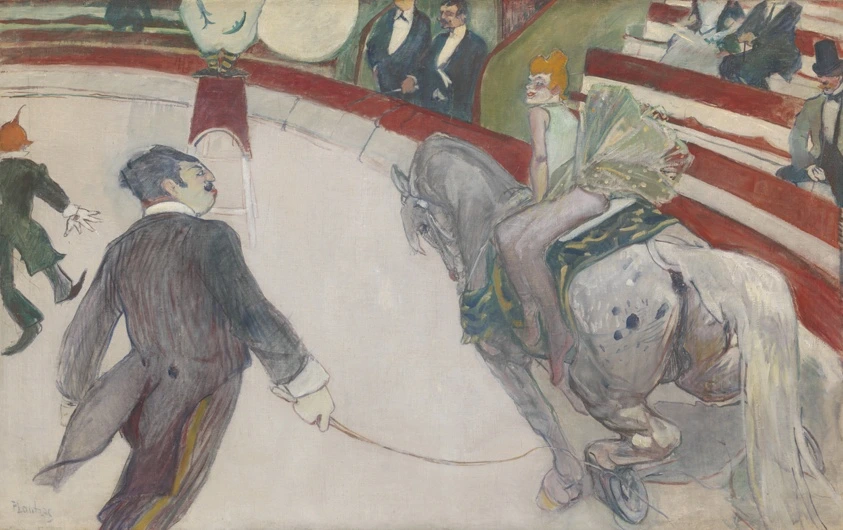
Equestrienne (At the Cirque Fernando)

Description

This work, set at a circus, captures the tense moment in which a female trick rider prepares to stand up on her horse and leap through a paper hoop held by a clown. The horse gathers speed, spurred on by the whip of famous ringmaster Monsieur Loyal. Henri de Toulouse-Lautrec may have based the garishly made-up rider, dressed in a tutu of gauze and sequins, on Suzanne Valadon, a former circus performer, model, and artist with whom he had a nearly three-year relationship. The rider seems to snarl at Monsieur Loyal, who glares back at her. Toulouse-Lautrec’s setting is the same circus in Montmartre depicted in Pierre-Auguste Renoir’s portrait of the Wartenberg sisters.

This is one of thirty-five works that comprise the Winterbotham Collection. Click here to learn more about the collection.

Provenance

Joseph Oller, Paris, 1888 (bought for his café concert, Le Moulin Rouge) until 1914 [see Paris, Paul Rosenberg 1914]. Baron LaFaurie, Paris, by 1914 [see Paris, Manzi Joyant, 1914]. Paul Rosenberg & Co., Paris by 1924 [see Paris 1924]. Joseph Winterbotham, Chicago, by 1924; given to the Art Institute of Chicago, 1925.

Equestrienne (At the Cirque Fernando)

Henri de Toulouse-Lautrec

1887–88

Accession Number

16146

Medium

Oil on canvas

Dimensions

100.3 × 161.3 cm (39 1/2 × 63 1/2 in.); Framed: 123.2 × 181 × 8.3 cm (48 1/2 × 71 1/4 × 3 1/4 in.)

Classification

oil on canvas

Museum

The Art Institute of Chicago

Chicago, United States

Credit Line

Joseph Winterbotham Collection
Background & Context

Background Story

Henri de Toulouse-Lautrec (1864-1901) painted Equestrienne (At the Cirque Fernando) in 1887-88, one of his earliest circus subjects and a precursor to the cabaret and nightlife scenes that would make him famous. The Cirque Fernando was a popular Parisian circus where Toulouse-Lautrec spent many hours sketching the performers, and this painting depicts a bareback rider in the ring with the characteristic off-center composition and bold outlines that distinguish his mature style. The 1887-88 date places this at the very beginning of Toulouse-Lautrec's career, when he was just discovering the Montmartre nightlife subjects that would become his signature.

Cultural Impact

Equestrienne at the Cirque Fernando is one of Toulouse-Lautrec's earliest works in the circus subject matter that would become one of his most important themes. The painting demonstrates that the compositional innovations of his mature style—the off-center composition, the bold outlines, the cropped figures—were already in place in 1887-88, before he had developed the lithographic technique that would make his posters famous. The circus, like the cabaret, was a popular entertainment that Toulouse-Lautrec treated with the same seriousness and observational skill that other painters reserved for high society.

Why It Matters

Equestrienne is Toulouse-Lautrec before Montmartre: a circus subject that anticipates the cabaret and nightlife scenes that would make him famous, with the off-center composition and bold outlines that distinguish his mature style already in place. The 1887-88 painting shows that his compositional innovations preceded his lithographic technique.