Woman Reading

Description

During the late nineteenth century, Parisian cafés were the gathering places of artists and writers and were ideal locations for observing the urban scene. Many Impressionist paintings depict the Café Nouvelle-Athènes on the rue Pigalle, where two tables were reserved for Édouard Manet and his circle—a group that included the painters Edgar Degas, Claude Monet, Camille Pissarro, and Pierre-Auguste Renoir, and the writers Charles Baudelaire and Émile Zola.

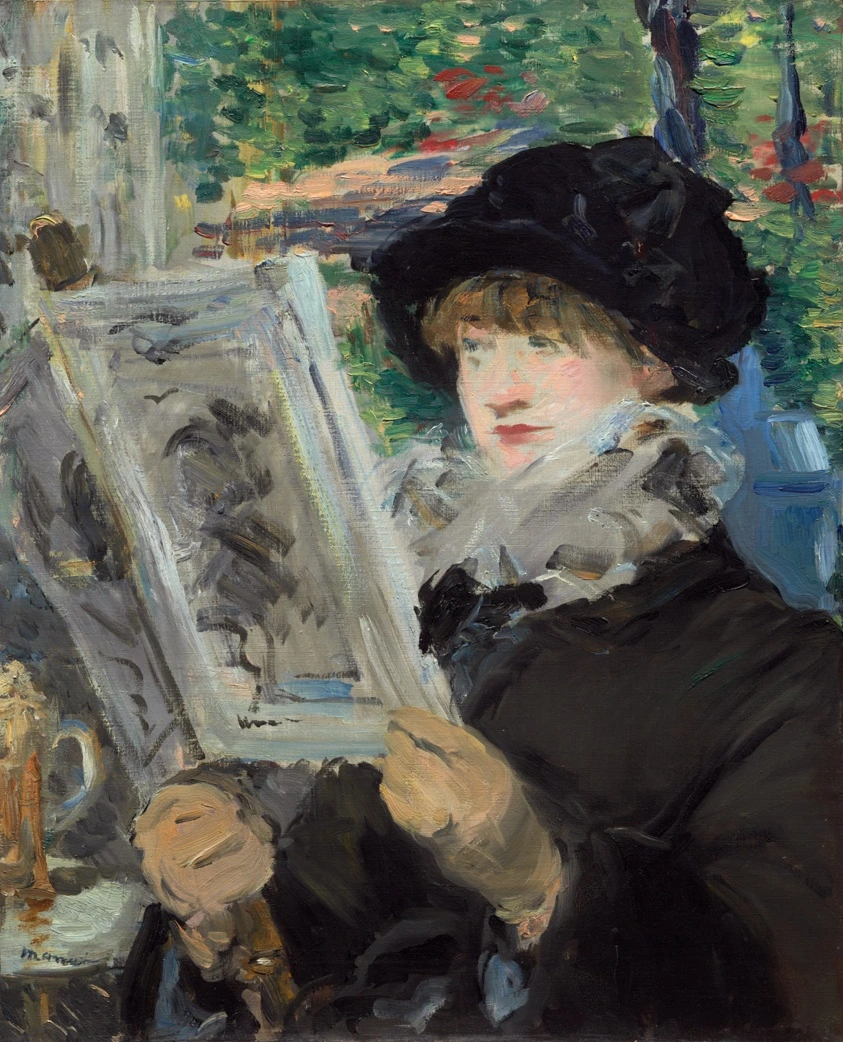
At first glance, this fashionably dressed young woman appears to have been captured sitting at a favorite café: the marble tabletop, beer mug, and magazine attached to a wooden bar suggest such a setting, and her heavy clothing and kid gloves indicate that she is at an outdoor table and that the weather is cool. However, the floral background is actually one of Manet's paintings and the café a re-creation in his studio.

Woman Reading is one of the most Impressionist of Manet’s images; the quick, free brushstrokes and light colors are characteristic of his technique late in his career. Painted only a few years before his death, this work admirably captures a fleeting moment, the sense of modern life that Manet and his contemporaries sought to represent.

Provenance

The artist; sold to Jean-Baptiste Faure (d. 1914), Paris, March 1882 [per Leenhoff, c. 1910, published online, fol. 81, https://gallica.bnf.fr/ark:/12148/btv1b10548955r]; by descent to his son, Maurice Faure (1862-1915), Paris, probably through 1928 [per Tabarant 1931, p. 341; according to Bernheim-Jeune exhibition label on the stretcher from 1928, the painting was possibly still with the family]. Possibly Galerie Bernheim-Jeune, Paris, 1928 or 1929 [per Allan, Beeny, and Groom, 2019, p. 303]. Howard Young Galleries, New York, by 1929; sold to Mrs. Lewis Larned Coburn (née Annie Swan, d. 1932), Chicago, 1929 [per Art News 27, 40 (Sept. 14, 1929), p. 12]; bequeathed to the Art Institute of Chicago, 1933.

Woman Reading

Édouard Manet

1880–82

Accession Number

14591

Medium

Oil on canvas

Dimensions

61.2 × 50.7 cm (24 1/16 × 19 7/8 in.); Framed: 83.2 × 73.1 × 9.9 cm (32 3/4 × 28 3/4 × 3 7/8 in.)

Classification

oil on canvas

Museum

The Art Institute of Chicago

Chicago, United States

Credit Line

Mr. and Mrs. Lewis Larned Coburn Memorial Collection

Background & Context

Background Story

Woman Reading from 1880-82 is a late work by Manet, depicting a woman absorbed in a book in the intimate, sketch-like style that characterizes his last paintings. The 1880-82 date places this in the final years of Manet's life, when his failing health had confined him to his studio and garden, and his painting had achieved the loose, spontaneous handling that would influence the next generation of Impressionists. The woman reading is both a portrait of a specific person and a meditation on the act of reading—a private, absorbed activity that Manet presents with the same respect and attention that he brought to public scenes of Parisian life.

Cultural Impact

Manet's late paintings of women reading are among the most influential works in the history of modern painting because they demonstrate the loose, spontaneous handling that would become the hallmark of Impressionist technique. Woman Reading shows Manet painting with the freedom that his failing health and his artistic maturity had given him—the brushstroke is rapid and confident, the composition seems effortless, and the result is a painting that feels both immediate and timeless.

Why It Matters

Woman Reading is late Manet at his most spontaneous: a woman absorbed in a book rendered with the loose, confident brushwork that would influence the Impressionists. The 1880-82 painting shows the freedom that Manet's failing health and artistic maturity had given him—the brushstroke rapid, the composition effortless, the result both immediate and timeless.