The Races at Longchamp

Description

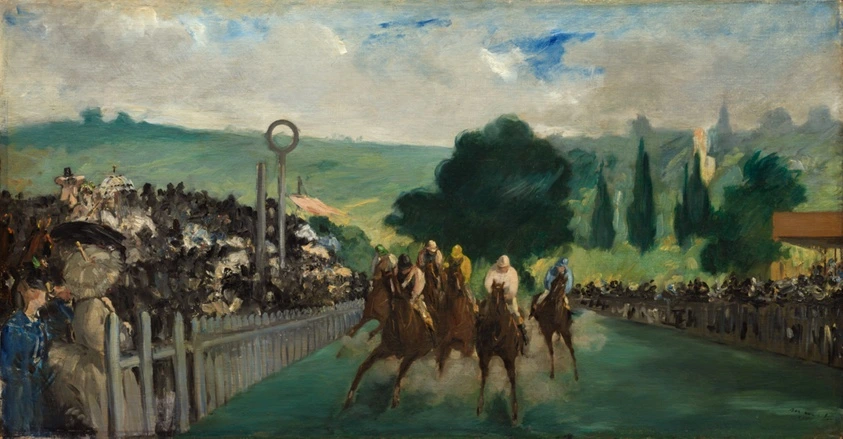
Édouard Manet dared to compose this scene of a racetrack so that the throng of horses and jockeys thunders straight toward the viewer. In contrast to traditional sporting artists, who always showed races from the side with the horses in profile, Manet achieved a sense of expansive space with this thrilling vantage. The painting records the last moments of the race as the horses rush past the finish line, indicated by the pole with a circular top.

Racing was not one of Manet’s preferred subjects, despite his interest in depicting the pleasures of modern life; this is one of only two surviving paintings by the artist on this theme.

Provenance

The artist; sold to Emile Théodore Delius, Paris, 1877, for 1,000 francs [per see Copie faite pour E. Moreau-Nélaton de documents sur Manet appartenant à Léon Leenhoff vers 1910, Bibliothèque nationale de France, Estampes et photographie, RESERVE 8-YB3-2401, p. 76]; sold to Durand-Ruel, Paris, June 1, 1896, for 3,000 francs [this and the following per Durand-Ruel, Paris, stock book for c. 1896 (no. 3838, as Les Courses), copy of archival reference in curatorial object file]; sold to Potter Palmer (d. 1902), Chicago, June 21, 1896, for 45,000 francs; by descent in the Palmer family, Chicago; given to the Art Institute of Chicago, Chicago, 1922.

The Races at Longchamp

Édouard Manet

1866

Accession Number

81533

Medium

Oil on canvas

Dimensions

44 × 84.2 cm (17 5/16 × 33 1/8 in.); Framed: 69.6 × 109.9 × 10.2 cm (27 3/8 × 43 1/4 × 4 in.)

Classification

oil on canvas

Museum

The Art Institute of Chicago

Chicago, United States

Credit Line

Potter Palmer Collection

Background & Context

Background Story

The Races at Longchamp from 1866 depicts a horse race at the Longchamp racetrack in the Bois de Boulogne, one of the most fashionable social events in Second Empire Paris. Manet's treatment is characteristically modern: the horses are seen from behind, charging toward the viewer in a composition that breaks with the traditional side-view convention of equestrian painting. The racetrack crowd is rendered in rapid, sketch-like brushstrokes that suggest the movement and noise of the race without describing it in detail—a solution that anticipates the Impressionist treatment of crowds and movement by several years.

Cultural Impact

The Races at Longchamp is one of the most important paintings in the development of modern art because it breaks with the traditional side-view convention of equestrian painting and presents the horses charging toward the viewer from behind. This compositional innovation—presenting the race from the viewer's perspective rather than from the conventional side view—is one of Manet's most radical departures from tradition and one of his most influential contributions to the development of modern painting.

Why It Matters

The Races at Longchamp is Manet breaking with convention: the horses seen from behind, charging toward the viewer in a composition that abandons the side-view tradition of equestrian painting. The 1866 painting presents the race from the viewer's perspective, creating one of the most radical compositional innovations in 19th-century art.