Description
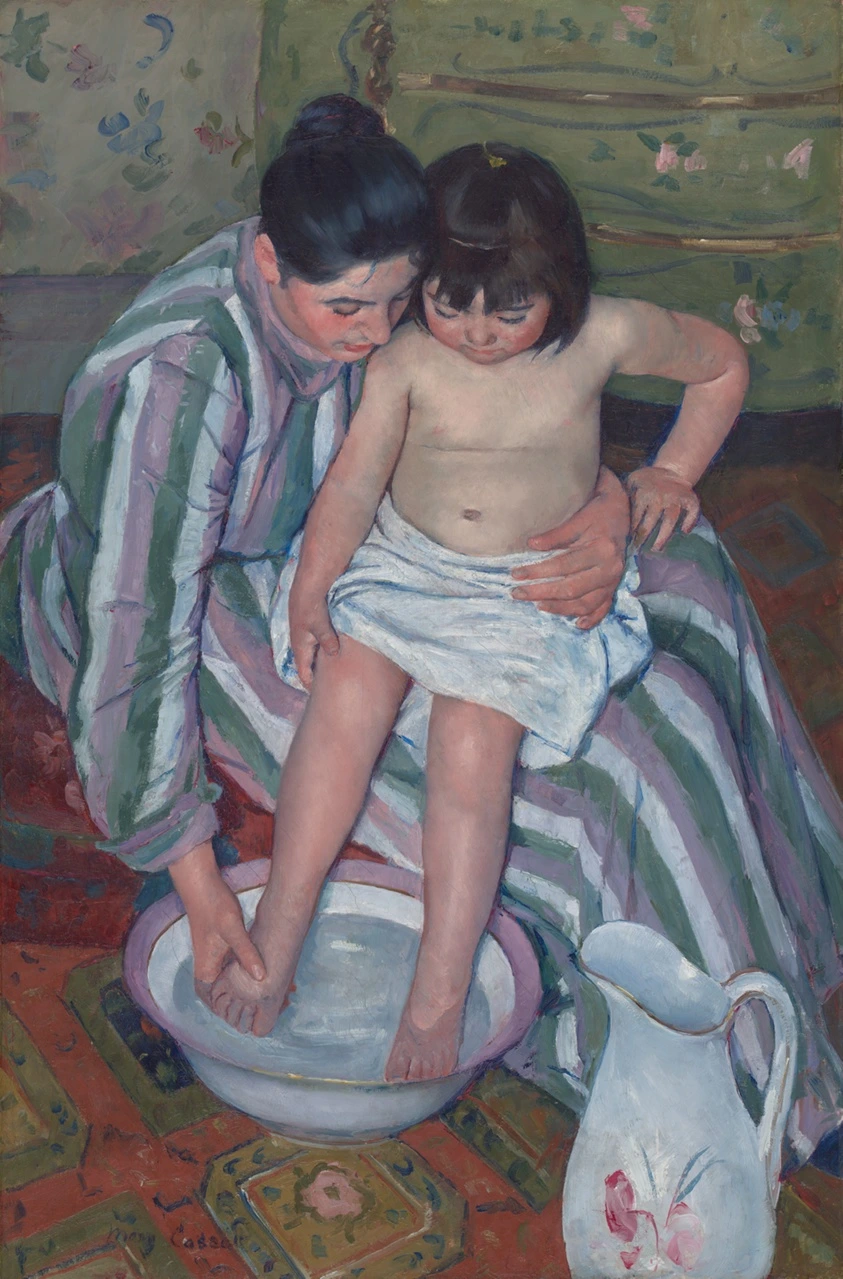
The Child’s Bath is a tender portrayal of familial closeness, a subject that Mary Cassatt explored throughout her career. The caregiver’s cheek brushing the child’s shoulder, her encircling embrace, and the child’s pudgy hand on her knee suggest an emotional bond between the two.
Captivated by a large exhibition of Japanese prints in Paris in 1890, Cassatt set out to produce a series of color prints influenced by Japanese aesthetics. She then continued her investigation across media, culminating in this bold composition, with its dramatically flattened picture plane, decorative patterning, and bright palette.
Provenance
The artist; sold to Durand-Ruel, Paris, November 24, 1893 [Paris 2015]; sold to Harris Whittemore, CT, January 17, 1894 [Paris 2015]; sold by him back to Durand-Ruel, New York, February 4, 1899 [Paris 2015]; sold to the Art Institute of Chicago, 1910.
Accession Number
111442
Medium
Oil on canvas
Dimensions
101.3 × 67.3 cm (39 15/16 × 26 1/2 in.)
Classification
Painting
Credit Line
Robert A. Waller Fund
Background & Context
Background Story
Mary Cassatt (1844-1926) painted The Child's Bath in 1893, creating what has become one of the most beloved images of mother and child in American art. The painting depicts a woman bathing a child in a basin, viewed from above in the steep perspective and flattened forms that Cassatt developed under the influence of Japanese prints. The intimate subject of a mother bathing her child is one that Cassatt returned to throughout her career, but The Child's Bath is her most accomplished treatment of the mother-and-child theme—a theme that Cassatt, as a woman painter, was able to observe and depict with an intimacy and understanding that her male contemporaries could not achieve.
Cultural Impact
The Child's Bath is important in the history of American art because it is the most accomplished treatment of the mother-and-child theme by the greatest female Impressionist. Cassatt's intimate observation of the mother bathing her child—combined with the Japanese-influenced perspective and flattened forms that she developed in the 1890s—creates a type of mother-and-child painting that is simultaneously modern in form and intimate in subject, representing the most significant contribution of a female painter to the Impressionist movement.
Why It Matters
The Child's Bath is Cassatt's most beloved mother and child: a woman bathing a child viewed from above in the steep perspective and flattened forms that she developed from Japanese prints. The 1893 painting is the most accomplished treatment of the mother-and-child theme by the greatest female Impressionist, combining modern form with intimate observation.


