Description
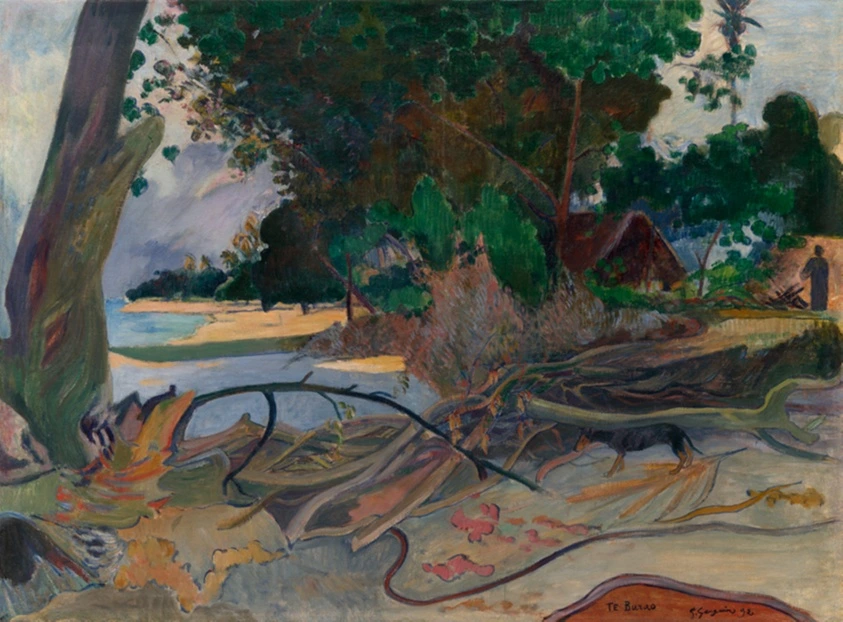
Completed early in Paul Gauguin’s first Tahitian sojourn, this landscape shows the artist grappling with representing an unfamiliar environment. Rather than documenting botanical species scientifically, Gauguin focused on the artistic potential of their variegated colors, textures, and forms. The human figure in the distance and the dog roaming through fallen branches activate the landscape and establish a sense of scale.
This is one of thirty-five works that comprise the Winterbotham Collection. Click here to learn more about the collection.
Provenance
Marius de Zayas, New York; sold his sale, The Anderson Galleries, New York, March 23–24, 1923, lot 83 for $3,000 to the Art Institute [price according to an annotated copy of the sale catalogue in the Ryerson Library, Art Institute]; purchased by the Art Institute with funds provided by Joseph Winterbotham for the Joseph Winterbotham Collection, 1923.
Accession Number
8360
Medium
Oil on canvas
Dimensions
68 × 90.7 cm (26 3/4 × 35 11/16 in.); Framed: 86.4 × 109.3 × 8.9 cm (34 × 43 × 3 1/2 in.)
Classification
oil on canvas
Credit Line
Joseph Winterbotham Collection
Background & Context
Background Story
Paul Gauguin (1848-1903) painted Te burao (The Hibiscus Tree) during his first stay in Tahiti (1891-93), depicting a Tahitian landscape with the hibiscus tree of the title and the simplified forms and brilliant colors that characterize his Polynesian paintings. The Tahitian title demonstrates Gauguin's desire to incorporate Tahitian language and culture into his art, and the 1892 date places this in the most productive period of his first Tahitian stay, when he was producing the paintings that would make him the most influential Post-Impressionist painter after Van Gogh and Cézanne.
Cultural Impact
Te burao is important in Gauguin's Tahitian period because it demonstrates the synthesis of Tahitian subject and Post-Impressionist technique that characterizes his most influential work. The simplified forms and brilliant colors of the Tahitian landscape show Gauguin moving beyond both Impressionism and the Pont-Aven Synthetism of his earlier career toward the more radical simplification and color that would influence the Fauves and the German Expressionists.
Why It Matters
Te burao (The Hibiscus Tree) is Gauguin's Tahiti at its most brilliant: a Tahitian landscape with simplified forms and brilliant colors that demonstrate the synthesis of Polynesian subject and Post-Impressionist technique. The 1892 painting shows Gauguin moving beyond Impressionism toward the radical simplification that would influence the Fauves and Expressionists.