Description
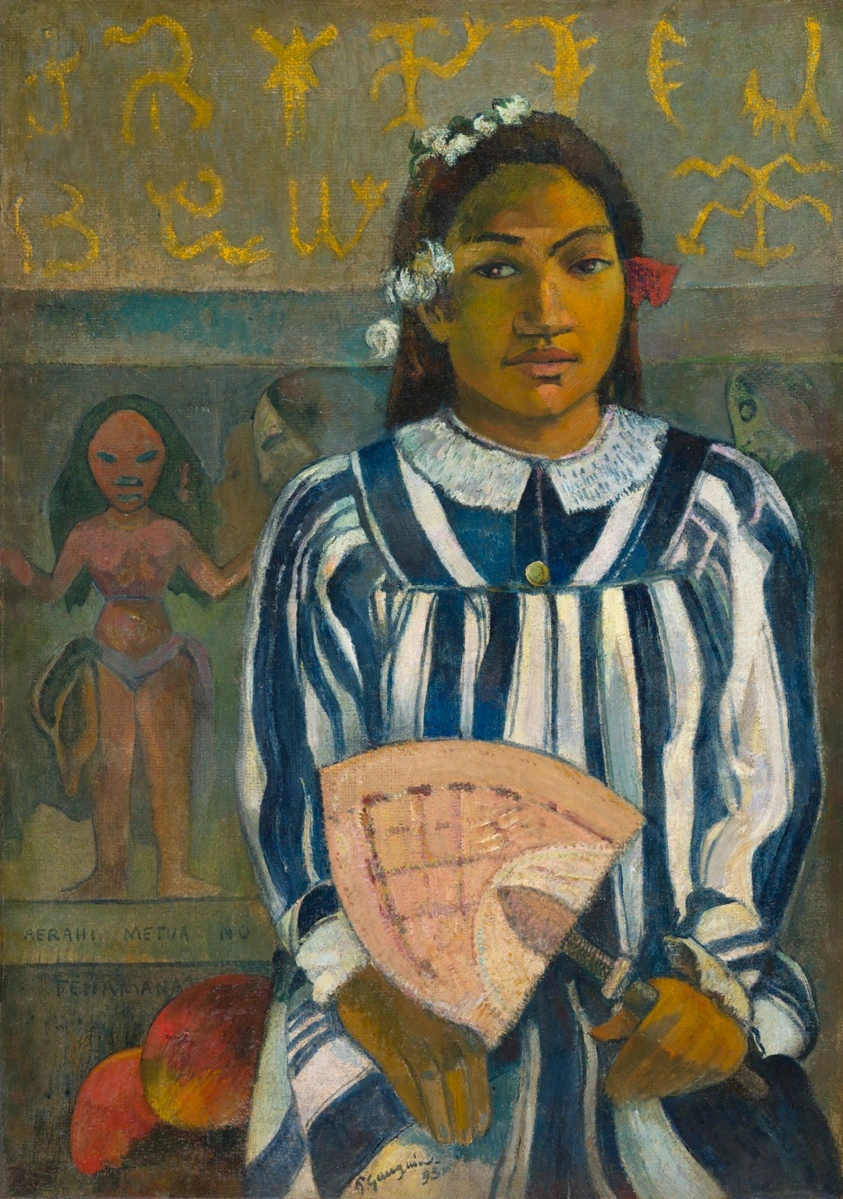
In this portrait, the 13-year-old Tahitian girl named Tehamana appears stoic, shoulders squared and gaze unflinching. She wears a missionary dress and wields a Samoan fan as white flowers tumble from her hair. The ripe mango beside her alludes to fertility. In the background, Gauguin combined various non-European emblems—glyphs derived from an Easter Island tablet and a female deity inspired by Polynesian and Hindu sources—to build a generic sense of foreigness and mystery, transforming Tehamana into the embodiment of his own desire.
Provenance
Gauguin Sale, Paris, Hôtel Drouot, February 18, 1895, lot 32; bought in for 300 francs; given by the artist to Daniel de Monfreid (died 1929), Paris; by descent to Mme Daniel de Monfreid, Paris; by descent to her daughter, Mme Huc de Monfreid; sold to Jacques Seligmann, Paris and New York, 1937 [see New York 1937 and Vogue 1937]. Stephen C. Clark, New York by 1938 [see Rewald 1938]. Mr. and Mrs. Chauncey McCormick, Chicago by 1955 [see Chicago 1955]; by descent to Mr. Charles Deering McCormick; on extended loan to the Art Institute, 1970; given to the Art Institute, 1980.
Accession Number
60812
Medium
Oil on jute canvas
Dimensions
75 × 53 cm (29 1/2 × 20 7/8 in.); Framed: 98.8 × 76.6 × 8.3 cm (38 7/8 × 30 1/8 × 3 1/4 in.)
Classification
oil on canvas
Credit Line
Gift of Mr. and Mrs. Charles Deering McCormick
Tags
Color: Orange Color: Yellow
Background & Context
Background Story
Merahi metua no Tehamana from 1893 is one of Gauguin's most enigmatic Tahitian paintings, depicting his Tahitian companion Tehamana (also called Teha'amana) with the symbolic complexity that characterizes his most ambitious Polynesian works. The Tahitian title translates as 'Tehamana has many parents' or 'The ancestors of Tehamana,' and the painting includes the symbolic references to Tahitian religion and mythology that Gauguin had studied during his first stay in Tahiti. The 1893 date places this at the end of Gauguin's first Tahitian stay, when he was producing his most symbolically complex paintings.
Cultural Impact
Merahi metua no Tehamana is one of Gauguin's most symbolically complex Tahitian paintings because it combines the portrait of his Tahitian companion with the symbolic references to Tahitian religion and mythology that he had been studying. The painting demonstrates Gauguin's ambition to create a new mythological art based on Polynesian culture rather than classical mythology, a project that would influence the Symbolist movement and the development of modernist primitivism.
Why It Matters
Merahi metua no Tehamana is Gauguin's most symbolically complex Tahitian painting: his companion Tehamana surrounded by references to Tahitian religion and mythology, creating a new mythological art based on Polynesian culture. The 1893 painting embodies Gauguin's ambition to replace classical mythology with Polynesian myth.