Description
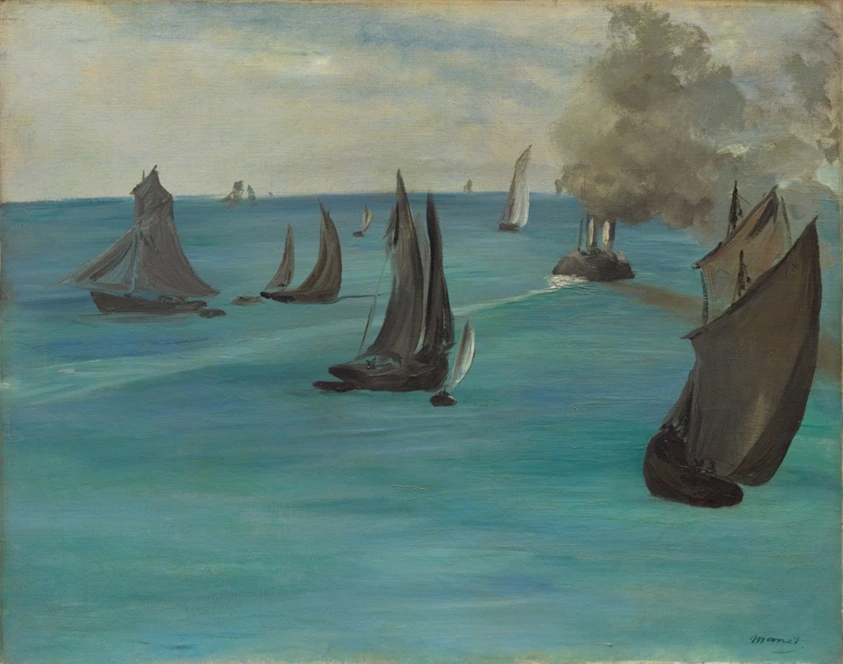
Although boldly brushed and almost calligraphic in form, the vessels in this composition remain identifiable as specific types. To the right of center, a side-wheel packet steamer heads up the English Channel, leaving slower sailing boats in its wake. This is one of Édouard Manet’s earliest paintings of the sea, a subject to which he returned repeatedly. He painted it in Paris along with two or three other works based on sketches he made on a vacation with his family in the northern French port of Boulogne-sur-Mer.
Provenance
The artist; probably sold to Louis Gauthier-Lathuille, Paris, 1881, for 1,000 francs [per transcript in Leenhoff, c. 1910, p. 80]; sold to Durand-Ruel, Paris, February 20, 1900, for 20,000 francs [per Durand-Ruel, Paris, stock book (no. 5699, as La Rade de Boulogne)]; transferred from Durand-Ruel, Paris, to Durand-Ruel, New York, December 1900 [this and the following per Durand-Ruel, Paris, stock book (no. 2428, as Marine, la Rade de Boulogne)]; sold to Edward Fullerton Milliken, New York, December 31, 1900, for $10,000; sold, American Art Galleries, New York, February 14, 1902, lot 17, to Knoedler and Co., New York, as agent for Mrs. Bertha Potter Palmer (d. 1918), for $7,050; by descent in the Palmer family; given to the Art Institute of Chicago, 1922.
Accession Number
81535
Medium
Oil on canvas
Dimensions
73.6 × 92.6 cm (29 × 36 1/2 in.); Framed: 97.8 × 117.2 × 12.7 cm (38 1/2 × 46 1/8 × 5 in.)
Classification
Painting
Credit Line
Potter Palmer Collection
Background & Context
Background Story
Sea View, Calm Weather from 1864 is one of Manet's most radical seascapes, depicting the sea with a compositional minimalism that was unprecedented in 19th-century marine painting. The painting reduces the seascape to three horizontal bands—sky, sea, and the faint silhouette of a ship—in a composition that eliminates the foreground detail and atmospheric perspective that traditional marine painting required. The 1864 date places this in the period when Manet was producing his most controversial works, and the seascape's radical simplicity anticipates the flat, horizontal compositions that would become characteristic of modernist painting.
Cultural Impact
Sea View, Calm Weather is one of the most radical paintings of the 1860s because it reduces the seascape to three horizontal bands of color—sky, sea, and ship—eliminating the foreground detail and atmospheric perspective that traditional marine painting required. The painting's compositional minimalism anticipates the flat, horizontal compositions that would become characteristic of modernist painting and demonstrates Manet's ability to represent the sea with unprecedented directness.
Why It Matters
Sea View, Calm Weather is Manet's seascape reduced to its essentials: three horizontal bands—sky, sea, and the silhouette of a ship—with no foreground detail and no atmospheric perspective. The 1864 painting anticipates the flat, horizontal compositions of modernist painting and represents the sea with unprecedented directness.