The Beach at Sainte-Adresse

Description

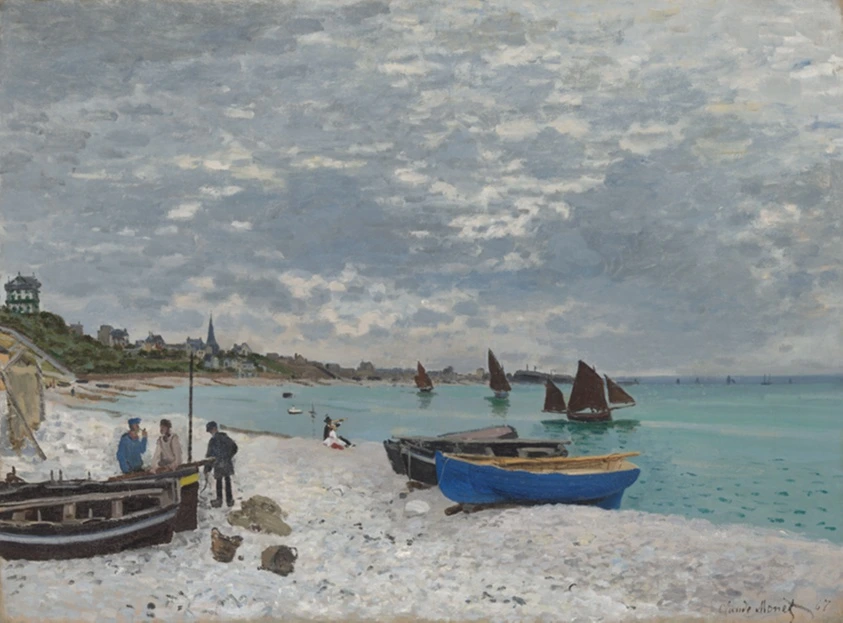
In the summer of 1867, Claude Monet stayed with his aunt at Sainte-Adresse, an affluent suburb of the port city Le Havre in northern France. The artist was familiar with the landscape, having grown up in the area, but the region changed significantly during his lifetime. The expansion of the country’s rail network turned this small, rural fishing village into a seaside resort for tourists. Here, Monet hinted at this transformation. The viewer is immediately drawn to the visible aspects of local life—dark-sailed fishing boats drift in the water, with groups of fishermen, their equipment, and other craft on the shore. The beached boats frame two figures sitting on the shoreline, highlighted by a few strokes of red and yellow paint: a man in a dark hat and suit looks through a telescope, accompanied by a woman wearing a straw hat with a scarlet ribbon. The presence of this couple—undoubtedly vacationers, given their fashionable attire—changes what might have been a traditional coastal scene into a painting of modern life, one of the artist’s first explorations of tourism.

Monet began this painting outdoors and revised it later in his studio. Conservation research has revealed that he changed his mind about the composition while he worked: he initially included other tourist figures and yachts in the scene but later painted over these details, shifting his focus to the fishermen, the aspect of life in Sainte-Adresse that he knew best.

Monet’s seascapes from this summer are markedly different from those painted only a few years earlier, and Beach at Sainte-Adresse exemplifies his evolving painting technique. It also foreshadows some of the qualities that became characteristic of the Impressionist movement, which is perhaps why Monet chose to show it at the second Impressionist exhibition in 1876, nearly ten years after he painted it.

Provenance

The artist (d. 1926); sold to Durand-Ruel, Paris, Feb. 28, 1873, for 400 francs [per Durand-Ruel, Paris, stock book for 1868–73 (no. 2585, as Marine, temps gris), as confirmed by Paul-Louis Durand-Ruel and Flavie Durand-Ruel, Durand-Ruel Archives, to the Art Institute of Chicago, Oct. 5, 2010, curatorial object file]; probably sold to Jean-Baptiste Faure, Paris, by 1876 [per Wildenstein 1996; the Durand-Ruel Archives are unable to confirm Faure's purchase, see Paul-Louis Durand-Ruel and Flavie Durand-Ruel, Durand-Ruel Archives, to the Art Institute of Chicago, Oct. 5, 2010, curatorial object file]; sold to Durand-Ruel, Paris, Jan. 9, 1893, for 7,000 francs [this and the following per Durand-Ruel, Paris, stock book for 1891 (no. 2585, as Sainte-Adresse), as confirmed by Paul-Louis Durand-Ruel and Flavie Durand-Ruel, Durand-Ruel Archives, to the Art Institute of Chicago, Oct. 5, 2010, curatorial object file]; sold to Henri Véver, Paris, Jan. 17, 1893, for 8,000 francs; sold Henri Véver, Paris, sale, Galerie Georges Petit, Paris, Feb. 1–2, 1897, lot 79, to Boulley, as the agent for Georges Kohn, Paris, for 9,000 francs [per Galerie Georges Petit, Paris, sale cat. Feb. 1–2, 1897, the Durand-Ruel Archives also confirms that the painting was “acheté à G. Kohn (et non pas Kahn)”; see Paul-Louis Ruel and Flavie Durand-Ruel, Durand-Ruel Archives, to the Art Institute of Chicago, Oct. 5, 2010, curatorial object file]; sold jointly to Durand-Ruel, Paris, and Bernheim-Jeune, Paris, June 11, 1920, for 40,000 francs [per Durand-Ruel, Paris, stock book for 1921 (no. 11701, as Sainte-Adresse), as confirmed by Paul-Louis Durand-Ruel and Flavie Durand-Ruel, Durand-Ruel Archives, to the Art Institute of Chicago, Oct. 5, 2010, curatorial object file]; sold to Annie Swan Coburn, Chicago (d. 1932), Feb. 8, 1923 [per Durand-Ruel, New York, deposit book for 1894–1925 (no. 8044, as Sainte-Adresse), as confirmed by Paul-Louis Durand-Ruel and Flavie Durand-Ruel, Durand-Ruel Archives, to the Art Institute of Chicago, dated Oct. 5, 2010, curatorial object file, see also a letter on Durand-Ruel letterhead, Mar. 18, 1932, verifying that Coburn purchased the painting from Durand-Ruel] Bequeathed to the Art Institute of Chicago, 1933.

The Beach at Sainte-Adresse

Claude Monet

1867

Accession Number

14598

Medium

Oil on canvas

Dimensions

75.8 × 102.5 cm (29 13/16 × 40 5/16 in.); Framed: 104.1 × 130.2 × 11.4 cm (41 × 51 1/2 × 4 1/2 in.)

Classification

Painting

Museum

The Art Institute of Chicago

Chicago, United States

Credit Line

Mr. and Mrs. Lewis Larned Coburn Memorial Collection
Background & Context

Background Story

Claude Monet's "The Beach at Sainte-Adresse" (1867) is one of the earliest masterpieces of Impressionism, painted when Monet was just 27 years old and still developing the technique that would revolutionize painting. The beach at Sainte-Adresse — a fashionable seaside resort near Le Havre, where Monet grew up — is shown on a sunny summer day, with boats in the water, figures on the sand, and a terrace crowded with well-dressed vacationers enjoying the sea air. The year 1867 was a pivotal one in Monet's career. He was living in dire poverty, unable to pay his rent, subsisting on charity, and — to add to his difficulties — his companion Camille Doncieux was pregnant with their first child. Despite these hardships, Monet produced an extraordinary series of paintings during the summer at Sainte-Adresse that marked a decisive step toward Impressionism. Working on the beach and the terrace of his aunt's house, he painted the sea, the boats, and the holiday crowds with a freshness and chromatic boldness that had no precedent in French painting. "The Beach at Sainte-Adresse" is remarkable for its rejection of the compositional conventions that had governed marine painting for centuries. Where traditional seascapes featured dramatic storms, shipwrecks, or naval battles, Monet shows a calm sea, a sunny sky, and a beach crowded with pleasure-seekers. Where academic painters sought to create atmospheric depth through carefully graded tones, Monet fills his canvas with broad areas of bright, flat color — the blue of the sea, the green of the boats, the white of the sails and parasols — that create a decorative pattern as much as an illusion of space. The painting also demonstrates Monet's early mastery of the division of tone that would become the foundation of Impressionist technique. The water is not painted as a single expanse of blue but as a network of individual brushstrokes in blues, greens, and purples that suggest the movement of light across the surface. The heads and figures on the beach are reduced to dabs of pigment — barely identifiable as individuals, yet alive with the movement of a crowd on a summer afternoon. Perhaps most significantly, the painting announces Monet's determination to paint modern life as he saw it — not the heroic marine subjects of the Salon, but the ordinary pleasure of a day at the beach. This commitment to painting the contemporary world, in all its mundane beauty, would become the defining principle of Impressionism and of Monet's entire career.

Cultural Impact

This early Monet painting announces the arrival of Impressionism — a sunny beach scene that replaces the dramatic seascapes of academic tradition with the ordinary beauty of modern leisure, painted in bold, flat colors that anticipate the revolution to come.

Why It Matters

Painted in 1867 during Monet's most impoverished period, this beach scene at Sainte-Adresse is one of Impressionism's founding documents — a declaration that modern life on a sunny beach was worthy of serious painting.