Arrival of the Normandy Train, Gare Saint-Lazare

Description

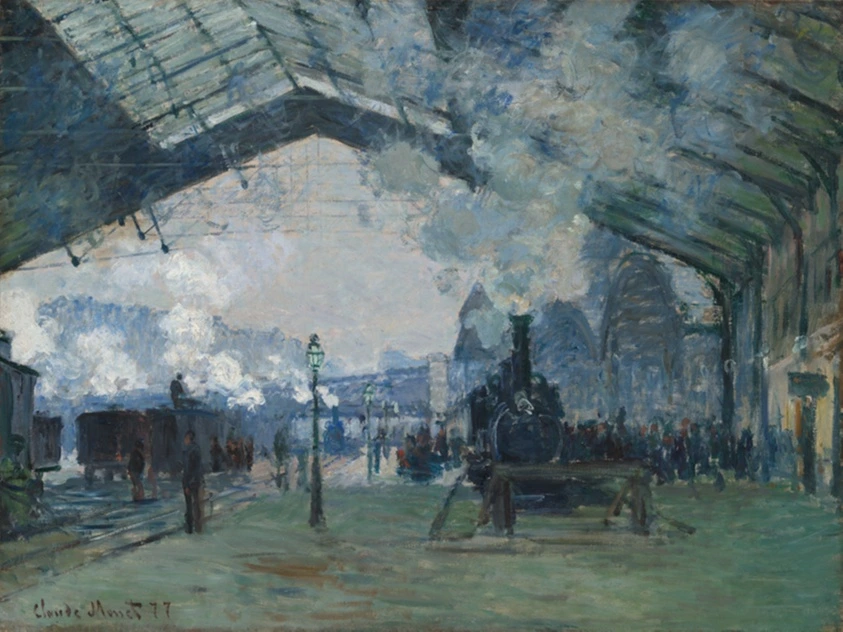
One of the most avant-garde aspects of the Impressionists was their choice of subject matter, which frequently included scenes derived from modern, industrial Paris, from iron bridges to exhibition halls to train sheds. The train station at Saint-Lazare would have been a familiar, meaningful sight to Claude Monet in the 1870s. The terminal linked Paris to Normandy, where the artist developed his technique of painting outdoors in the 1860s. It was also the point of departure for the towns and villages west and north of Paris that the Impressionists frequently visited. Monet completed eight of his twelve known paintings of the Gare Saint-Lazare in time for the third Impressionist exhibition, in 1877, probably displaying them in the same gallery.

Monet chose to focus his attention here on the glass-and-iron train shed, where he found an appealing combination of artifi cial and natural effects—the rising steam of locomotives trapped within the structure and the daylight penetrating large, glazed sections of the roof, for instance. Monet’s depictions of the station inaugurated what was to become for him an established pattern of painting a specific motif repeatedly in order to capture subtle and temporal atmospheric changes, as in his famous series of stacks of wheat. But the Saint-Lazare paintings also represented his last attempt to capture urban life: from this point on in his career, Monet largely devoted himself to landscapes.

Provenance

The artist (d. 1926); sold to Ernest Hoschedé, Paris and Montgeron, Mar. 1877 [this and the following per Wildenstein 1996]. Georges de Bellio (d. 1894), Paris, 1878; by descent his daughter Victorine (de Bellio) Donop de Monchy and son-in-law Eugène Donop de Monchy, Paris, 1894 [per Niculescu, Paragone 249 (Nov. 1970)]. Bernheim-Jeune, Paris, around 1899 [this and the following per Wildenstein 1996]. Paul Rosenberg, Paris, by Oct. 13, 1911; sold to Durand-Ruel, Paris, Oct. 13, 1911, for 13,000 francs [per Durand-Ruel, Paris, stock book for 1901 (no. 9749, as La gare Saint-Lazare, le train de Normandie), as confirmed by Paul-Louis Durand-Ruel and Flavie Durand-Ruel, Durand-Ruel Archives, to the Art Institute of Chicago, Oct. 5, 2010, curatorial object file]. Durand-Ruel, New York, by Dec. 16, 1911 [this and the following per Durand-Ruel, New York, stock book for 1904–24 (no. 3502, as Paris la gare Saint-Lazare), as confirmed by Paul-Louis Durand-Ruel and Flavie Durand-Ruel, Durand-Ruel Archives, to the Art Institute of Chicago, Oct. 5, 2010, curatorial object file]; sold to Martin A. Ryerson (d. 1932), Chicago, Dec. 16, 1911, for $7,000; bequeathed to the Art Institute of Chicago, 1933.

Arrival of the Normandy Train, Gare Saint-Lazare

Claude Monet

1877

Accession Number

16571

Medium

Oil on canvas

Dimensions

60.3 × 80.2 cm (23 3/4 × 31 1/2 in.); Framed: 80.7 × 100.4 × 10.2 cm (31 3/4 × 39 1/2 × 4 in.)

Classification

Painting

Museum

The Art Institute of Chicago

Chicago, United States

Credit Line

Mr. and Mrs. Martin A. Ryerson Collection
Background & Context

Background Story

Claude Monet's "Arrival of the Normandy Train, Gare Saint-Lazare" (1877) is one of the most celebrated paintings of the Impressionist era, depicting the bustling interior of Paris's Gare Saint-Lazare — the railway station that connected Paris to the suburbs of Argenteuil, Bougival, and beyond, where Monet and his fellow Impressionists painted. The painting shows a locomotive arriving under the station's great iron-and-glass roof, its steam and smoke filling the vaulted space with a luminous haze that transforms the industrial architecture into a shimmering field of blue, gray, and violet light. The Gare Saint-Lazare paintings represent Monet's first fully realized series — a group of twelve canvases depicting the same subject from different viewpoints and under different conditions of light and atmosphere. This serial approach, which Monet would develop further in the 1890s with the Haystacks, Rouen Cathedral, and Water Lilies, began here in the steam and smoke of a Parisian railway station. The choice of subject was deliberately provocative. In 1877, railway stations were the apotheosis of modernity — vast, noisy, smoke-filled spaces that embodied the industrial transformation of French life. By choosing to paint the Gare Saint-Lazare — and to paint it with the same sensitivity to light and atmosphere that he had previously devoted to landscapes and gardens — Monet was making an explicit statement: modern life, in all its smoke and noise and mechanical power, was as worthy of artistic treatment as any natural scene. The painting's composition is a masterpiece of spatial organization. The iron ribs of the station roof create a dramatic perspective that pulls the eye toward the locomotive, while the steam and smoke fill the intervening space with layers of translucent vapor that both obscure and reveal the architecture. The train itself — a dark, powerful form emerging from the haze — is the focal point of the composition, its headlight piercing the atmospheric gloom like a miniature sun. The juxtaposition of the rigid iron structure and the formless steam, of mechanical power and atmospheric subtlety, creates a visual tension that is the painting's core achievement. Monet's access to the station was arranged through the art dealer Paul Durand-Ruel, who used his connections to get Monet permission to paint inside the Gare Saint-Lazare — an arrangement that required the station authorities to delay trains and clear platforms to accommodate the artist. This fact reveals the extent to which Monet was already seen as a significant artist by the mid-1870s: even the national railway was willing to rearrange its operations for him.

Cultural Impact

Monet's Gare Saint-Lazare series established the railway station as a subject for serious art and inaugurated the serial method that would define his career — painting modernity without apology.

Why It Matters

This painting of the Gare Saint-Lazare announces that modernity itself — steam, iron, and the railway — is worthy of Impressionism's most luminous treatment, inaugurating Monet's serial method in the heart of industrial Paris.