Description
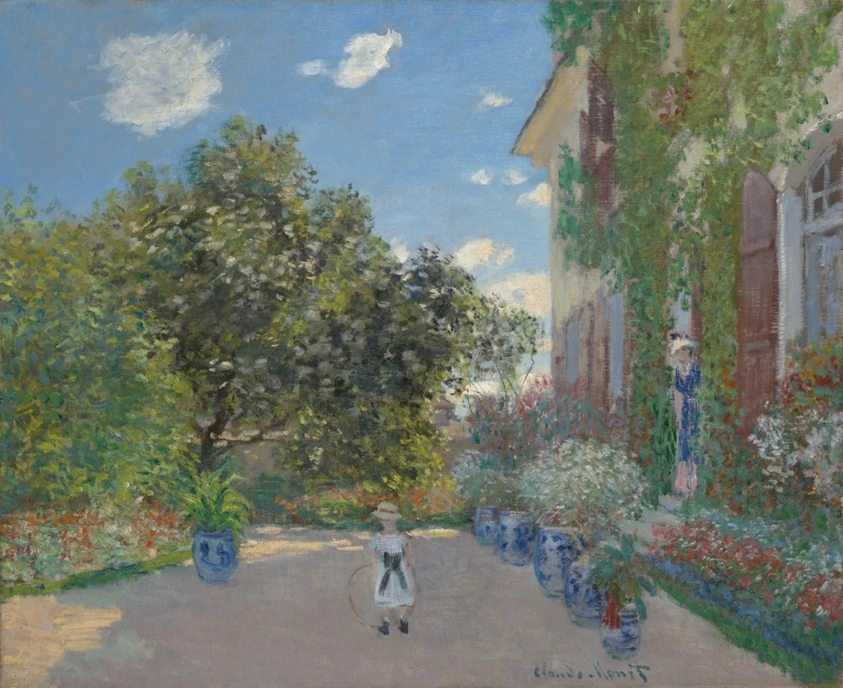
Claude Monet and his family lived at Argenteuil, outside Paris, from 1871 to 1878. Here he depicted his five- or six-year-old son, Jean, playing with a hoop and his wife, Camille, standing in the doorway of their vine-covered house. The pleasant weather and neatly kept garden, a forerunner of the artist’s celebrated garden at Giverny, give a sense of tranquility and well-being to this painting. This was a period of financial security for Monet thanks to recent sales of his work to the Paris art dealer Paul Durand-Ruel.
Provenance
The artist (d. 1926); possibly sold to Alexandre Dubourg, Paris, 1873 [per Wildenstein 1996, the Durand-Ruel Archives could not verify this information, as confirmed by Paul-Louis Durand-Ruel and Flavie Durand-Ruel, Durand-Ruel Archives, to the Art Institute of Chicago, Oct. 5, 2010, curatorial object file]; possibly sold to Durand-Ruel, Paris, Jan. 9, 1882 [per Wildenstein 1996, the Durand-Ruel Archives could not verify this information: “Durand-Ruel Paris (stock 2147) achète à Dubourg un tableau de Monet intitulé Son jardin le 9 janvier 1882 mais nous n’avons aucune preuve qu’il s’agisse du tableau du AIC,” Durand-Ruel, Paris, stock book for 1880–82 and stock book for 1880–84; as confirmed by Paul-Louis Durand-Ruel and Flavie Durand-Ruel, Durand-Ruel Archives, to the Art Institute of Chicago, Oct. 5, 2010, curatorial object file]. Durand-Ruel, Paris, Apr. 29, 1890, for 1,500 francs [this and the following per Durand-Ruel, Paris, stock book May 1, 1890 (no. 277, as Maison de l’artiste), as confirmed by Paul-Louis Durand-Ruel and Flavie Durand-Ruel, Durand-Ruel Archives, to the Art Institute of Chicago, Oct. 5, 2010, curatorial object file; in the same letter, the Durand-Ruel Archives state that they do not know from whom the painting was purchased]; sold to Potter Palmer, Chicago, July 8, 1891, for 5,000 francs; sold to Durand-Ruel, New York, Nov. 23, 1894, for $2,500 [this and the following per Durand-Ruel, New York, stock book for 1894–1905 (no. 1279, as Sa Maison à Argenteuil), as confirmed by Paul-Louis Durand-Ruel and Flavie Durand-Ruel, Durand-Ruel Archives, to the Art Institute of Chicago, Oct. 5, 2010, curatorial object file]; sold to Martin A. Ryerson (d. 1932), Chicago, Apr. 24, 1912, for $6,200 [see previous; a purchase receipt on Durand-Ruel letterhead, dated May 23, 1912, includes this painting as one of several sold by Durand-Ruel, New York, to M. A. Ryerson, photocopy in curatorial object file]; bequeathed to the Art Institute of Chicago, 1933.
Accession Number
16554
Medium
Oil on canvas
Dimensions
60.2 × 73.3 cm (23 11/16 × 28 7/8 in.); Framed: 80.7 × 93.4 × 11.5 cm (31 3/4 × 36 3/4 × 4 1/2 in.)
Classification
oil on canvas
Credit Line
Mr. and Mrs. Martin A. Ryerson Collection
Background & Context
Background Story
Claude Monet's "The Artist's House at Argenteuil" (1873) depicts the rented house in Argenteuil where Monet lived with his companion Camille Doncieux and their growing family from 1871 to 1878. The painting shows the house from the garden, with its distinctive blue shutters and flowering plants, while Monet's wife Camille and their young son Jean can be seen in the garden. It is simultaneously a domestic scene, a portrait of a home, and a document of the most productive period of Monet's career.
The years in Argenteuil (1871–1878) were the most important of Monet's development as an artist. Argenteuil — a small town on the Seine northwest of Paris that was rapidly being transformed by suburban development — offered Monet an ideal combination of rural beauty, river scenery, and modern industrial life. From his house and garden, Monet could walk to the riverbank in minutes, and the Seine at Argenteuil provided endless subjects: sailing boats, pleasure steamers, bridges, regattas, and the ever-changing reflections on the water.
The house itself became one of Monet's favorite subjects during this period. He painted it repeatedly from different angles, in different seasons, and with different family members in the garden. In each version, the house and garden are presented not as a real estate prospectus — an inventory of property and possessions — but as an integrated visual experience, where the architecture of the house, the colors of the flowers, the light on the path, and the figures of the family all contribute to a single chromatic harmony.
"The Artist's House at Argenteuil" also documents a pivotal moment in the history of the middle-class garden. The 1870s saw the rise of the suburban garden as a space of aesthetic cultivation, shaped by the horticultural innovations of the previous decades (new plant varieties, improved cultivation techniques) and by the growing middle-class appetite for domestic beauty. Monet's garden at Argenteuil — with its carefully planted borders, potted flowers, and climbing vines — is a small-scale version of the elaborate garden he would later create at Giverny, which would become his greatest artistic subject.
The painting's domestic subject matter was radical for its time. By choosing to paint his own house, his own family, and his own garden rather than a grand view or a heroic subject, Monet was asserting the principle that the everyday experience of modern life was worthy of serious artistic attention — the same principle that would become the foundation of Impressionism.
Cultural Impact
Monet's Argenteuil paintings established suburban domestic life as a subject for serious artistic treatment, asserting that a house, a garden, and a family were as worthy of painting as any classical or historical subject.
Why It Matters
This painting of Monet's rented house at Argenteuil documents the most productive period of his career — a domestic scene that doubles as a manifesto for painting modern life and a preview of the garden art that would define his late work.