Étretat: The Beach and the Falaise d'Amont

Description

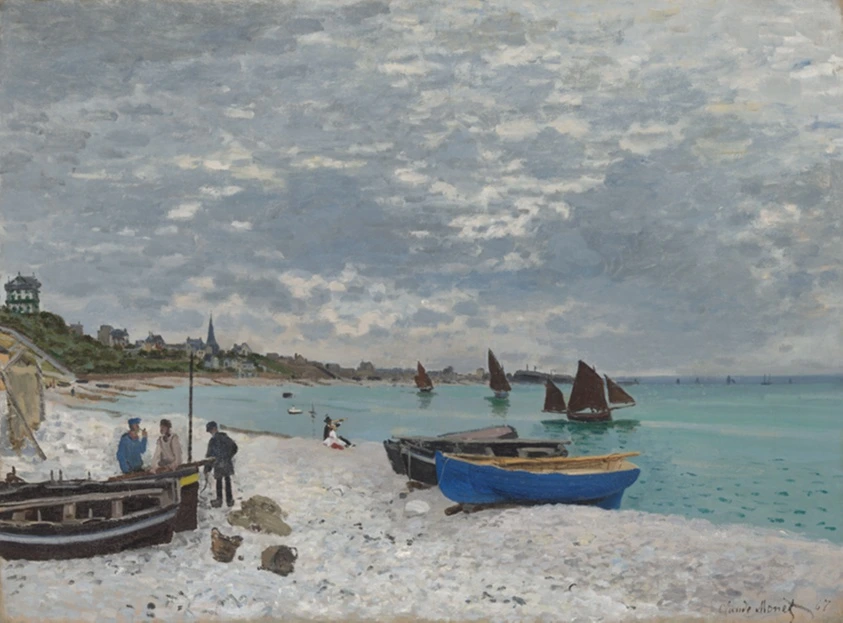
Claude Monet painted this sun-soaked scene of the cliffs of Amont in Étretat on the northern coast of France in saturated tones of blue, orange, and pink. Étretat was a popular tourist destination, but Monet decided to travel there with his family during the town’s offseason, in the fall and winter of 1885. Instead of bustling with travelers, as it would have been during the summer months, the beach appears desolate aside from a small grouping of local fishing boats gathered at the shore.

This is one of thirty-five works that comprise the Winterbotham Collection. Click here to learn more about the collection.

Provenance

Bongniat et Cie [per Wildenstein 1996]. Bernheim-Jeune, Paris, by Aug. 1, 1912 [this and the three following per Durand-Ruel, Paris, stock book for 1913 (no. 10089, as Falaises à Etretat, 1876), as confirmed by Paul-Louis Durand-Ruel and Flavie Durand-Ruel, Durand-Ruel Archives, to the Art Institute of Chicago, Oct. 5, 2010, curatorial object file]; half-share to Durand-Ruel, Paris, Aug. 1, 1912, for 3,500 francs; remaining half-share sold to Durand-Ruel, Paris, Jan. 13, 1916; sent to Durand-Ruel, New York, Feb. 1916; sold to Chester Johnson, Chicago, June 29, 1929 [per Durand-Ruel, New York, stock book for 1929 (no. 3926, as Falaises à Etretat), as confirmed by Paul-Louis Durand-Ruel and Flavie Durand-Ruel, Durand-Ruel Archives, to the Art Institute of Chicago, Oct. 5, 2010, curatorial object file]. Mrs. Anne R. Winterbotham, Chicago, by 1964; given to the Art Institute of Chicago, 1964 (died 1970), who retained a life interest in the painting. In 1973, it became a part of the Art Institute’s Joseph Winterbotham Collection; see Lyn DelliQuadri, “A Living Tradition: The Winterbothams and Their Legacy,” in “The Joseph Winterbotham Collection at the Art Institute of Chicago,” special issue, Art Institute of Chicago Museum Studies 20, 2 (1994), p. 109.

Étretat: The Beach and the Falaise d'Amont

Claude Monet

1885

Accession Number

20535

Medium

Oil on canvas

Dimensions

69.3 × 66.1 cm (27 1/4 × 26 in.); Framed: 90.8 × 88.3 × 10.8 cm (35 3/4 × 34 3/4 × 4 1/4 in.)

Classification

Painting

Museum

The Art Institute of Chicago

Chicago, United States

Credit Line

Gift of Mrs. John H. (Anne R.) Winterbotham in memory of John H. Winterbotham; Joseph Winterbotham Collection

Background & Context

Background Story

"Étretat: The Beach and the Falaise d'Amont" presents one of the most dramatic geological formations on the Normandy coast—the massive limestone arch known as the Porte d'Amont, visible from the town beach at low tide. Painted during his 1885 campaign, the canvas shows the cliff face rising from the shingle beach with almost architectural severity, its pale surface striated by erosion and crowned with sparse vegetation. Monet treats the cliff not as a romantic sublime backdrop but as a color problem: how to render the warm ivory of limestone under an overcast sky, how to make the wet pebbles in the foreground resonate with the dry stone above. The horizontal format emphasizes the cliff's lateral extension and the beach's gradual slope toward the water, creating a meditation on geological time versus human time. This painting exemplifies Monet's growing ambition to capture what he called the "envelope" of atmosphere surrounding objects rather than the objects themselves. Contemporary critics often struggled with such works, complaining that the artist had abandoned traditional composition in favor of meteorological accident. Yet precisely this surrender to contingency—painting what the weather offers rather than what the studio demands—defines the radical modernity of Monet's Étretat series.

Cultural Impact

This canvas transforms a famous geological landmark into a study of atmospheric color, demonstrating how Monet replaced romantic sublime with perceptual empiricism.

Why It Matters

It matters as proof that Monet could make even a tourist postcard subject into a rigorous investigation of light, stone, and air.