Vétheuil

Description

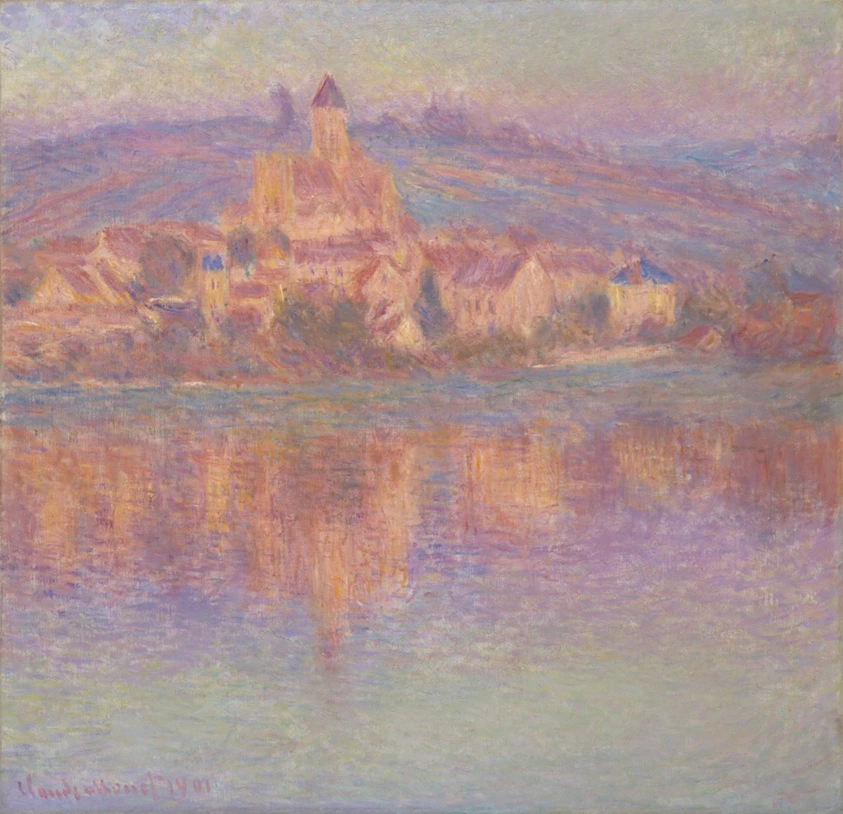
In summer 1901 Claude Monet rented a modest house in Lavacourt, a small hamlet across the Seine from Vétheuil and not far from his property at Giverny, which he was in the process of expanding. He began 15 paintings of Vétheuil from the balcony of this rented home, all of which feature the same restricted view of the riverbank and town—punctuated by the church—and document the changes in light throughout the day. The Art Institute holds two paintings from the series, one from midday and another from sunset. Painted on nearly square canvases, Monet divided each composition in half, separating the town from its reflection. Rather than replicating the area’s topography or creating a convincing illusion of space, Monet emphasized the decorative over the descriptive qualities of this riverscape. His loose brushwork and subtle color transitions blur the distinctions between the scene’s various forms, dissolving the borders, for example, between the water and the land and the land and the sky. The shapes of the different buildings along the shoreline emerge through changes in the direction of brushstrokes and slight shifts in hue.

Provenance

The artist (d. 1926); sold to Durand-Ruel, Paris, Dec. 8, 1905, for 12,000 francs [this and the following per Durand-Ruel, Paris, stock book for 1901–13 (no. 8051, as Vétheuil au soleil couchant, 1901), as confirmed by Paul-Louis Durand-Ruel and Flavie Durand-Ruel, Durand-Ruel Archives, to the Art Institute of Chicago, Feb. 5, 2013, curatorial object file]; sold to Paul Mulle de Jaegher, Roubaix, France, Nov. 8, 1911, for 20,000 francs. Bernheim-Jeune, Paris, by Apr. 18, 1912 [this and the following per Durand-Ruel, Paris, stock book for 1901–13 (no. 10004, as Vétheuil au soleil couchant, 1901), as confirmed by Paul-Louis Durand-Ruel and Flavie Durand-Ruel, Durand-Ruel Archives, to the Art Institute of Chicago, Feb. 5, 2013, curatorial object file]; sold to Durand-Ruel, Paris, Apr. 18, 1912, for 16,000 francs; sent to Durand-Ruel, New York (for Martin A. Ryerson, Chicago), July 31, 1914 [this and the following per Durand-Ruel, Paris, stock book for 1901–13 (no. 10004, as Vétheuil au soleil couchant, 1901), as confirmed by Paul-Louis Durand-Ruel and Flavie Durand-Ruel, Durand-Ruel Archives, to the Art Institute of Chicago, Feb. 5, 2013, curatorial object file; see also Durand-Ruel to Martin A Ryerson, dated Aug. 20, 1914, which describes a shipment sent to Mr. Ryerson; excerpted in Daniel Wildenstein 1985]; sold to Martin A. Ryerson (died 1932), Chicago, July 31, 1914; bequeathed to the Art Institute of Chicago, 1933.

Vétheuil

Claude Monet

1901

Accession Number

16579

Medium

Oil on canvas

Dimensions

90 × 93 cm (36 7/16 × 36 5/8 in.); Framed: 102.3 × 105.1 × 7 cm (40 1/4 × 41 3/8 × 2 3/4 in.)

Classification

Painting

Museum

The Art Institute of Chicago

Chicago, United States

Credit Line

Mr. and Mrs. Martin A. Ryerson Collection
Background & Context

Background Story

This second Vétheuil canvas from 1901 offers a different viewpoint of the same village, probably from the opposite bank of the Seine or a lower elevation than its companion piece. The composition is more intimate, focusing on the river foreground and the reflection of village buildings in the water rather than the panoramic sweep of the valley. The palette is correspondingly more saturated, with the blues and greens of the river asserting themselves against the warm tones of the architecture. Monet's brushwork here is exceptionally free, with long horizontal strokes in the water suggesting current and reflection simultaneously without literal description. This painting illustrates what the artist meant when he said that he wished he had been born blind and then gained sight, so that he could paint without knowing what objects were—pure visual sensation untainted by nominal identification. The village houses are rendered as color patches rather than recognizable structures, their individuality submerged in the overall chromatic harmony. The canvas also demonstrates Monet's mature understanding of water as a painting subject: not a mirror but a continuously moving surface that fragments, distorts, and reassembles whatever stands before it. In the history of landscape painting, this Vétheuil canvas represents the culmination of a tradition stretching back to Claude Lorrain, but with the classical order replaced by modern perceptual relativism.

Cultural Impact

This intimate Vétheuil view demonstrates Monet's mature water painting technique, transforming river reflection from mirror image into fragmented color abstraction.

Why It Matters

It matters as a masterclass in painting water—not as a surface that reflects, but as a surface that dissolves everything it touches.