Description
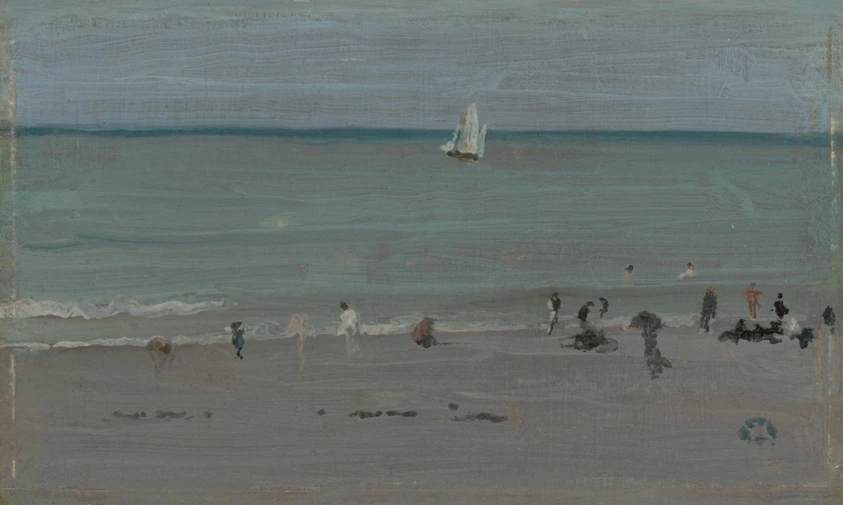
In this intimately scaled seascape, James McNeill Whistler employed the sparest of compositional elements to evoke a coastal atmosphere. Broad horizontal bands of blues and gray suggest sky, ocean, and sand, with dabs of thin pigment giving economical, yet expressive form to around a dozen figures on the windswept beach. Whistler dedicated much of his artistic practice to capturing the mood and color harmonies of marine scenes. Coast Scene, Bathers was painted en plein air, a practice to which the artist returned in the 1880s. It marked a distinctive shift from his studio-produced Nocturnes of the previous decade.
Provenance
Mrs. J. Cross, by November 1917; sold to P. and D. Colnaghi and Co., London, November 1, 1917 [according to Young, MacDonald, Spencer, and Miles 1980]; partial share sold to M. Knoedler and Co., New York, December 31, 1917; sold to Charles B. Eddy (1872–1951), New York, April 1918 [M. Knoedler and Co. Stock Book 6, Stock No. 14346, copy in curatorial object file]; returned to M. Knoedler and Co., New York, by January 1919; sold to R.C. and N.M. Vose Gallery, Boston, November 1919 [M. Knoedler and Co. Stock Book 6, Stock No. 14561, copy in curatorial object file]; sold to Woodruff J. Parker (1880–1930), Chicago, June 5, 1922. With Chester H. Johnson Galleries, Chicago, by 1926; sold to Walter Stanton Brewster (1872–1954), Chicago, 1926 [according to Young, MacDonald, Spencer, and Miles 1980]; given to the Art Institute of Chicago, 1933.
Accession Number
14309
Medium
Oil on panel
Dimensions
13.3 × 21.9 cm (5 1/4 × 8 5/8 in.)
Classification
Painting
Credit Line
Walter S. Brewster Collection
Background & Context
Background Story
"Coast Scene, Bathers" is a small oil panel from 1884–85 that captures Whistler's fascination with the figure in landscape during his most tonally austere period, when the human body was becoming merely another element in his compositions of color and light. The panel shows a beach with figures entering or leaving the water, rendered with the swift, summary brushwork that Whistler reserved for plein-air studies and private sketches. The palette is cool and restrained—pale blues, grays, and flesh tones that suggest the chill of Northern seas rather than the Mediterranean warmth that attracted his contemporaries. The bathers themselves are barely individualized: they are shapes rather than people, their forms suggested by a few strokes of the brush that gesture toward anatomy without detailing it. This reduction of the human figure was controversial at the time; critics accustomed to the narrative clarity of academic painting found Whistler's figures ghostly and insubstantial. Yet this very insubstantiality is what makes the panel modern: it anticipates the dissolution of the figure in twentieth-century art from Monet's late bathers to Picasso's Demoiselles. The small size—barely 13 × 22 centimeters—suggests that Whistler considered this a study rather than a finished work, though the concentration of the image makes it feel complete on its own terms. The support of wood panel rather than canvas allowed rapid execution and easy transport during Whistler's seaside excursions. Art historians have compared this panel to the beach scenes of Boudin and the early Impressionists, but Whistler's treatment is more abstract, less concerned with social observation or meteorological accuracy.
Cultural Impact
This small panel reduced bathers to tonal ghosts, anticipating twentieth-century figure dissolution from late Monet to Picasso while asserting the coast as a site for color abstraction.
Why It Matters
It matters because Whistler painted people in water until they were almost invisible—proving that even bodies could dissolve if the light was pale enough.