Provenance
By descent from the artist to his son, Michel Monet (1878–1966), Giverny, from 1926 [Wildenstein 1991]. Wildenstein and Company, New York, by Feb. 1951 [Ay-Whang Hsia to the Art Institute of Chicago, Dec. 14, 2006]; sold to Richard S. Davis, New York, May 1951 [Ay-Whang Hsia to the Art Institute of Chicago, Dec. 14, 2006]; sold to the Art Institute, Jan. 1988.
Accession Number
108583
Medium
Black chalk on ivory laid paper
Dimensions
20.6 × 31.4 cm (8 1/8 × 12 3/8 in.)
Classification
chalk
Credit Line
Clarence Buckingham Collection
Background & Context
Background Story
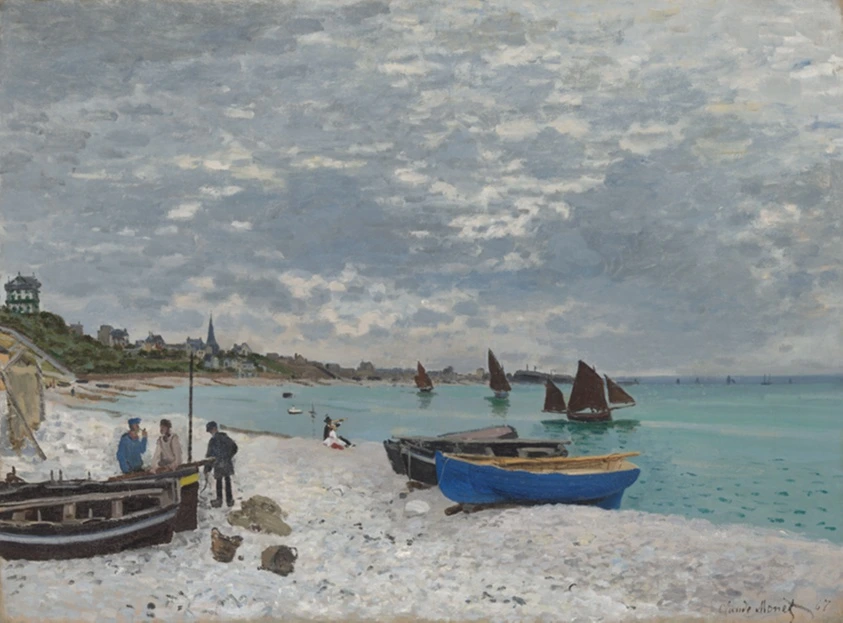
Claude Monet's "Cliffs and Sea, Sainte-Adresse" (c. 1864) is a black chalk drawing on ivory laid paper that predates the full flowering of Impressionism but already shows the young artist's commitment to direct observation of nature. Sainte-Adresse is a coastal town near Le Havre, and the cliffs and sea of the Normandy coast would remain a recurring subject throughout Monet's career. This drawing shows the cliffs with the sea beyond, the forms captured with a directness and simplicity that contrast with the more finished quality of his caricatures. The black chalk technique is loose and experimental, with the lines searching for the forms rather than defining them with the certainty of the earlier caricatures. This shift from the confident caricaturist to the searching landscape artist reflects the influence of Eugène Boudin, who had urged Monet to abandon caricature and study nature directly. This drawing belongs to the crucial transitional period when Monet was finding his way from conventional draftsmanship toward the revolutionary approach to light and color that would become Impressionism.
Cultural Impact
Monet's early landscape drawings document the decisive turning point in his career, when he abandoned caricature for nature study under the influence of Boudin, setting the course for Impressionism.
Why It Matters
This chalk drawing of the cliffs at Sainte-Adresse captures a moment of transition in Monet's development: the caricaturist becoming a landscape artist, the eye turning from human character to the forms of nature.