Interior at Nice

Description

Beginning in 1917, Henri Matisse spent most winters in Nice, on the Mediterranean coast. He often stayed at the Hôtel Mediterranée, a Rococo-style building he later fondly termed "faked, absurd, delicious!" Interior at Nice is perhaps the most ambitious of a series of images the painter created using the hotel as a backdrop. The pink-tiled floors and yellow, arabesque-patterned wall-paper are present in many of these works, as are the skirted dressing table, oval mirror, shuttered French window, and balcony. The balcony in fact was one of the artist’s favorite themes, allowing him to link internal and external space into a continuum structured by patterns and modulated light.

Additionally, Matisse often included a young woman somewhere in the scene. Here, his favorite model at the time, Antoinette Arnoux, plays an important role. Not only is she the subject of the painting on the wall, but the composition’s high viewpoint and plunging, wide-angled perspective draw all attention to her as she sits on the balcony, her back to the sea. Framed by shimmering curtains, she gazes directly at the viewer.

Provenance

Georges Menier (1880–1933), Paris, by May 15, 1930 [Fels 1930]. Henri Matisse, Nice, before June 16, 1931 [this and the following according to letter from Pierre Matisse, Oct. 21, 1974; copy in curatorial file]; Pierre Matisse (June 13, 1900–Aug. 10, 1989), New York, by June 16, 1931; sold to Mr. Charles Goodspeed (1885–1947) and Mrs. Elizabeth “Bobsy” Goodspeed (née Elizabeth Barret Fuller, remarried as Mrs. Gilbert W. Chapman, 1893–1980), Chicago and New York, Dec. 24, 1936 [stockbook, Pierre Matisse Gallery Archives, MA 5020, box 171, folder 34, Department of Literary and Historical Manuscripts, Morgan Library and Museum, New York; copy in curatorial file]; partially given to the Art Institute of Chicago, Dec. 31, 1956 [full ownership obtained on Oct. 22, 1962].

Interior at Nice

Henri Matisse

1919 or 1920

Accession Number

2816

Medium

Oil on canvas

Dimensions

131.5 × 90.7 cm (51 13/16 × 35 11/16 in.)

Classification

Painting

Museum

The Art Institute of Chicago

Chicago, United States

Credit Line

Gift of Mrs. Gilbert W. Chapman
Background & Context

Background Story

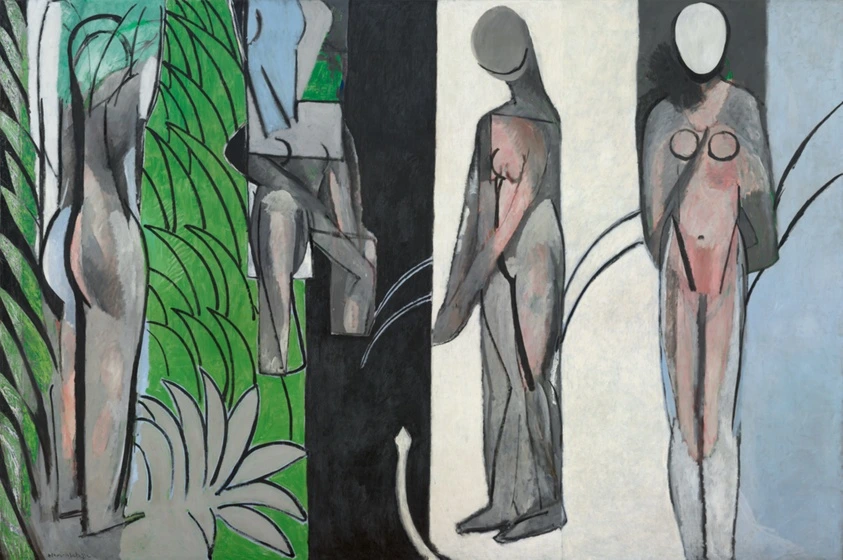
"Interior at Nice" is one of Matisse's most sophisticated treatments of the interwar domestic scene, painted in 1919 or 1920 during the period when he was dividing his time between Paris and the Mediterranean coast. The composition shows a sun-filled room with an open window looking toward the sea, the interior space animated by the arabesques of furniture, textiles, and the figures that populate Matisse's Nice interiors. The palette is warmer than his wartime works, with coral reds, Mediterranean blues, and creamy whites that suggest both the southern light and the decorative abundance of bourgeois life. The painting belongs to a series of interiors that Matisse produced throughout the 1920s, each exploring the relationship between enclosed domestic space and the infinite horizon visible through the window. This dialectic—inside and outside, intimacy and openness, decoration and nature—is what gives the series its philosophical depth. The brushwork is notably relaxed, with broad, unmodulated areas of color that recall the flatness of Islamic decorative arts, one of Matisse's lifelong influences. The work also reflects his personal circumstances: by 1919 he was established as the leading French painter of his generation, and the Nice interiors document a life of professional security and domestic comfort that his early Fauve years had not promised. Art historians have compared these interiors to Vermeer's domestic scenes and to the "window" paintings of Bonnard, though Matisse's treatment is more abstract, less concerned with atmospheric depth and more interested in the two-dimensional patterns that the interior presents to the eye.

Cultural Impact

This interior established the Mediterranean window motif as a Matisse signature, balancing decorative flatness with infinite horizon to influence mid-century domestic painting from Bonnard to Hockney.

Why It Matters

It matters because Matisse painted a room that wanted to be the sea—proving that a window could hold as much freedom as the sky outside.