Accession Number
12043
Medium
Gouache and black crayon, with watercolor and touches of brown crayon, over traces of charcoal, on off-white wove paper
Dimensions
41 × 33.1 cm (16 3/16 × 13 1/16 in.)
Classification
watercolor
Credit Line
Gift of Peter B. Bensinger Charitable Trust
Background & Context
Background Story
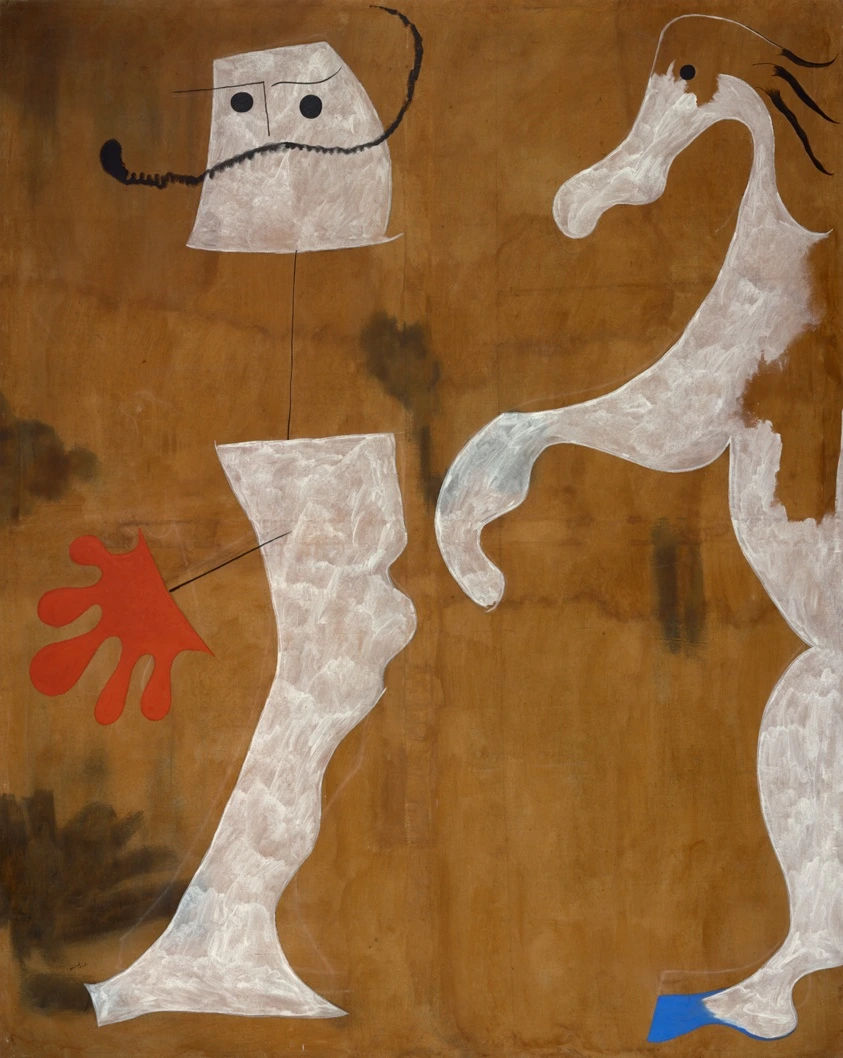
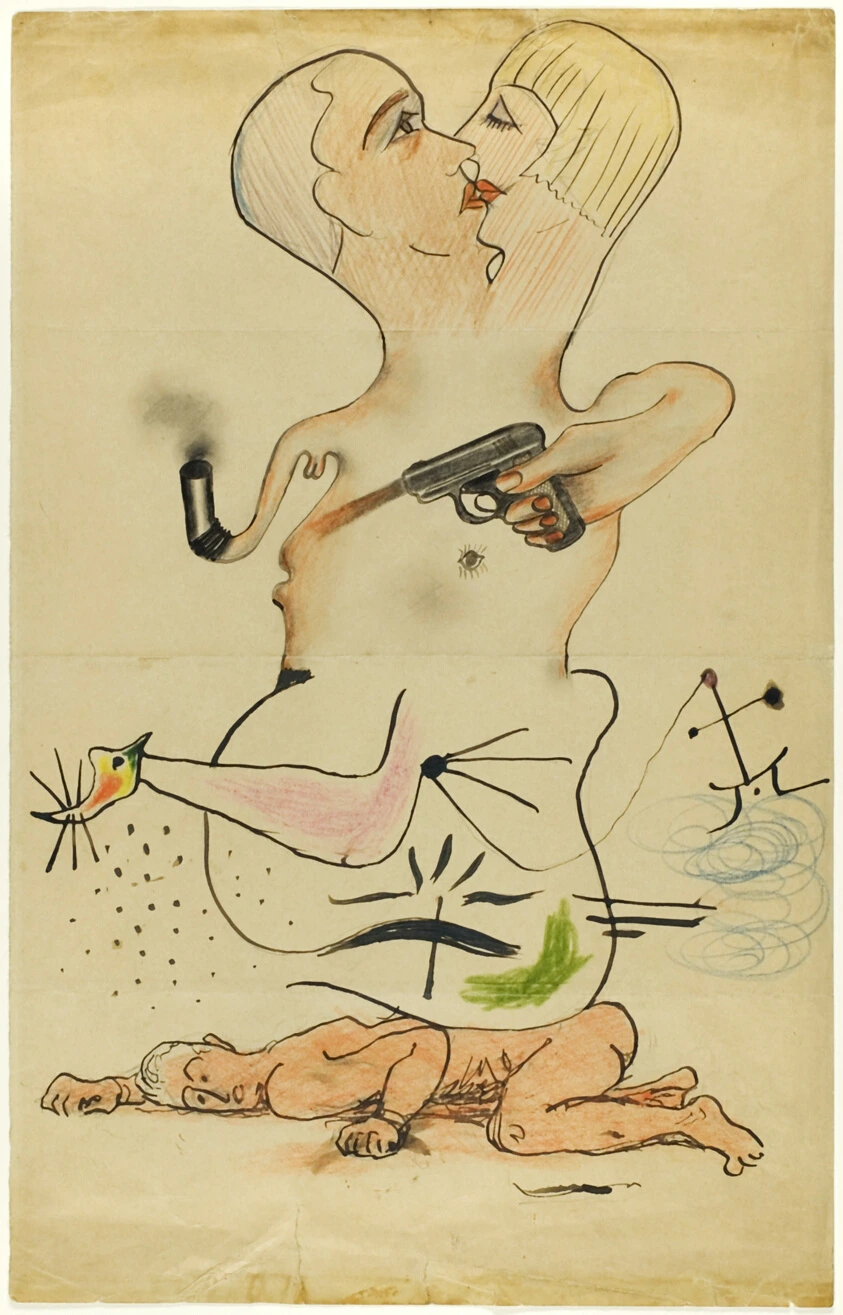
This 1938 watercolor belongs to the most emotionally intense period of Miró's career, when the Spanish Civil War and the threat of European fascism transformed his playful biomorphism into something more anxious and haunting. The image shows two attenuated figures with bird-like heads or companions, rendered in black crayon and gouache on off-white paper with the spontaneous, almost automatic drawing technique that Surrealism had encouraged. The bird in the title is not clearly identifiable as a separate creature or a projection of the figures' psyches; this ambiguity is characteristic of Miró's mature symbolism, in which animality and humanity interpenetrate. The palette is restricted to blacks, browns, and pale washes that suggest a nocturnal or twilight atmosphere, a departure from the bright primaries of his earlier Constellations series. The figures themselves are barely anchored to the ground line, floating in an undefined space that amplifies their psychological dislocation. This work was produced in Paris, where Miró had fled from the advancing Nationalist forces, and its haunted quality may reflect the artist's exile and the destruction of his Catalan homeland. Art historians have compared these wartime watercolors to Picasso's contemporaneous "Guernica," though Miró's response to violence was less explicitly narrative and more symbolic. The bird motif also connects to broader Surrealist interests in ornithology as a language of the unconscious; birds appear throughout Miró's work as messengers between worlds, carriers of desire or dread. The medium of crayon and watercolor allowed rapid execution that preserved the immediacy of emotional response.
Cultural Impact
This wartime watercolor channeled Spanish exile and European catastrophe into haunted biomorphism, using rapid crayon and wash to preserve the immediacy of collective anxiety during fascism's rise.
Why It Matters
It matters because Miró drew people turning into birds while Barcelona burned—proving that poetry could survive when politics turned monstrous.