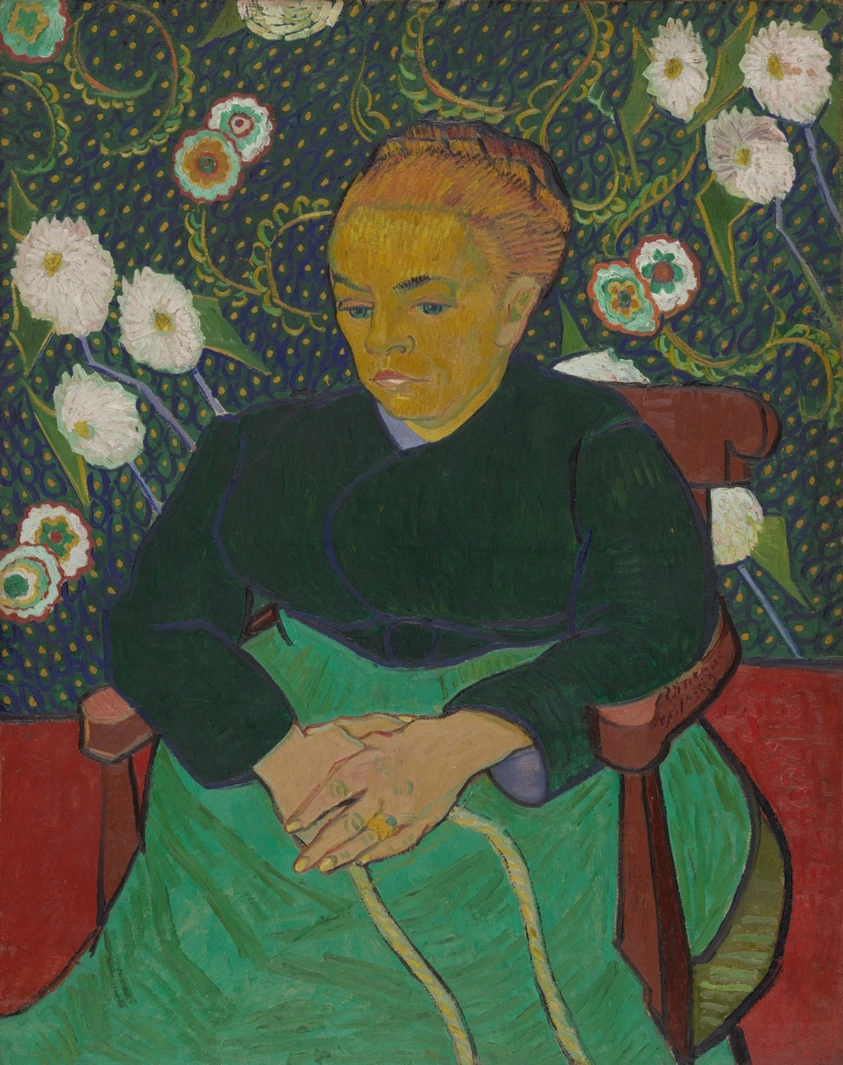
Madame Roulin Rocking the Cradle (La berceuse)

Description

Vincent van Gogh saw in Augustine Roulin—along with her husband, Joseph, and their children—a model of love and family life. In this portrait, Roulin rocks a cradle by pulling on a rope. The title La Berceuse (the lullaby) suggests a consoling figure, and the artist described his palette as a soothing “lullaby in colors.”

Van Gogh painted five versions of this image. He completed this one in January 1889, soon after returning from his stay in the hospital following Paul Gauguin’s fraught departure. Madame Roulin sits in Gauguin’s chair, an attempt by Van Gogh to fill the space left by the older artist. In May 1889, Van Gogh gave this canvas to Gauguin as a gesture of reconciliation and friendship, instructing that it be hung between two paintings of sunflowers.

Madame Roulin Rocking the Cradle (La berceuse)

Vincent van Gogh

1889

Accession Number

27949

Medium

Oil on canvas

Dimensions

92.7 × 73.8 cm (36 1/2 × 29 1/2 in.); Framed: 111.9 × 91.8 × 8.3 cm (44 1/16 × 36 1/8 × 3 1/2 in.)

Classification

oil on canvas

Museum

The Art Institute of Chicago

Chicago, United States

Credit Line

Helen Birch Bartlett Memorial Collection
Background & Context

Background Story

Vincent van Gogh's "Madame Roulin Rocking the Cradle (La berceuse)" (1889) depicts Augustine Roulin, the wife of the Arles postman Joseph Roulin, rocking an unseen cradle by pulling on a rope. The painting is one of five versions of the same composition that van Gogh painted between December 1888 and January 1889 — a period of intense emotional turmoil that included the famous ear-mutilation incident and his subsequent hospitalization. The Roulins — Joseph, Augustine, and their three children — were van Gogh's closest friends during his time in Arles. Van Gogh painted portraits of all five members of the family, producing over twenty paintings in total, and described Joseph Roulin as 'a man who is not bitter, not melancholy, not perfect, but a wise man who sees clearly.' In Augustine Roulin, van Gogh found a model for maternal comfort and domestic stability — qualities that were painfully absent from his own life. The composition of "La berceuse" is one of van Gogh's most deliberate and symbolically charged. Madame Roulin sits in a chair, her hands gripping the cradle rope that would connect to an unseen baby's cradle. Her expression is calm and focused, her gaze directed somewhere between the viewer and the cradle. Behind her, the background glows with the intense colors of a Japanese print — rich reds, greens, and blues that fill the space with chromatic warmth. The title "La berceuse" means both "the lullaby" and "the woman who rocks the cradle," and van Gogh intended the painting to function like a lullaby — a visual image of comfort that would soothe the viewer as a cradle soothes a child. Van Gogh's ambitious plan for the "Berceuse" series was to flank each of the five versions with paintings of sunflowers, creating a triptych in which the luminous yellow of the sunflowers would contrast with the deep reds and greens of Madame Roulin's figure. He wrote to Theo: 'I want to arrange them so that there is a Berceuse in the center, and on either side the Sunflowers, and the whole thing will be a kind of symphony in yellow and blue.' This scheme — a secular altarpiece of domestic comfort — reveals van Gogh's conception of painting as a quasi-religious activity, capable of providing spiritual solace through color and composition. The five versions of "La berceuse" differ in subtle but significant ways: the background color shifts from deep red to blue-green, the intensity of the floral pattern varies, and Madame Roulin's expression changes from serene to contemplative. These variations demonstrate van Gogh's practice of repeating compositions as a form of artistic meditation — returning to the same subject multiple times in order to refine its expressive power and explore its chromatic possibilities.

Cultural Impact

The Roulin family portraits represent van Gogh's most sustained engagement with portraiture, and the 'Berceuse' series reveals his ambition to create paintings that would function like secular altarpieces — images of comfort for a world that desperately needed it.

Why It Matters

This painting of Madame Roulin rocking a cradle was designed as part of a 'symphony in yellow and blue' — a secular altarpiece of maternal comfort flanked by sunflowers, painted during van Gogh's most turbulent period in Arles.