Still Life with Geranium

Description

Like his artistic hero, Paul Cezanne, Henri Matisse merged the traditional and the avant-garde. In Still Life with Geranium, he transformed a simple still life into a populated Arcadian landscape painting, rendered in the brilliant color, thick paint, and rapid brushwork characteristic of the group of painters known as the Fauves (French for “wild beasts”). Matisse was recognized by critics as the leader of this group.

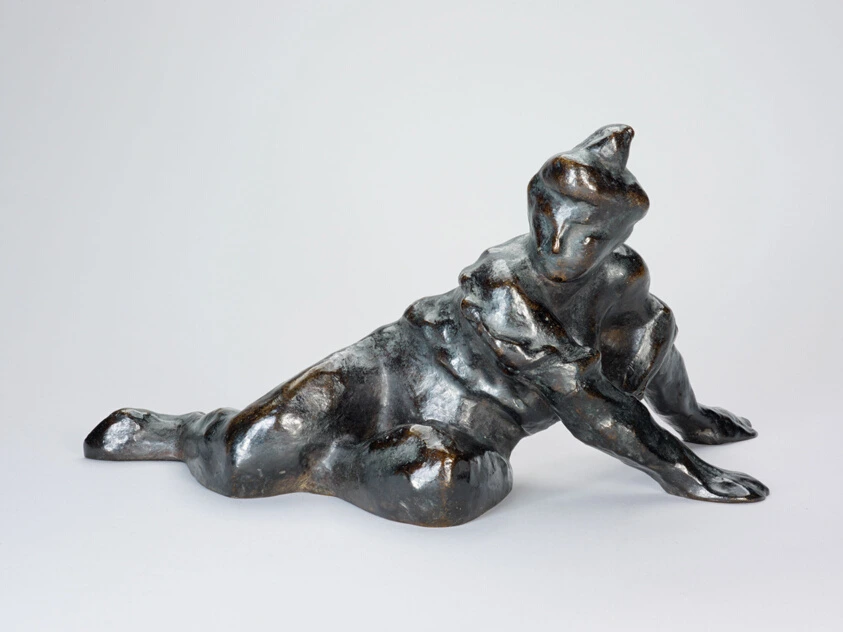
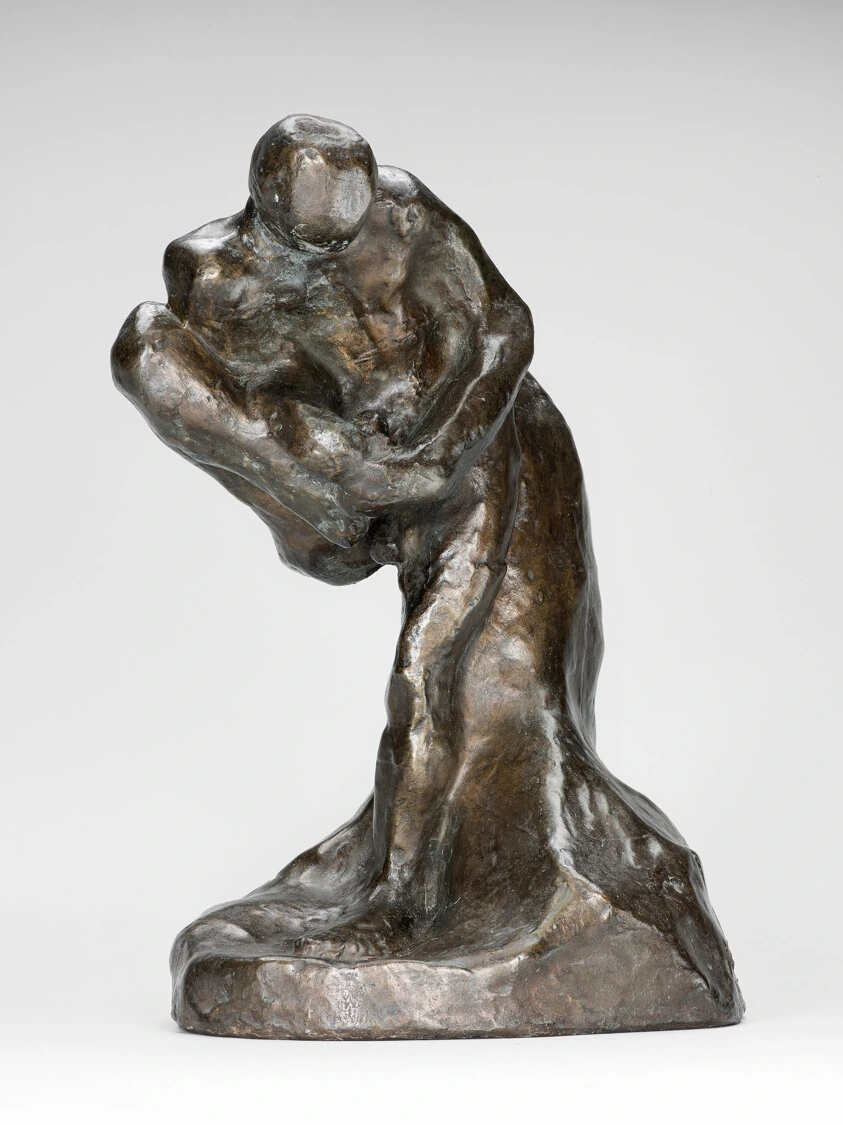
This composition is one of contrasts—the pale palette and light brushwork in the upper half of the picture are juxtaposed with the darker colored, heavily painted lower half; the firmly planted pose of the female figure is contraposed with the almost-fleeing figure of the male; and the red vegetables grown near Paris are set near ceramic objects from exotic, faraway places. One of many still-life paintings in which Matisse incorporated his own figurative sculptures, here the artist challenged his viewers’ expectations by rendering his modeled figures with minimal color and simple lines. Probably represented as plaster casts, these figures would later be made in bronze editions by the artist; versions of Woman Leaning on Her Hands (on the right of the geranium) and Thorn Extractor (on the left) are also in the collection of the Art Institute.

This is one of thirty-five works that comprise the Winterbotham Collection. Click here to learn more about the collection.

Provenance

The artist; sold to Bernheim-Jeune, Paris, Mar. 1, 1907; sold to Oskar (July 21, 1875–Aug. 19, 1947) and Greta (1884–1977) Moll, Breslau, Germany (present-day Wrocław, Poland), from Oct. 27, 1908 [letter from Marguerite G. Duthuit, Sept. 17, 1975; photocopy in curatorial file]. Likely acquired by the Valentine Gallery, New York, inventory #147, fall 1927 [inventory card and letter from Valentine Dudensing to Pierre Matisse, Dec. 15, 1927, Pierre Matisse Gallery Archives, Morgan Library & Museum, New York; photocopies in curatorial file]; sold to Frank Crowninshield (June 24, 1872–Dec. 28, 1947), Paris, Apr. 11, 1928 [this and the following according to Valentine Dudensing Ledger Books, Museum of Modern Art Archives; photocopy in curatorial file]; returned to the Valentine Gallery, Paris, Aug. 1928 [letter from Valentine Dudensing to Pierre Matisse, summer 1928; photocopy in curatorial file]; sold to Frederick Clay Bartlett (1873–1953), Chicago, Oct. 27, 1928 [Cambridge 1929]; sold to the Art Institute of Chicago, Dec. 27, 1932.

Still Life with Geranium

Henri Matisse

1906

Accession Number

87045

Medium

Oil on canvas

Dimensions

100.3 × 81.5 cm (39 1/2 × 32 1/8 in.)

Classification

Painting

Museum

The Art Institute of Chicago

Chicago, United States

Credit Line

Joseph Winterbotham Collection
Background & Context

Background Story

Painted in 1906, "Still Life with Geranium" belongs to the critical transition between Matisse's Fauve explosion and the more structured compositions that would follow, a canvas that documents his growing interest in color as an independent expressive force rather than a descriptive tool. The geranium itself is a conventional still life subject, but Matisse's treatment is anything but conventional: the plant erupts from its pot in a mass of saturated red that dominates the composition, while the surrounding space is flattened into areas of green, blue, and ochre that refuse conventional perspective. This chromatic aggression is characteristic of the Fauve years, when Matisse and Derain were competing to push color beyond nature toward emotional truth. The palette—red against green, blue against orange—employs complementary opposition with a confidence that academic painters would have considered vulgar. The brushwork is rapid and visible, each stroke asserting its own identity rather than blending into illusionistic texture. This technique would influence American painting directly through the work of Hans Hofmann, who studied Matisse's color theory and transmitted it to the Abstract Expressionists. The painting also reflects Matisse's working method: he was known to keep potted plants in his studio for months, painting them repeatedly as they changed with the seasons. This geranium is thus not a single moment but an accumulated observation, the plant's life cycle compressed into a single explosive image. The canvas stands as a manifesto for the autonomy of color, asserting that a painting's subject is as much the relationship between reds and greens as it is the geranium itself.

Cultural Impact

This transitional canvas pushed Fauve color toward autonomous expression, using complementary opposition to demonstrate that a geranium could be an excuse for emotional chromatic truth.

Why It Matters

It matters because Matisse looked at a flowerpot and saw a revolution—proving that red and green could argue more loudly than any political manifesto.