Mount Athos Carved as a Monument to Alexander the Great

Description

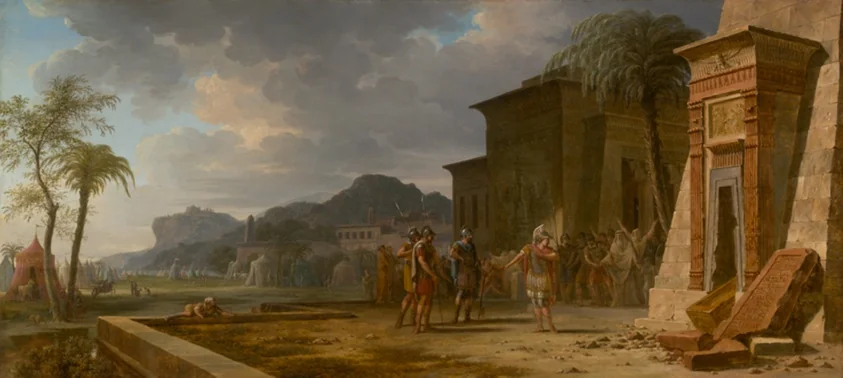
Pierre-Henri de Valenciennes, a leading landscape artist in late-18th-century France, sought to elevate the art of landscape to the level of history painting. In the hierarchy of subjects set by the French artistic establishment, the painting of inspiring religious and historical narratives was placed higher than the imitation of nature. Valenciennes followed the 17th-century precedent of Nicolas Poussin by imbuing his landscapes with moral content. This work and its companion, Alexander at the Tomb of Cyrus the Great, address questions of fame and mortality through episodes from the life of Alexander the Great (356–323 B.C.). Here Valenciennes depicted an unrealized project to perpetuate Alexander’s glory—a monumental image of the ruler carved into Mount Athos.

Provenance

James Hunt (died 1801), London, offered for sale, Christie’s, London, February 5, 1802, lot 62, bought in [according to Maria Wilson of Christie’s, letter of January 9, 1996, to Larry Feinberg, in curatorial files]; Hunt family, London. Reverend George Augustus Frederick Hart (died 1872), M. A., Vicar of Arundel, Tower House, Arundel, Sussex; by descent to his niece Catherine (Mrs. John Lord); sold at Tower House, Arundel, Sotheby’s, May 20–21, 1873, lot 130, to G. Fry for £36 [British Museum annot. cat.]. Alderman Philip Spowart (died 1945), Berwick-upon-Tweed, from c. 1937 [according to recollection of Alan G. Burns, letter of February 9, 1988, in curatorial file]; his widow, Anne Nicholson Spowart (née Wood); given to her nephew, Alan G. Burns, Berwick-upon-Tweed, 1960 [Alan G. Burns letters of April 4, 1984, and February 9, 1988, in curatorial file]; sold, Henry Spencer and Sons, Retford, Nottinghamshire, November 9, 1978, lot 212, to Crozier acting on behalf of Trafalgar Galleries and P. and D. Colnaghi, London, 1978 [A. G. E. Marriot letter of April 10, 1984, and notes in curatorial file]; transferred to Colnaghi, New York, 1982; sold to the Art Institute, 1983.

Mount Athos Carved as a Monument to Alexander the Great

Pierre Henri de Valenciennes

1796

Accession Number

100061

Medium

Oil on canvas

Dimensions

41.9 × 91.4 cm (16 1/2 × 36 in.); Framed: 58.5 × 108.3 cm (23 × 42 5/8 in.)

Classification

oil on canvas

Museum

The Art Institute of Chicago

Chicago, United States

Credit Line

Purchased with funds provided by Mrs. Harold T. Martin
Background & Context

Background Story

Pierre Henri de Valenciennes's Mount Athos Carved as a Monument to Alexander the Great shows the fantastical scheme of carving Mount Athos into a colossal statue of Alexander.

Cultural Impact

Valenciennes's capricci show the imaginative side of Neoclassical landscape.

Why It Matters

This architectural fantasy captures the ambition of the classical imagination.