Provenance
Sold by J. B. Neumann to Saidenberg Gallery, New York [a letter from Eleanor Saidenberg in curatorial file]; sold to Mr. and Mrs. Leigh Block, Chicago, by 1955 [New York 1955]; given to the Art Institute, 1976.
Accession Number
50529
Medium
Watercolor
Dimensions
28.5 × 17 cm (11 1/4 × 6 3/4 in.)
Classification
watercolor
Credit Line
Gift of Mary and Leigh Block
Background & Context
Background Story
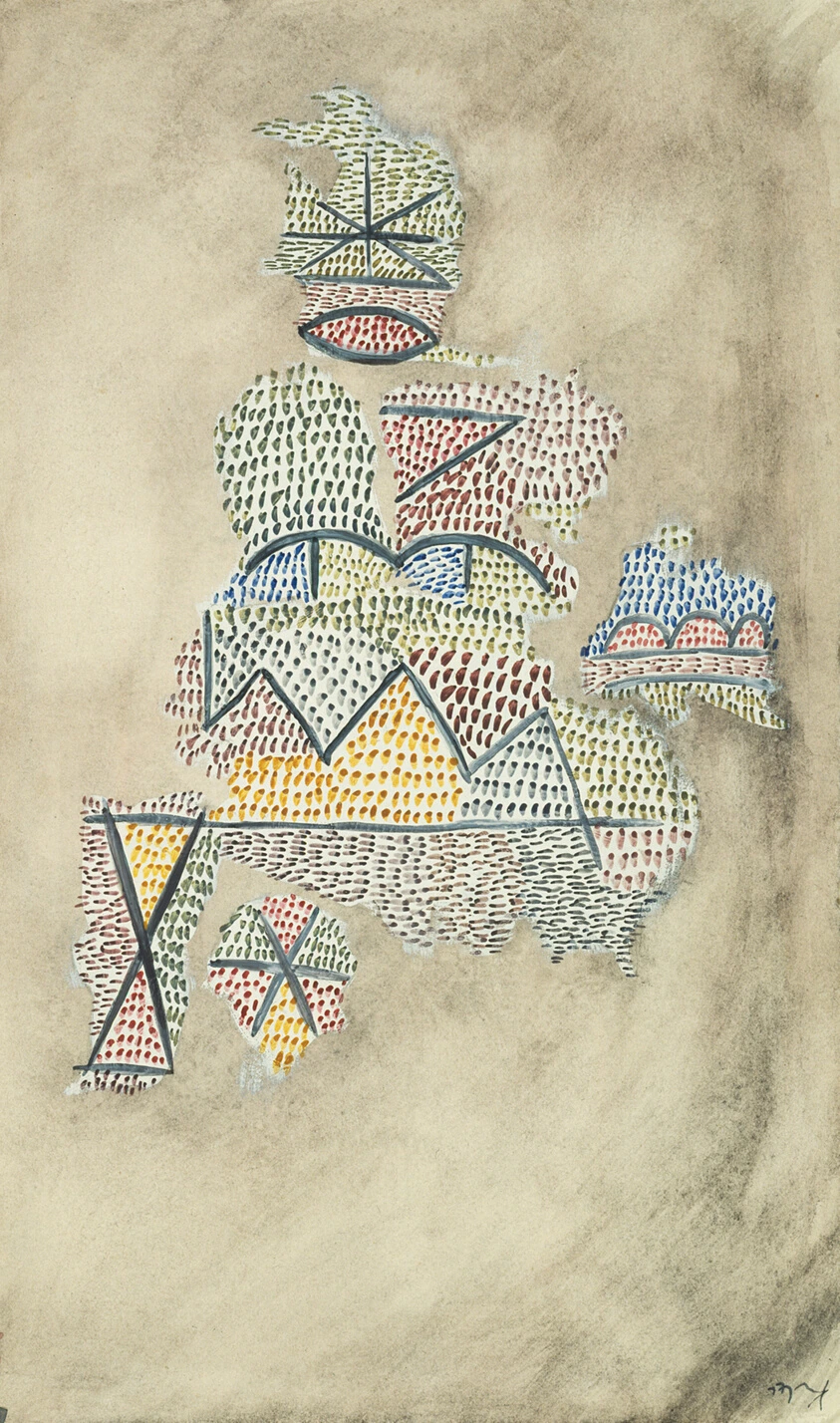
"Physiognomy of Fragments" is one of Paul Klee's most enigmatic watercolors, undated but probably executed during his Bauhaus period (1921–1931) when he was exploring the relationship between line, color, and symbolic meaning in the daily exercise sheets he called his "picture diaries." The composition shows abstract fragments—geometric shapes, organic curves, and calligraphic marks—arranged in a vertical format that suggests a figure without depicting one. The title is typical of Klee's poetic wordplay: "physiognomy" refers to the reading of character from facial features, but here applied to abstract forms that have no face, creating a paradox that invites the viewer to project personality onto pure geometry. The watercolor medium is handled with extraordinary delicacy, transparent washes layered to create depth without opacity, the paper itself functioning as a luminous ground that shines through the pigment. This technique was standard for Klee's Bauhaus watercolors, which he often produced in series of five or ten in a single day, exploring variations on a theme with the systematic playfulness of a musician improvising on a chord progression. The work also reflects Klee's theoretical interests: he was teaching at the Bauhaus during this period, and his pedagogy emphasized the "primordial beginning" of mark-making, the moment when a line first detaches from the blank page to create meaning. Art historians have connected these fragmentary compositions to Klee's interest in child art and the art of the mentally ill, sources he valued for their freedom from academic convention. In the broader history of abstraction, the work stands as evidence that geometric forms could carry psychological weight when arranged with sufficient subtlety and wit.
Cultural Impact
This enigmatic Bauhaus watercolor used abstract geometry as psychological physiognomy, combining systematic playfulness with theoretical pedagogy to influence child-art-inspired abstraction.
Why It Matters
It matters because Klee drew shapes and dared you to read their faces—proving that even fragments could have personalities if arranged with enough care.