Provenance
Adolf Rothermundt, Dresden-Blasewitz, before 1923 [according to Scheffler 1923 and 1935 Graupe sale cat. cited below]. Max Silberberg, Breslau, by 1923 to 1935 [according to 18 July 1967 letter from Fritz Nathan to Charles Cunningham in curatorial file, and Scheffler 1923]; sold Galerie Paul Graupe, Berlin, Mar. 23, 1935, no. 20 [price given in Die Weltkunst 1935]. German private collection [according to Alexander, Graf Strasoldo of Lempertz, Cologne, letter of 21 September 1998 in curatorial file]; sold Lempertz, Cologne, Nov. 11-14, 1964, no. 289, to Galerie Nathan, Zurich [Nathan letter cited above]; sold by Galerie Nathan to Paul Rosenberg Gallery and Co., New York, June 4, 1965 [copy of invoice in curatorial file]; sold to the Art Institute, 1967.
Accession Number
27027
Medium
Oil on canvas
Dimensions
80.2 × 100.3 cm (31 1/2 × 39 1/2 in.); Framed: 113.1 × 134 × 11.5 cm (44 1/2 × 52 3/4 × 4 1/2 in.)
Classification
oil on canvas
Credit Line
Emily Crane Chadbourne Fund and Major Acquisitions Centennial Fund
Background & Context
Background Story
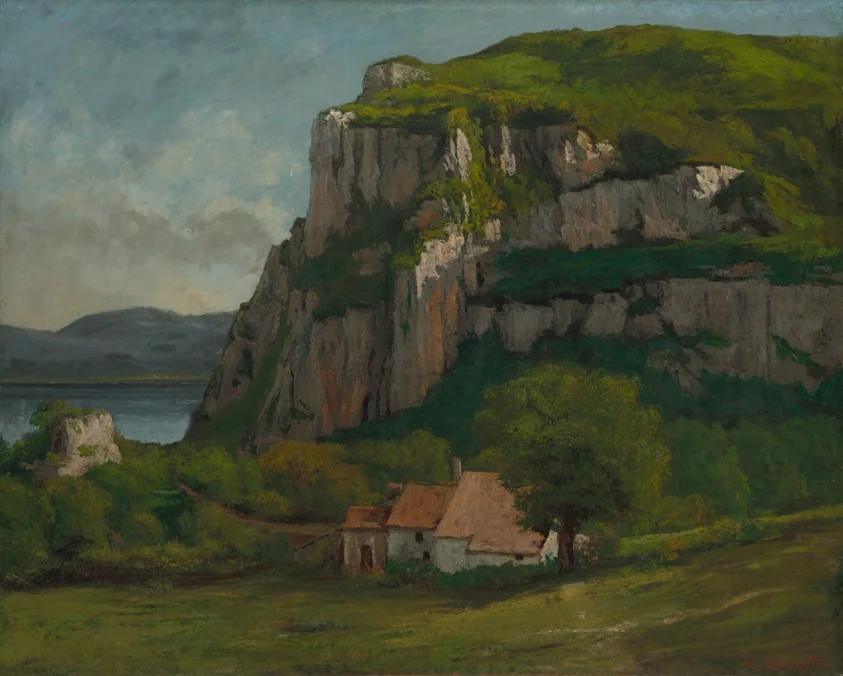
Gustave Courbet's "The Rock of Hautepierre" (c. 1869) is an oil on canvas that captures the dramatic geology of the French countryside. Courbet (1819–1877) was the leader of the Realist movement in 19th-century French painting, committed to representing the world as it actually appeared, without idealization or academic convention. The Rock of Hautepierre was a distinctive geological formation in the Jura region of eastern France, near Courbet's birthplace. This painting shows the massive rock formation rising from the landscape, its forms rendered with Courbet's characteristic attention to the physical substance of the world. The palette is dominated by the earth tones of the rock, with the surrounding vegetation and sky providing contrast. Courbet's handling is vigorous and tactile, the paint applied with a palette knife in places, creating a surface that seems to have the same material substance as the rock it depicts. This painting belongs to Courbet's late period, when he was producing some of his most powerful landscapes, combining his Realist principles with a new freedom of handling that anticipated Impressionism.
Cultural Impact
Courbet's landscape paintings were revolutionary in their commitment to representing the physical reality of the natural world, rejecting idealization in favor of the direct observation of nature's forms and textures.
Why It Matters
This painting of the Rock of Hautepierre captures the material presence of the geological formation with extraordinary force, Courbet's palette knife technique creating a surface that seems as solid and substantial as the rock itself.