Description
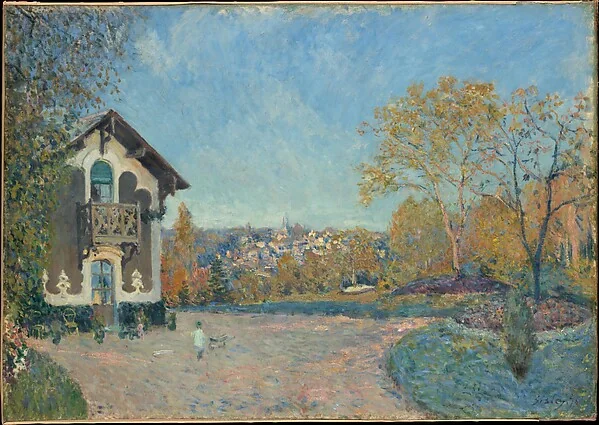
In 1875 Alfred Sisley moved to the village of Marly-le-Roi, where in the 1600s King Louis XIV had built an elegant country retreat. The artist’s home on the rue de l’Abreuvoir flanked the pool, or “watering place,” featured on the left of this canvas. The pool was all that remained of the water gardens that had been part of the king’s park.
Sisley remained faithful to landscape subjects throughout his career, spending most of his life painting in the villages along the Seine River, in the region referred to as the cradle of Impressionism.
Provenance
Louis Flornoy, Paris; his sale, Hôtel Drouot, Paris, April 10, 1905, lot 40 for 5350 fr. to Camentron; M. L. Camentron, Paris. Paul Rosenberg and Co., Paris and New York [acc. to Daulte 1959]. M. Ziegler [according to Daulte 1959]. Possibly Wildenstein and Co., New York [Wildenstein valued the painting in 1971 and the Runnells purchased many paintings through them]; Mrs. Clive Runnells, Lake Forest, Illinois by 1971; given to the Art Institute, December 1971 [half-interest acquired by the AIC].
Accession Number
37741
Medium
Oil on canvas
Dimensions
39.5 × 56.2 cm (15 7/16 × 22 1/8 in.); Framed: 63.9 × 80.7 × 9.6 cm (25 1/8 × 31 3/4 × 3 3/4 in.)
Classification
oil on canvas
Credit Line
Gift of Mrs. Clive Runnells
Background & Context
Background Story
"Watering Place at Marly" is an 1875 oil on canvas by Alfred Sisley that captures the British-French Impressionist in his most characteristic and serene mode, the image showing the watering place on the river at Marly-le-Roi with the soft, diffused light and the fluid brushwork that made Sisley the most consistently Impressionist of the Impressionist painters. The composition is a horizontal view of the riverbank, the watering place and the surrounding trees rendered with a palette of greens, blues, and silvery greys that suggest both the specific light of a summer day and the general mood of Impressionist contemplation. The 1875 date places this work in the period of Sisley's most intensive engagement with the Marly and Louveciennes landscapes, when he was producing the paintings that established his reputation as a painter of water, sky, and the subtle effects of light on the natural world. Art historians have compared this painting to the works of Monet and Pissarro from the same period, noting that Sisley's treatment is more serene, more focused on the quiet beauty of the scene rather than the dramatic or the socially engaged content of these contemporaries. The work also demonstrates Sisley's mastery of the oil medium for capturing atmospheric effects: the fluid brushwork and the nuanced palette create a surface that suggests both the physical reality of the scene and the transient effects of light and weather.
Cultural Impact
This 1875 oil canvas made Marly riverbank serenely Impressionist through green-blue-silver fluid brushwork and horizontal summer-light contemplation, using 1875-period water-sky specialization to focus on quiet atmospheric beauty beyond Monet's dramatic social engagement.
Why It Matters
It matters because Sisley painted a watering place and made the canvas feel like it was rippling in the light—proving that even a quiet afternoon could glow if the brush was fluid enough.