Accession Number
96559
Medium
Oil on canvas
Dimensions
54.5 × 64.7 cm (20 3/4 × 25 1/2 in.); Framed: 76.2 × 87 × 8.9 cm (30 × 34 1/4 × 3 1/2 in.)
Classification
oil on canvas
Credit Line
Charles H. and Mary F. S. Worcester Collection
Background & Context
Background Story
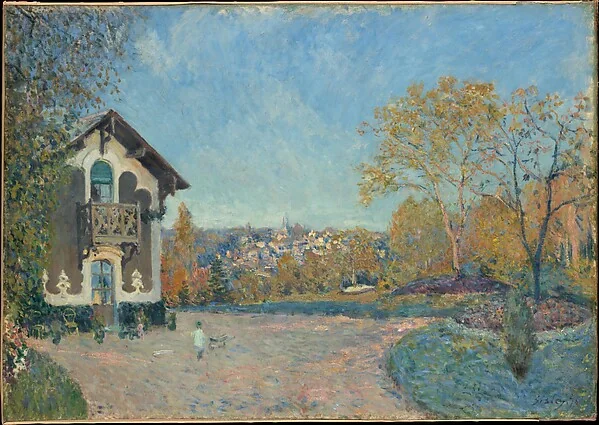
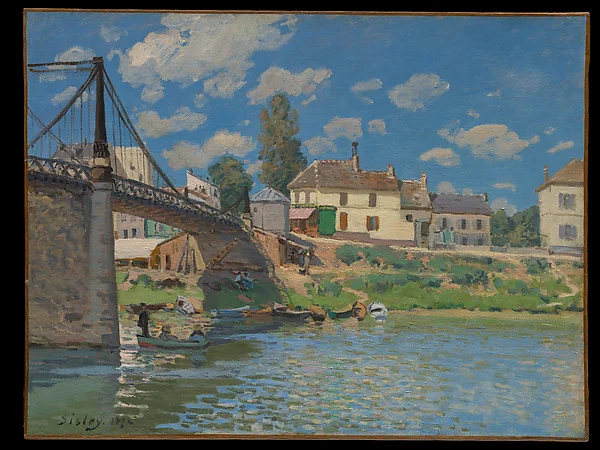
Alfred Sisley's "A Turn in the Road" (1873) is an early masterpiece from the period when Impressionism was first taking shape. Painted in 1873—the year before the first Impressionist exhibition—this work captures a country road curving through a landscape of fields, trees, and scattered buildings. The composition is anchored by the road itself, which leads the viewer's eye through the scene, creating a sense of depth and inviting exploration. Sisley's palette is already characteristically subtle, with soft greens, blues, and earth tones, and the brushwork is lively without being aggressive. The sky, always important in Sisley's work, occupies a significant portion of the canvas, its clouds and blue patches establishing the overall atmosphere. This painting dates from the period when Sisley was working closely with Monet, Renoir, and Bazille, developing the techniques of plein-air painting and broken color that would define Impressionism. The year 1873 was particularly productive for Sisley, and this painting shows the young artist fully in command of his growing powers.
Cultural Impact
Painted on the eve of the first Impressionist exhibition, "A Turn in the Road" captures the movement at its most optimistic and innovative, embodying the fresh approach to landscape that would revolutionize Western painting.
Why It Matters
This early work shows Sisley's Impressionist vision already fully formed: a commitment to the direct observation of nature, a sensitivity to atmospheric effects, and an ability to find inexhaustible beauty in the simplest rural scene.